
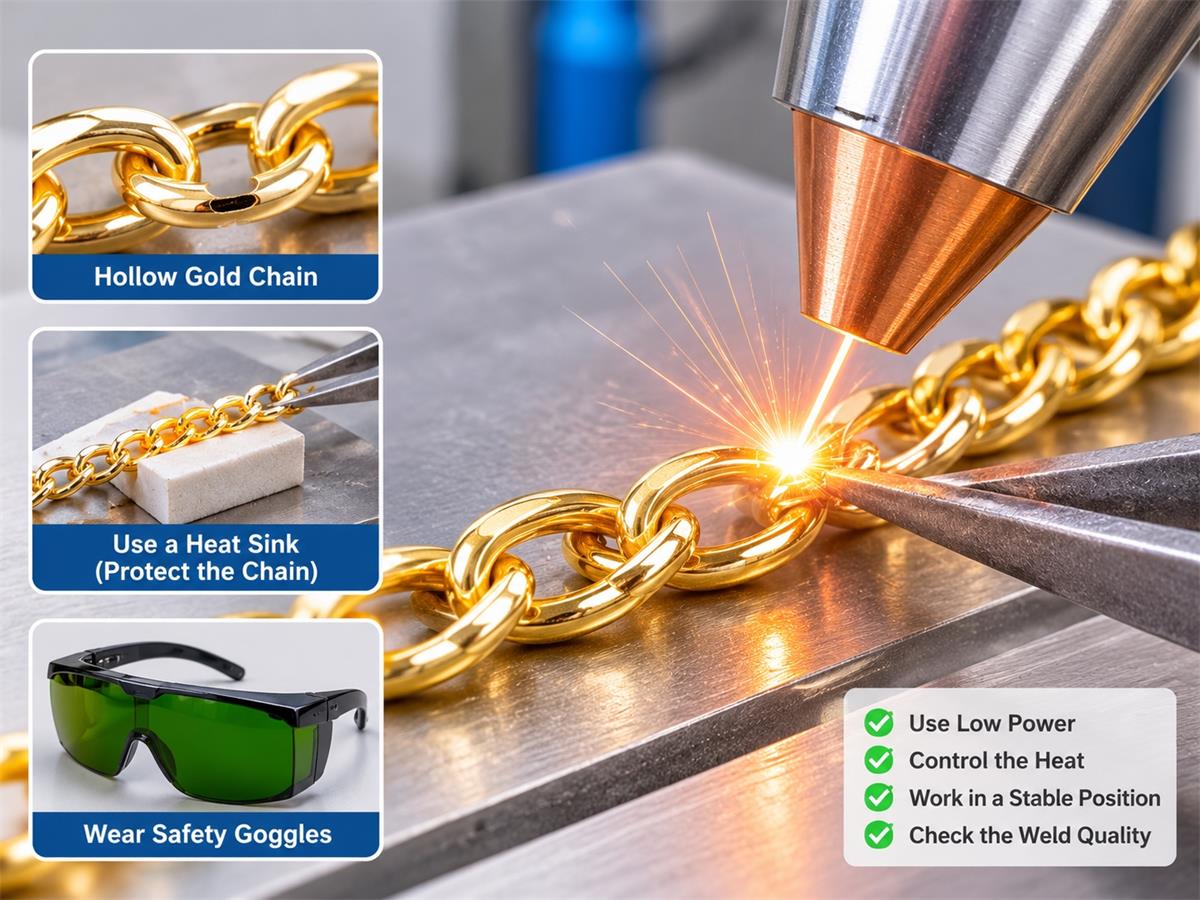
Laser welding a hollow gold chain requires more precision than repairing a solid gold chain. Hollow chains have thin metal walls and an internal cavity, which makes them particularly sensitive to excessive heat. Too much laser energy can burn through the surface, deform the chain, or create visible welding marks that are difficult to polish away.
For jewelry repair shops, a pulsed YAG jewelry laser welding machine provides a practical way to repair small cracks and broken connections with localized heat input. However, choosing the right pulse settings, supporting the chain properly, and understanding its construction are essential for achieving a clean repair.
1. Why Is Hollow Gold Chain Welding More Difficult?
Unlike solid gold chains, hollow gold chains are manufactured with a thin outer metal wall surrounding an empty internal space. This construction reduces material usage and makes the jewelry lighter, but it also makes the chain more vulnerable during welding.
There are several challenges:
- Thin metal walls: The laser can penetrate the material too quickly, creating holes or burning through the chain.
- Risk of deformation: Excessive heat can cause the thin structure to collapse or lose its original shape.
- Limited repair area: Small cracks and broken links require accurate positioning under a microscope.
- Visible surface damage: Excessive melting can leave bumps, pits, or discoloration.
- Internal cavity: The hollow structure makes it important to check for trapped moisture, cleaning residues, or other contamination before welding.
The biggest difference is that the operator must control the heat carefully without damaging the thin outer wall or changing the chain’s shape.
2. Which Types of Hollow Gold Chains Can Be Laser Welded?
Many hollow gold chain designs can be repaired using a jewelry laser welder, depending on their construction, wall thickness, alloy, and the location of the damage.
Hollow Rope Chains
Rope chains have a twisted appearance created by interconnected metal elements. If a small section breaks, laser welding may be used to reconnect the damaged area. Accurate positioning is important because the decorative surface can easily show repair marks.
Hollow Cuban Link Chains
Hollow Cuban link chains are popular because they provide a larger appearance with less gold material than solid alternatives. Their relatively thin walls require careful heat control when repairing broken connections.
Hollow Figaro Chains
Figaro chains combine links of different lengths. Laser welding can be useful for repairing individual damaged connections while limiting heat exposure to adjacent links.
Hollow Box Chains
Box chains contain small interconnected sections with a relatively structured appearance. Repairing a damaged section requires accurate alignment to preserve the chain’s original geometry.
Not every damaged hollow chain is suitable for direct laser repair. If a large section has collapsed or several links have lost their structural integrity, replacing the damaged section may be more appropriate.
3. How to Prepare a Hollow Gold Chain Before Laser Welding
Preparation is particularly important when repairing hollow jewelry. A clean and properly positioned chain is easier to weld and less likely to develop defects.
Step 1: Identify the Gold Purity
Determine whether the chain is 14K, 18K, or another gold alloy. Different gold alloys have different melting characteristics and may require different welding parameters.
Step 2: Inspect the Damaged Area
Use a microscope to examine the broken section. Determine whether the damage is a small crack, a completely separated connection, or a crushed hollow link.
Check whether the surrounding metal is still structurally sound. Welding a badly collapsed section may not restore the chain’s original strength.
Step 3: Clean the Chain
Remove oil, dirt, polishing compounds, and other surface contamination before welding. If cleaning solutions are used, make sure the chain is completely dry, including any accessible internal cavities. Never laser weld jewelry containing trapped cleaning solvents or other flammable residues.
Step 4: Position the Chain Correctly
Place the damaged section on a stable welding surface. Align the broken ends carefully and use suitable supports or fixtures to prevent movement.
Avoid excessive clamping pressure because thin hollow links can easily become deformed.
4. What Laser Parameters Should You Use for Hollow Gold Chains?
There is no universal laser parameter setting for hollow gold chains. The correct settings depend on gold purity, wall thickness, chain design, and the size of the damaged area.
For pulsed YAG jewelry laser welding, the following parameters are particularly important:
| Parameter | Importance for Hollow Chains |
|---|---|
| Pulse energy | Must be controlled carefully to prevent burning through the thin metal wall. |
| Pulse duration | Influences heat delivery and the size of the molten area. |
| Pulse frequency | Controls the interval between pulses and affects the welding process. |
| Spot diameter | Determines how concentrated the laser energy is at the repair position. |
| Shielding gas | Helps protect the molten metal from atmospheric contamination. |
For thin hollow chains, the operator should begin with conservative energy settings and gradually adjust them after testing on similar scrap material.
Short, controlled pulses and an appropriately sized spot can help limit unnecessary heat input. However, the goal is not simply to use the lowest possible energy. The laser must still create sufficient fusion to produce a reliable joint.
5. Step-by-Step: How to Laser Weld a Broken Hollow Gold Chain
For a small break in an otherwise structurally sound hollow gold chain, the following workflow can be used as a starting point.
Step 1: Align the Broken Ends
Bring the two broken ends together and check that the original chain shape is maintained. Avoid forcing the thin metal walls into position.
Step 2: Position the Welding Point Under the Microscope
Use the microscope to obtain a clear view of the damaged area. Accurate positioning is important because the laser spot must reach the joint rather than unnecessarily melting the surrounding surface.
Step 3: Perform a Small Tack Weld
Apply a controlled pulse to hold the two sections together. Check whether the joint is aligned correctly before proceeding.
Step 4: Complete the Joint Gradually
Apply additional controlled pulses where necessary to achieve sufficient fusion. Avoid repeatedly firing at exactly the same position without checking the molten area.
For certain joints, compatible gold filler wire may be required. Its composition should be selected according to the original alloy and the intended repair.
Step 5: Inspect the Weld
Examine the repaired area under magnification. Look for incomplete fusion, holes, cracks, excessive melting, and deformation.
Step 6: Polish the Repaired Area
After confirming the joint quality, perform appropriate finishing to restore the chain’s appearance. Avoid aggressive polishing because the surrounding hollow wall may be extremely thin.
6. Common Mistakes When Welding Hollow Gold Chains
Even experienced jewelry repair technicians can encounter problems when working with hollow gold jewelry.
Mistake 1: Using the Same Settings as Solid Gold
Solid gold components generally have more material available around the welding point. Applying the same energy settings to a thin hollow chain can cause excessive melting.
Better approach: Test the parameters on material with comparable wall thickness and construction.
Mistake 2: Applying Too Much Laser Energy
Excessive energy can burn through the outer wall or cause the hollow link to collapse.
Better approach: Adjust pulse energy and duration carefully, checking the result after each test.
Mistake 3: Poor Alignment
If the broken ends are not correctly aligned, the repaired chain may have an uneven appearance or a weak connection.
Better approach: Secure the chain gently and verify its original geometry before welding.
Mistake 4: Excessive Polishing
Hollow gold chains have limited material thickness. Aggressive polishing can weaken the repaired section or create new holes.
Better approach: Use controlled finishing techniques and inspect the surface frequently.
7. Is a 150W Jewelry Laser Welder Suitable for Hollow Gold Chains?
A 150W desktop pulsed YAG jewelry laser welder can be a practical option for many precision gold jewelry repair applications, including suitable hollow chain repairs.
For jewelry workshops, its important features include:
- Adjustable laser pulse parameters.
- Precise spot welding for small repair areas.
- Microscope-assisted positioning.
- Suitable energy control for delicate gold components.
- Flexibility for repairing different jewelry designs.
However, machine wattage alone does not determine whether a particular hollow chain can be repaired successfully. Pulse energy range, pulse duration, spot size, and the actual chain wall thickness must all be evaluated.
For workshops handling thicker jewelry components as well as delicate repairs, a higher-power configuration may also be considered. The final selection should be based on actual sample testing rather than rated wattage alone.
Learn more about Dowin Jewelry Laser Welding Machines and their applications in gold jewelry repair.
8. Can You Laser Weld Hollow Gold Chains Without Leaving Visible Marks?
Laser welding can produce a relatively small repair area, but completely invisible repairs are not guaranteed.
The final appearance depends on several factors:
- Gold purity and alloy composition.
- Original surface finish and polishing condition.
- Size and location of the damaged area.
- Laser parameter selection.
- Filler material compatibility.
- Operator experience and finishing technique.
For high-polish gold chains, careful polishing may help blend the repaired area with the surrounding surface. However, if the chain has a special texture, plating, or decorative coating, additional finishing may be necessary.
9. Laser Welding vs Traditional Soldering for Hollow Gold Chains
Traditional soldering is still used for many gold chain repairs. However, heating a larger section of a delicate hollow chain can increase the risk of affecting nearby links.
| Comparison | Laser Welding | Traditional Soldering |
|---|---|---|
| Heat application | Localized | Generally heats a larger area |
| Precision | Suitable for small repair points | Depends on torch control and operator skill |
| Nearby links | Reduced heat exposure with proper settings | May require more extensive protection |
| Thin hollow structures | Offers localized energy control | Requires careful heat management |
| Post-processing | May require less finishing | May require additional solder cleanup |
Laser welding is particularly useful for localized repairs where controlling heat exposure is important. Traditional soldering remains an option for suitable chain designs and repair conditions.
10. FAQ: Laser Welding Hollow Gold Chains
Can a jewelry laser welder repair a broken hollow gold chain?
Yes. A pulsed YAG jewelry laser welder can repair certain broken hollow gold chains. The chain must have sufficient remaining material around the damaged area to create a reliable joint.
Can laser welding burn through a hollow gold chain?
Yes. Excessive laser energy can penetrate the thin outer wall and create holes. Proper pulse energy, duration, spot size, and sample testing are important.
Is 14K or 18K hollow gold easier to weld?
Neither is automatically easier. Their alloy compositions and melting characteristics differ, so the appropriate parameters should be determined through testing on the actual gold alloy.
Can a 150W jewelry laser welder repair thin gold chains?
A 150W pulsed YAG machine can be suitable for many thin gold chain repairs. However, the minimum controllable pulse energy and actual wall thickness are more important than the wattage rating alone.
Do hollow gold chains need filler wire during laser welding?
Not always. Some small joints can be repaired without additional filler material. Other repairs may require compatible gold filler wire to restore the connection or fill a material gap.
Can laser welding repair a completely crushed hollow gold chain?
Not necessarily. If the hollow structure has collapsed over a large area, welding may not restore its original shape or strength. Replacing the damaged section may be a better repair solution.
Is laser welding safer than soldering for delicate gold chains?
Laser welding offers more localized heat application, which can reduce unnecessary heating of nearby links. However, the operator must still use suitable laser safety equipment and follow the machine’s operating procedures.
Conclusion
Laser welding is an effective option for repairing many hollow gold chains, but the thin outer wall makes heat control especially important. Excessive energy can cause holes, deformation, and visible surface damage.
A pulsed YAG jewelry laser welding machine allows operators to control the welding process more precisely, making it useful for delicate gold chain repairs. Proper inspection, accurate alignment, conservative parameter testing, and careful finishing are essential for good results.
If your jewelry repair shop handles hollow 14K or 18K gold chains, explore Dowin Jewelry Laser Welding Machines. You can send your chain samples and repair requirements to discuss a suitable machine configuration and request a welding test.
Post time: Nov-16-2026
