
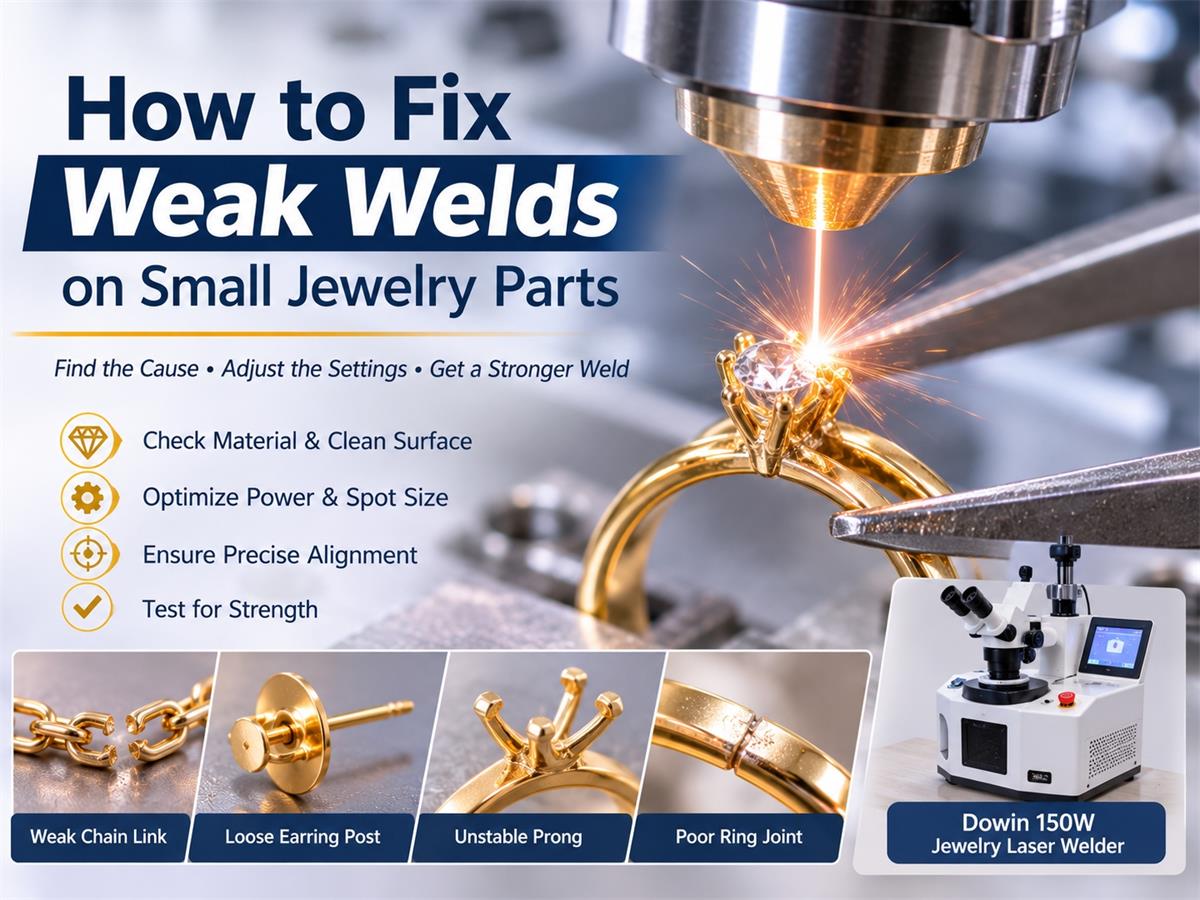
Weak laser welds are a common problem when repairing small jewelry components such as gold chains, ring bands, earring posts, and prong settings. Even when the metal appears to melt, the joint may break easily because of insufficient penetration, incorrect pulse energy, poor alignment, or contamination. Using a properly adjusted jewelry laser welding machine, technicians can improve weld strength while maintaining precise control over small and delicate parts. This guide explains how to identify weak welds, understand their causes, and correct them in practical jewelry repair applications.
1. What Does a Weak Laser Weld Look Like?
A weak weld does not always look defective. In many cases, the surface appears smooth, but the connection has insufficient fusion underneath.
Here are some common signs of weak laser welding:
- Easy separation: Two metal parts come apart under light pulling or handling.
- Surface-only melting: The welding area looks melted, but the joint edges are not properly fused.
- Small cracks: Fine cracks appear around the welding point after cooling.
- Unstable connections: Earring posts, chain links, or decorative components become loose after polishing.
- Incomplete penetration: The upper surface is connected, but the weld does not reach the required depth.
For jewelry repair shops, this problem is particularly important because small components often experience repeated mechanical stress during daily use.
2. Five Common Reasons Why Small Jewelry Welds Are Weak
Reason 1: Insufficient Laser Energy
This is one of the most common reasons for weak laser welds.
When the pulse energy is too low, the laser may only melt the surface of the metal without creating sufficient fusion between the two components.
For example, when welding a small gold chain link, the surface may show a visible welding spot, but the two ends may still separate when the chain is pulled.
How to fix it:
- Gradually increase pulse energy.
- Adjust pulse duration to improve melting depth.
- Check whether the laser is correctly focused on the joint.
- Test the settings on matching scrap material before repairing valuable jewelry.
Do not immediately increase the machine’s power to the maximum. Excessive energy can cause burn-through, excessive melting, and deformation, especially on thin gold components.
Reason 2: Incorrect Laser Spot Size
Spot diameter directly affects how laser energy is distributed across the welding area.
If the spot is too large, the energy may spread over a wider area without concentrating sufficiently on the joint. If it is too small, the laser may create excessive local heat while failing to cover the required welding area.
For small jewelry components, a practical starting reference is:
| Spot Diameter | Typical Application |
|---|---|
| 0.2–0.3 mm | Fine chain links, small cracks, delicate details |
| 0.3–0.5 mm | Gold ring joints, earring posts, general jewelry repair |
| 0.5–0.8 mm | Larger joints and thicker jewelry components |
How to fix it: Select a spot diameter that matches the joint dimensions. Make sure the laser spot covers the actual connection area rather than only one edge.
Reason 3: Poor Joint Alignment
Even with sufficient laser energy, poor positioning can result in a weak connection.
Small jewelry parts are particularly sensitive to alignment errors. If two chain ends do not touch properly, the laser may melt one side without adequately connecting the other.
This frequently happens when repairing:
- Fine gold and silver chains.
- Small jump rings.
- Earring posts and decorative components.
- Thin ring bands.
- Small prong connections.
How to fix it:
- Clean the metal surfaces before welding.
- Align the two components carefully.
- Use suitable tweezers or a positioning fixture to stabilize the parts.
- Apply one or two low-energy positioning pulses when appropriate.
- Complete the weld using controlled overlapping pulses.
Accurate positioning is particularly important when working under a microscope.
Reason 4: Incorrect Pulse Duration or Frequency
Laser welding depends on more than power alone. Pulse duration and frequency also affect the amount of heat delivered to the workpiece.
If pulse duration is too short, the metal may not melt deeply enough to create a strong joint. If it is too long, the heat-affected area may become unnecessarily large.
Similarly, excessive pulse frequency can cause heat accumulation when working on small or thin components.
How to fix it:
- Increase pulse duration gradually if penetration is insufficient.
- Reduce pulse frequency if repeated pulses cause excessive heat buildup.
- Allow cooling intervals when working on delicate components.
- Adjust one parameter at a time to identify the actual cause.
Always remember that pulse energy, duration, frequency, and spot size work together. A successful setting on one gold alloy or component thickness may not work equally well on another.
Reason 5: Contaminated Metal or Unsuitable Filler Wire
Oil, polishing compounds, oxidation, old solder, and other contaminants can interfere with the formation of a stable weld pool.
Using filler wire with an incompatible alloy composition can also affect joint quality and introduce cracking or color differences.
How to fix it:
- Clean the welding area before processing.
- Remove old solder and surface contamination where appropriate.
- Use filler material compatible with the base metal.
- Check the condition and feeding consistency of the filler wire.
- Use suitable shielding gas, such as argon, when required by the application.
For precious metal jewelry, matching the filler alloy is important for both mechanical performance and final appearance.
3. How to Improve Welding Strength on Different Small Jewelry Parts
Different jewelry components require different welding approaches. Here are four common repair situations.
A. Gold Chain Links
Fine gold chains contain small connecting links that can easily deform under excessive laser energy.
When repairing a broken chain link, make sure both ends are properly aligned and touching. Direct the laser at the connection point and use controlled pulses to fuse the metal.
Avoid repeatedly firing at exactly the same position because accumulated heat can enlarge the opening or damage the surrounding link.
B. Earring Posts
Earring posts are small components that must remain securely connected to the decorative front of the earring.
A weak connection may cause the post to detach during normal use.
For better results:
- Keep the post perpendicular to the intended connection surface.
- Ensure the contact area is clean.
- Use a suitable spot diameter for the joint size.
- Apply controlled pulses around the connection rather than concentrating all energy in one location.
For very small earring components, microscope positioning helps improve welding accuracy.
C. Ring Prongs and Stone Settings
Prongs hold gemstones in place, so their connections must be mechanically reliable.
When repairing a loose or damaged prong, use a carefully controlled welding process. The technician must consider the gemstone’s heat sensitivity and the distance between the welding area and the stone.
Some gemstones should be removed before welding. Others may require additional thermal protection or a different repair method.
D. Small Gold and Silver Decorative Components
Decorative jewelry often contains thin metal sections, small connectors, and complicated geometries.
The main challenge is achieving sufficient fusion without changing the original shape.
Use a spot size appropriate to the joint, stabilize the components, and make several controlled welds if necessary.
4. How to Test Whether a Jewelry Laser Weld Is Strong Enough
A smooth surface does not necessarily mean a strong weld. Jewelry workshops should establish a repeatable inspection process.
Step 1: Visual Inspection
Use a microscope or magnifying glass to check whether both sides of the joint have fused properly.
Look for cracks, visible gaps, pores, and incomplete fusion.
Step 2: Check the Joint Geometry
Confirm that the welded component has not changed its original position or shape. This is especially important for chain links, earring posts, and ring settings.
Step 3: Mechanical Testing
Test samples made from matching material and similar geometry using an appropriate pull, bend, or other mechanical test.
For valuable customer jewelry, avoid applying destructive testing directly to the finished piece. Use representative test samples to establish reliable parameters.
Step 4: Record Successful Parameters
Once a suitable combination of energy, pulse duration, frequency, and spot size has been established, record the settings for future repairs involving the same material and geometry.
5. Which Jewelry Laser Welding Machine Is Suitable for Small Parts?
When repairing small jewelry components, machine power is only one consideration. Precise positioning, stable pulse output, adjustable parameters, and a suitable optical system are equally important.
For jewelry repair shops, a desktop pulsed YAG laser welding machine is a practical option for applications requiring localized heat input and fine welding control.
Dowin 150W Jewelry Laser Welding Machine
For workshops handling gold rings, silver jewelry, chain repairs, and small decorative components, Dowin’s 150W desktop jewelry laser welding machine is worth considering.
Its main features include:
- 150W rated power: Suitable for many precision jewelry repair and manufacturing applications.
- Fine spot adjustment: Supports localized welding for small metal components.
- Microscope observation: Helps operators accurately position the laser on small joints.
- LED shadowless lighting: Provides clearer visibility of the welding area.
- YAG pulsed laser technology: Allows controlled pulse-based welding of precious metal components.
- Compact desktop design: Suitable for jewelry repair workshops and manufacturing environments.
The machine can be used for applications such as gold chain repair, earring post welding, ring resizing, prong repair, and small metal component connections.
View Dowin Jewelry Spot Laser Welding Machines and Product Details.
When selecting a machine, ask the manufacturer to demonstrate welding samples using your actual metal material, component thickness, and joint geometry. This is a more reliable way to evaluate welding performance than comparing rated wattage alone.
6. Common Mistakes to Avoid When Fixing Weak Jewelry Welds
When a weld breaks easily, some operators immediately increase laser power. However, this does not always solve the problem.
Here are several mistakes to avoid:
- Increasing power without checking focus: Incorrect focus can still produce poor penetration even at higher energy.
- Ignoring joint alignment: A gap between two components can prevent proper fusion.
- Using an oversized spot: The laser may heat the surrounding metal instead of concentrating on the joint.
- Welding dirty surfaces: Contamination can introduce pores and unstable melting.
- Repeating too many pulses: Heat accumulation can damage thin jewelry parts.
- Using incompatible filler wire: Different alloy compositions may produce weak or visibly mismatched repairs.
The best troubleshooting method is to inspect the material and joint first, verify focus and alignment, and then adjust the laser parameters gradually.
7. Frequently Asked Questions
Q1: Why does my gold laser weld break easily?
The most common causes are insufficient penetration, poor joint alignment, low pulse energy, incorrect focus, or contamination. Check the joint preparation and laser focus before increasing pulse energy.
Q2: Can increasing laser power make a weak weld stronger?
Sometimes, but not always. If the problem is insufficient energy, a gradual increase may improve fusion. However, if the real problem is poor alignment, contamination, or incorrect focus, increasing power may create more defects without improving joint strength.
Q3: What spot size is suitable for small jewelry parts?
A spot diameter of approximately 0.2–0.5 mm is a useful starting range for many small jewelry repairs. The ideal diameter depends on the component size, material thickness, and joint geometry.
Q4: Can a 150W jewelry laser welder repair small gold chains?
Yes. A 150W pulsed YAG jewelry laser welding machine can handle many small gold chain repair applications. The operator must select appropriate pulse energy and spot size to avoid damaging the delicate links.
Q5: Why does a weld look good but still have low strength?
A weld can look smooth on the surface while having incomplete penetration underneath. Visual inspection alone cannot confirm joint strength. Representative samples should be tested mechanically when developing a new welding process.
Q6: Is laser welding suitable for silver jewelry?
Yes. Laser welding can be used for silver jewelry repair and manufacturing. However, silver has different thermal and optical characteristics from gold, so the welding parameters must be adjusted for the material.
Conclusion
Weak welds on small jewelry parts are usually caused by a combination of insufficient fusion, incorrect laser settings, poor positioning, or surface contamination.
Instead of simply increasing laser power, jewelry technicians should identify the actual defect, improve joint preparation, check the focal position, and adjust pulse energy, duration, and spot size systematically.
For jewelry repair workshops working with gold, silver, and other precious metals, a pulsed YAG jewelry laser welding machine with precise microscope positioning provides an effective solution for small and delicate welding applications.
Contact Dowin to learn more about jewelry laser welding machines and request a welding sample test.
“`
Post time: Nov-19-2026
