
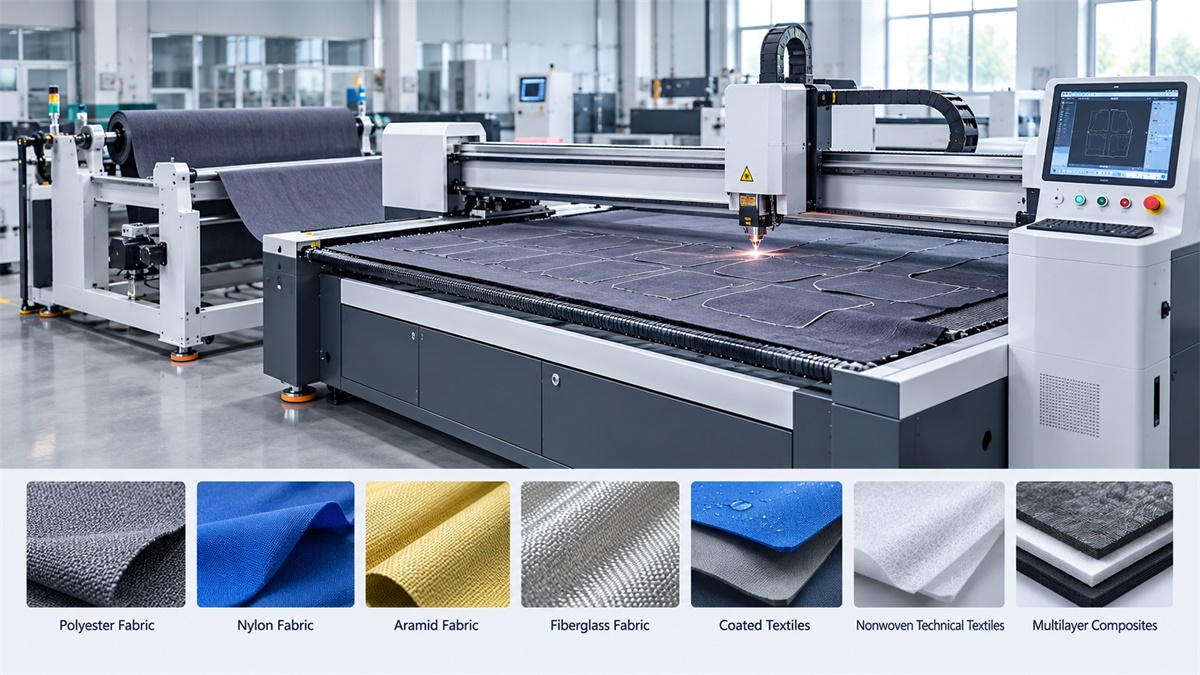
Technical textiles are engineered fabrics designed for specific industrial, protective, or functional applications. Unlike ordinary clothing fabrics, they must often meet strict requirements for strength, dimensional stability, heat resistance, filtration, or chemical performance. A laser cutting machine for technical textiles offers manufacturers a flexible way to process complex patterns, cut precise components, and automate repetitive production. For companies processing textile rolls or large-format materials, an automatic fabric laser cutting machine can help streamline material handling and maintain consistent cutting results across production batches.
However, cutting technical textiles requires more than selecting a laser power rating. Materials such as polyester, nylon, aramid, fiberglass fabric, coated textiles, and multilayer composites respond differently to heat. Some synthetic fibers can develop sealed edges during laser cutting, while heat-sensitive coatings and high-performance fibers may suffer thermal damage. Choosing the right laser source, processing parameters, exhaust system, and feeding method is essential for achieving the required edge quality without compromising the fabric’s functional properties. This guide explains how to cut technical textiles with a laser cutting machine, which materials are suitable, and how to select the right equipment for industrial production.
1. What Are Technical Textiles?
Technical textiles are textile products engineered primarily for performance and function rather than appearance. They are used in industries where materials must satisfy specific mechanical, thermal, chemical, or environmental requirements.
Common technical textile materials include:
-
Polyester fabric: Used in filtration, automotive interiors, industrial covers, and reinforcement products.
-
Nylon fabric: Applied in airbags, protective equipment, industrial bags, and load-bearing textile products.
-
Aramid fabric: Used in heat-resistant clothing, protective equipment, and high-strength industrial applications.
-
Fiberglass fabric: Found in thermal insulation, composite reinforcement, and industrial protection.
-
Coated textiles: Include PVC-coated polyester, PU-coated fabrics, and other materials designed for waterproofing, abrasion resistance, or chemical protection.
-
Nonwoven technical textiles: Used in filtration, automotive insulation, medical products, and industrial separation.
-
Multilayer composite textiles: Combine different fibers, coatings, membranes, or reinforcement layers to achieve specific performance characteristics.
The material composition determines whether laser cutting is suitable. A fabric that cuts cleanly under a CO2 laser may react very differently when it contains a heat-sensitive coating, a reflective layer, or a mixture of natural and synthetic fibers.
Before processing a new technical textile, identify its fiber composition, coating chemistry, thickness, and any relevant manufacturer safety information.
2. Can You Cut Technical Textiles with a Laser Cutting Machine?
Yes, many technical textiles can be laser cut. The most suitable process depends on the material, its functional requirements, and the acceptable level of thermal alteration.
A laser cutting machine uses a focused beam to remove or separate material along a programmed path. Since the process does not require a blade to press against the fabric, it can reduce mechanical deformation and support accurate cutting of intricate shapes.
Laser cutting is particularly useful when manufacturers need:
-
Complex contours and detailed geometries.
-
Consistent dimensions across repeated components.
-
Small holes, slots, and customized patterns.
-
Flexible changes to digital cutting files.
-
Reduced dependence on mechanical cutting dies.
-
Integration with automated material feeding and production systems.
Nevertheless, laser cutting is not suitable for every technical textile. Fiberglass, aramid, coated fabrics, and composite materials require particular attention to material compatibility and thermal effects. In some applications, mechanical cutting, waterjet cutting, or specialized textile cutting methods may be more appropriate.
The final decision should be based on sample testing and the performance requirements of the finished component.
3. Which Laser Is Best for Technical Textiles?
CO2 lasers are widely used for cutting many nonmetallic materials, including compatible textiles, felt, foam, and certain coated fabrics. However, the best laser source depends on the specific material and the required cutting quality.
CO2 laser cutting machines
CO2 lasers are a common choice for polyester fabrics, many nylon textiles, nonwoven materials, and certain coated textile products.
Their advantages include flexible cutting paths, non-contact processing, and suitability for automated fabric cutting systems. For synthetic fabrics, the thermal process may also fuse the cut edges and reduce fraying.
However, the same heat can cause melting, shrinkage, discoloration, or coating damage. Material testing is essential.
Fiber laser systems
Fiber lasers are primarily associated with metal processing. They are not the default choice for ordinary technical textiles, although specialized applications involving particular composite structures or laser-compatible materials may require other laser technologies.
For most conventional textile-cutting projects, evaluate the material and application before considering a fiber laser solely because of its higher power density.
UV and other specialized laser systems
Some sensitive or specialized materials may benefit from alternative laser wavelengths or ultrashort-pulse processing. These systems can be relevant when thermal effects must be tightly controlled, but their suitability and economic viability depend heavily on the application.
Practical recommendation: For polyester, nylon, and many nonwoven technical fabrics, begin by evaluating a CO2 laser cutting machine. For aramid, fiberglass, and coated composites, confirm compatibility through controlled sample tests before selecting the production system.
4. How to Cut Different Technical Textile Materials
Different technical textiles require different cutting strategies. The following table provides an initial guide.
| Material | Common applications | Key cutting considerations |
|---|---|---|
| Polyester | Filtration, automotive, industrial covers | Control melting, edge fusion, and shrinkage |
| Nylon | Airbags, protective equipment, industrial bags | Check heat sensitivity and dimensional stability |
| Aramid | Protective clothing, high-strength components | Verify edge quality and retained material performance |
| Fiberglass fabric | Insulation, composites, industrial protection | Evaluate fiber integrity, dust control, and equipment suitability |
| PVC-coated fabric | Tarpaulins, covers, industrial enclosures | Confirm coating compatibility and hazardous decomposition risks |
| PU-coated fabric | Protective products, waterproof components | Prevent coating damage and unwanted delamination |
| Nonwoven technical textiles | Filtration, insulation, industrial separation | Control melting, deformation, and functional changes |
| Multilayer composites | Reinforcement, specialized industrial parts | Test every layer for thermal compatibility |
This table should be treated as a starting point rather than a guarantee. Even fabrics made from the same base fiber can behave differently because of weave structure, coatings, additives, thickness, and manufacturing processes.
For example, a polyester fabric used for a simple industrial cover may tolerate laser cutting well, while a specialized filtration textile may require tighter control over pore structure and edge contamination.
5. How to Set Laser Cutting Parameters
The most important parameters are laser power, cutting speed, focal position, air assistance, and exhaust performance. These settings should be optimized together rather than adjusted independently.
Laser power
Higher power can help cut thicker or denser materials, but excessive energy may create a wider heat-affected zone.
Start with a controlled test and increase power only when necessary to achieve complete separation at the required speed.
Cutting speed
Cutting speed affects both productivity and edge quality. If the laser moves too slowly, the material may receive excessive heat. If it moves too quickly, the cut may be incomplete or inconsistent.
The appropriate speed depends on the material composition, thickness, laser output, and cutting geometry.
Focal position
Correct focusing concentrates energy where the cut is required. Poor focus can result in incomplete cutting, wider kerfs, and inconsistent results.
Air assistance
Airflow can influence debris removal and the cutting process. The correct setup depends on the fabric and machine configuration. Excessive airflow may disturb lightweight materials, while inadequate extraction can allow smoke and residues to accumulate.
Exhaust and filtration
Technical textiles may contain coatings, adhesives, pigments, and additives that produce hazardous fumes when heated. A suitable extraction system is essential, and filtration must be selected according to the contaminants involved.
Do not assume that a fabric is safe to laser cut simply because its base fiber is commonly used in textiles. Check the manufacturer’s safety data before processing coated or composite materials.
6. How to Prevent Melting, Fraying, and Edge Damage
Edge quality is especially important for technical textiles because cutting defects may affect strength, dimensional accuracy, sealing performance, or the function of the finished component.
Reduce excessive heat input
Use the lowest practical energy input that achieves reliable separation at the required production speed. Excessive energy can cause melted edges, shrinkage, discoloration, or damage to coatings.
Test the actual material
Do not rely exclusively on generic parameter recommendations. Test the exact fabric grade, thickness, color, coating, and layer structure used in production.
Maintain stable fabric positioning
Wrinkles and uneven tension can change the distance between the material and the cutting head, resulting in inconsistent cuts. Proper material support and controlled feeding help maintain dimensional accuracy.
Inspect the finished edge
Check for incomplete cuts, melted beads, loose fibers, discoloration, coating separation, and dimensional changes. For safety-critical components, visual inspection alone is insufficient; appropriate performance tests may also be required.
Validate functional performance
For technical textiles used in filtration, protective clothing, reinforcement, or other demanding applications, cutting quality must be evaluated against the relevant performance requirements. A clean-looking edge does not necessarily mean that the fabric retains its original mechanical or functional properties.
7. Manual vs. Automatic Laser Cutting for Technical Textiles
For manufacturers handling large quantities of technical fabric, automation can be just as important as the laser source.
| Feature | Manual material handling | Automatic feeding system |
|---|---|---|
| Initial investment | Usually lower | Usually higher |
| Material loading | More operator involvement | Reduced repetitive handling |
| Continuous roll processing | Requires more manual work | Better suited to compatible roll workflows |
| Repeatability | Depends on operator positioning | Can improve consistency with proper calibration |
| Production capacity | Suitable for smaller batches | Suitable for repeated production and larger volumes |
| Flexibility | Useful for samples and occasional jobs | Useful for standardized cutting workflows |
An automatic feeding system can help reduce material-handling time, particularly when processing long rolls of polyester, nylon, and other compatible textiles.
However, automatic feeding does not automatically guarantee higher output. Fabric width, roll weight, tension control, cutting layout, unloading requirements, and machine cycle time all affect actual production performance.
For manufacturers processing multiple fabric types, a suitable automatic fabric laser cutting machine is worth evaluating for its feeding stability, working area, motion accuracy, and compatibility with the intended materials.
8. Industrial Applications of Laser-Cut Technical Textiles
Laser cutting supports a wide range of industrial textile applications, although suitability depends on the material and the required end-use performance.
Automotive textiles
Automotive manufacturers use technical fabrics for interior trim, insulation, acoustic components, protective covers, and selected reinforcement products. Laser cutting can help produce repeatable shapes and complex outlines.
For safety-related components such as airbags, the process must meet the applicable material and component specifications. Laser cutting should not be assumed suitable without validation.
Filtration materials
Filter media may be made from woven fabrics, nonwovens, or multilayer composites. Laser cutting can produce customized shapes, but excessive heat or contamination may alter the filtration characteristics of some materials.
Protective textiles
Certain synthetic and high-performance textiles are used in industrial protective clothing and equipment. Before adopting laser cutting, manufacturers must verify that the process does not compromise the material’s required protective properties.
Industrial covers and tarpaulins
Compatible coated polyester fabrics can be used for covers, enclosures, and tarpaulins. Laser cutting may support customized dimensions and intricate shapes, but coating chemistry must be checked for safe processing.
Composite reinforcement
Technical textiles used in composite manufacturing can require highly accurate outlines and repeatable component dimensions. The appropriate cutting method depends on fiber type, resin system, layer structure, and whether thermal damage is acceptable.
Nonwoven insulation and acoustic products
Compatible nonwoven fabrics and felt materials may be laser cut into insulation pads, acoustic components, and other industrial shapes. Thick or dense materials may require a different machine configuration from lightweight textiles.
9. How to Choose a Laser Cutting Machine for Technical Textiles
Selecting the right equipment requires matching the machine to the actual production process.
1. Confirm material compatibility. Provide the supplier with the exact material specifications, including fiber composition, coatings, thickness, and any relevant safety data.
2. Define the working area. Choose a cutting area that accommodates the fabric width and the largest required component.
3. Evaluate production speed. Request a cutting demonstration using representative patterns and the required production volume. Compare finished-part quality, not just the machine’s maximum travel speed.
4. Check feeding and tension control. For roll-fed materials, stable alignment and appropriate tension are essential to prevent stretching, wrinkles, and dimensional variation.
5. Evaluate exhaust requirements. Verify that the extraction and filtration configuration is suitable for the actual fumes and particles generated by the material.
6. Consider the software workflow. Check support for the file formats, nesting methods, and production processes used by your team.
7. Calculate the total operating cost. Include electricity, maintenance, extraction filters, labor, downtime, and material waste rather than comparing purchase price alone.
8. Request sample testing. Ask the supplier to process your actual material and inspect the resulting edges. For high-performance or safety-critical textiles, include the relevant functional tests.
A machine that performs well on ordinary polyester may not deliver acceptable results on aramid, fiberglass, or a multilayer coated textile. Material-specific validation is essential.
10. Is Laser Cutting Better Than Mechanical Cutting?
Laser cutting and mechanical cutting each have advantages.
Laser cutting is useful for intricate contours, customized patterns, and frequent design changes because it does not require a dedicated physical die for every design. It also eliminates blade wear, although the laser system still requires regular maintenance.
Mechanical cutting can be preferable when thermal effects are unacceptable, when materials are incompatible with the laser, or when very high-volume production of simple shapes makes tooling-based processing more economical.
Waterjet cutting and other specialized methods may also be appropriate for certain technical fabrics and composite structures.
The most suitable process depends on the fabric’s composition, dimensional tolerances, production volume, edge requirements, and the effect of cutting on the finished product’s performance.
Frequently Asked Questions
1. Can a CO2 laser cut technical textiles?
Yes, a CO2 laser can cut many compatible technical textiles, including certain polyester, nylon, felt, and nonwoven materials. Suitability depends on the exact material composition, thickness, coating, and performance requirements.
2. Can laser cutting be used for aramid fabric?
Potentially, but aramid fabrics require material-specific testing. Their heat resistance does not automatically mean that laser cutting will produce an acceptable edge or preserve all required properties. Verify the manufacturer’s processing guidance and the finished material’s performance.
3. Can fiberglass fabric be laser cut?
Some fiberglass materials may be processed using specialized laser systems, but conventional laser cutting should not be assumed suitable for every fiberglass fabric. Fiber damage, debris, smoke, coatings, and equipment compatibility must be evaluated. Mechanical cutting may be preferable for some applications.
4. Does laser cutting seal technical textile edges?
Thermoplastic materials may develop fused edges because of localized heating. This can reduce fraying in suitable fabrics, but it can also create unwanted beads, shrinkage, or coating damage. The result depends on the material and cutting parameters.
5. What laser power is required for technical textiles?
There is no universal power rating. Required power depends on fabric thickness, density, composition, cutting speed, and edge-quality requirements. A supplier should determine the appropriate configuration through sample testing.
6. Is automatic laser cutting suitable for industrial textile production?
Yes. A compatible automatic feeding system can support repeated cutting and roll processing while reducing manual material handling. Actual productivity depends on feeding stability, machine speed, cutting layout, and unloading operations.
7. How can manufacturers avoid damaging coated technical fabrics?
Confirm the coating chemistry and safety data, then test power, speed, and focus on the actual material. Inspect for discoloration, melting, delamination, and changes in coating performance. Some coatings may be unsuitable for laser processing altogether.
Conclusion
Laser cutting can be an effective solution for processing many technical textiles, providing precise cutting paths, flexible digital production, and opportunities for automation. However, the right process depends on the specific fiber, coating, thickness, and functional requirements of the finished product.
For manufacturers processing compatible textile rolls, an automatic fabric laser cutting machine from Dowin Laser is worth evaluating for its material-handling capabilities and potential integration into an industrial workflow.
Before purchasing equipment, test the actual fabric, verify edge quality, assess any changes in functional performance, and confirm that the exhaust system is suitable for the material. These steps help ensure that the selected laser cutting solution meets both production and product-quality requirements.
Post time: Oct-19-2026
