
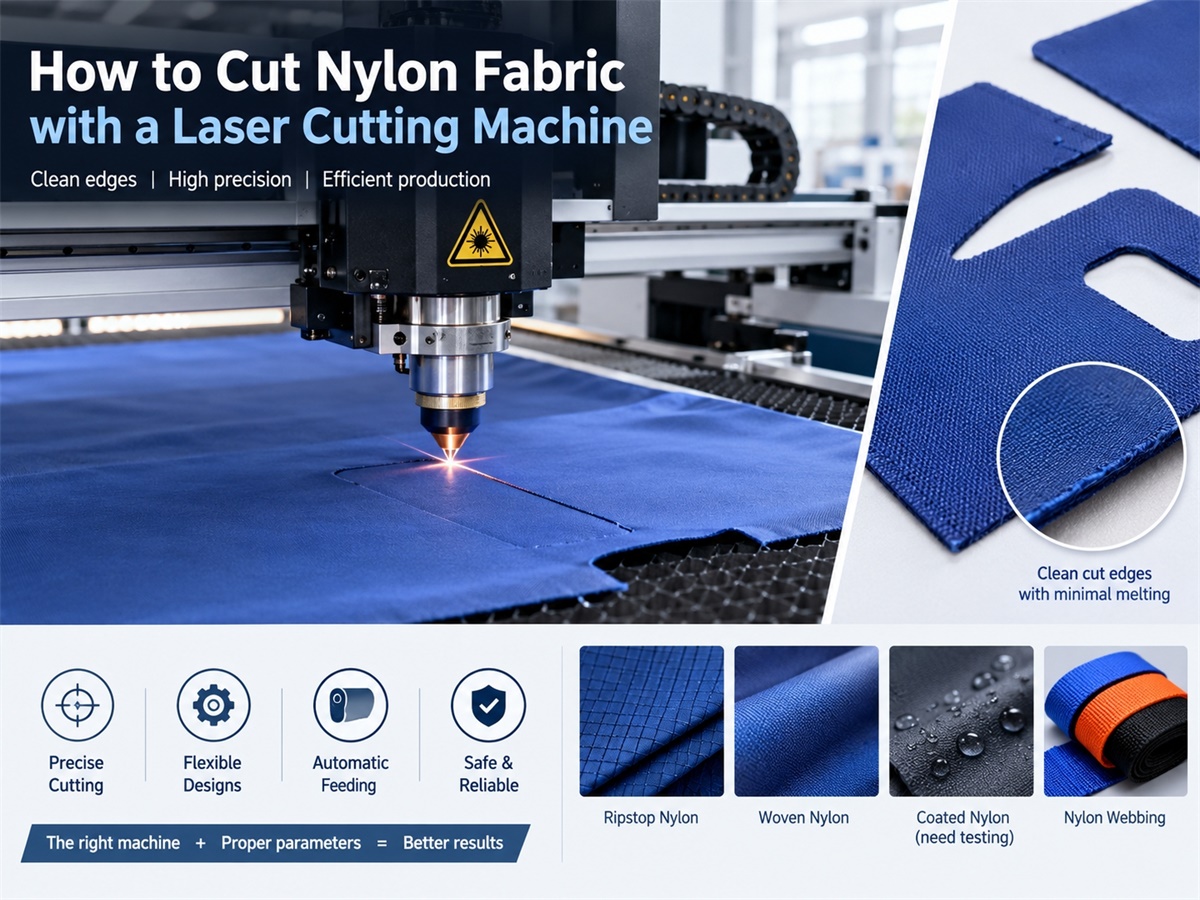
Nylon is widely used in outdoor equipment, sportswear, bags, automotive textiles, protective clothing, and industrial fabrics. However, cutting nylon cleanly can be challenging because it is a synthetic thermoplastic material that melts when exposed to excessive heat. Choosing the right cutting method is essential for achieving clean edges, consistent dimensions, and efficient production.
A CO2 laser cutting machine for fabric can be an effective solution for cutting many types of nylon textiles, especially when manufacturers need intricate patterns, flexible designs, and automated processing. However, the results depend on the nylon composition, fabric thickness, weave structure, laser power, and cutting parameters.
For manufacturers processing nylon fabric in batches, an automatic fabric laser cutting machine is worth considering because it can combine precise cutting with continuous fabric feeding, helping reduce manual handling and improve production efficiency.
This guide explains how to laser cut nylon fabric, how to select suitable equipment, and how to avoid common problems such as melted edges, discoloration, and incomplete cuts.
1. Can You Cut Nylon Fabric with a Laser?
Yes. Many nylon fabrics can be cut using a CO2 laser cutting machine, but the cutting performance varies depending on the material.
Nylon is a thermoplastic polymer, which means it softens and melts when heated. A laser concentrates energy on a narrow cutting line, melting or vaporizing the material locally to separate the fabric.
Unlike mechanical cutting tools, a laser does not need to press against the textile. This makes it useful for complex patterns, small holes, curved contours, and repeated designs.
However, nylon does not always produce the same clean edge as materials that respond more predictably to laser cutting. Excessive heat can cause melting, hard beads along the cut, discoloration, or distortion of lightweight fabric.
Before production, always test the exact nylon material you intend to process.
Nylon fabrics commonly considered for laser cutting
-
Nylon 6 and nylon 66 fabrics: Used in industrial textiles, bags, and technical applications. Cutting performance depends on the fabric construction and finish.
-
Ripstop nylon: Common in tents, backpacks, lightweight outdoor products, and protective covers.
-
Nylon webbing and thin woven nylon: May be laser processed when the thickness and melting behavior are suitable.
-
Coated nylon fabric: Requires additional testing because polyurethane, PVC, waterproof coatings, adhesives, or other finishes may change the cutting behavior and safety requirements.
Not every nylon product is suitable for laser processing. In particular, coated or laminated textiles should be identified before cutting. Materials containing PVC should not be laser cut because they can release hazardous and corrosive gases.
2. How Does a CO2 Laser Cutting Machine Cut Nylon?
A CO2 laser cutting machine directs a focused infrared laser beam onto the fabric. The concentrated energy heats a narrow area until the material separates along the programmed cutting path.
The process generally involves four steps:
-
Prepare the fabric: Lay the nylon flat and remove wrinkles. For roll materials, check that the fabric feeds evenly.
-
Set the cutting file: Import the required pattern into the machine software and confirm the dimensions.
-
Adjust the laser parameters: Select an appropriate combination of power, speed, focus, and air assistance based on material testing.
-
Inspect the cut: Check the edge for melting, hard beads, discoloration, incomplete separation, and dimensional accuracy.
One important advantage of laser cutting is that the process can follow complex digital patterns without requiring a separate cutting die for every design.
For production environments, an automatic feeding system can also reduce the need to reposition fabric manually between cutting jobs.
3. Recommended Laser Cutting Parameters for Nylon Fabric
There is no single laser setting that works for every nylon textile. A thin ripstop fabric, a dense woven nylon, and a coated technical textile may require very different settings.
The following table provides a starting point for testing rather than a guaranteed production recipe.
| Parameter | Recommended approach |
|---|---|
| Laser type | CO2 laser |
| Laser power | Select according to fabric thickness and cutting speed requirements |
| Cutting speed | Start with a relatively high speed and increase energy only as needed |
| Focus | Focus accurately on the fabric surface or the position established during testing |
| Air assistance | Use controlled airflow to help remove smoke and debris |
| Fabric support | Use a flat, stable cutting bed with suitable ventilation |
| Feeding method | Manual loading for small jobs; automatic feeding for continuous production |
How to find the right settings
Step 1: Start with a small test pattern. Use a sample of the actual production fabric, including its original coating or finish.
Step 2: Adjust the cutting speed. If the fabric does not separate completely, test a slower speed or a suitable increase in laser power. Change one parameter at a time.
Step 3: Inspect the edges. Look for excessive melting, fused fibers, hard beads, discoloration, and unwanted shrinkage.
Step 4: Test repeatability. Run multiple pieces and inspect the results before applying the settings to a full production batch.
The objective is not simply to cut through the material. It is to achieve consistent edges without introducing excessive heat or compromising the fabric’s functional properties.
4. How to Prevent Nylon Fabric from Melting During Laser Cutting
Melting is one of the most common challenges when laser cutting nylon. Because nylon is thermoplastic, the heat that separates the fibers can also soften adjacent material.
The following practices can help reduce this problem.
Use the minimum effective energy
Excessive laser energy can create wide heat-affected areas and hard, melted edges. Test higher cutting speeds and lower power levels where practical, while ensuring complete separation.
Avoid unnecessary repeated passes
Repeated passes can accumulate heat and increase the risk of deformation. Optimize the cutting path and parameters so that the material can be separated in a controlled pass whenever feasible.
Keep the fabric flat
Wrinkles and uneven material height can change the distance between the fabric and the laser focus. For lightweight nylon, this may lead to inconsistent cutting results.
Optimize the cutting path
Closely spaced cuts and small internal details can concentrate heat in a limited area. Appropriate path sequencing and spacing may help reduce localized melting.
Inspect the edge after cooling
A cut that appears acceptable immediately after processing may still have fused fibers or hard edges. Check the cooled fabric before approving the cutting parameters for production.
Important: A laser-cut edge is not automatically a high-quality edge. If the application requires soft, flexible edges with no fused beads, mechanical cutting or another process may be more suitable.
5. Laser Cutting vs. Knife Cutting for Nylon Fabric
Laser cutting and mechanical knife cutting each have advantages. The best option depends on fabric thickness, production volume, pattern complexity, and the required edge quality.
| Comparison | CO2 laser cutting | Mechanical knife cutting |
|---|---|---|
| Cutting method | Focused thermal energy | Physical blade |
| Complex patterns | Excellent for intricate contours | Depends on blade and machine capability |
| Edge characteristics | May melt or fuse nylon fibers | Usually avoids heat-related melting |
| Tool wear | No cutting blade to replace | Blades require maintenance and replacement |
| Multiple fabric layers | Requires careful evaluation | Often suitable with an appropriate cutting system |
| Automated production | Available with automatic feeding | Available with automatic feeding |
| Material limitations | Heat-sensitive materials require testing | Fabric compression and blade performance must be considered |
For nylon products where maintaining soft edges is critical, a knife cutter may be preferable. For intricate shapes, small cutouts, and flexible digital designs, laser cutting may offer greater convenience.
If your production involves several fabric layers, compare both technologies using the actual material and production requirements rather than assuming that one method is always faster.
6. How to Choose a Laser Cutting Machine for Nylon Fabric
Selecting the right machine requires more than choosing a laser power rating. Manufacturers should evaluate the complete cutting workflow.
Laser power and cutting speed
Choose a machine based on the thickness and structure of your nylon fabric, the smallest details in your patterns, and the required daily output. Higher power is not necessarily better if it creates excessive melting.
Working area
The working area should accommodate your largest cutting pattern and the fabric width used in production. Wider materials may require a dedicated fabric-processing configuration.
Automatic fabric feeding
For manufacturers processing fabric rolls, automatic feeding can reduce manual positioning and make long production runs easier to manage.
A properly configured system can coordinate material feeding and cutting, helping maintain a more consistent workflow.
Software and cutting accuracy
Check whether the machine supports your design files and production workflow. Evaluate contour accuracy, repeatability, nesting efficiency, and the ease of modifying patterns.
Exhaust and fire protection
Nylon cutting can generate smoke, fumes, and combustible debris. Select equipment with suitable extraction, appropriate fire-prevention measures, and accessible emergency controls. The material and any coating must be confirmed suitable for laser processing before production.
For factories that regularly process textile rolls, Dowin’s automatic fabric laser cutting machine range is a relevant starting point for evaluating automated textile-cutting equipment. Confirm the machine configuration and cutting performance against your particular nylon fabric before purchase.
7. Common Problems When Laser Cutting Nylon
| Problem | Possible cause | What to test |
|---|---|---|
| Fabric does not cut through | Insufficient energy or incorrect focus | Recheck focus and adjust speed or power |
| Hard beads along the edge | Excessive localized melting | Reduce heat input and test cutting speed |
| Uneven cutting | Wrinkles, inconsistent fabric height, or unstable feeding | Improve fabric tension and flatness |
| Brown or discolored edges | Excessive heat or material sensitivity | Test lower heat input and inspect the fabric finish |
| Fabric shrinks or deforms | Thermal stress during cutting | Reduce heat accumulation and evaluate another cutting method |
| Excessive smoke | Material composition, coating, or unsuitable settings | Verify material safety and improve extraction |
These problems should be diagnosed through controlled material testing. A change that improves edge quality on one nylon fabric may not produce the same result on another.
8. Is Laser Cutting Suitable for Nylon Fabric Production?
Laser cutting can be a practical choice for nylon manufacturers that need intricate patterns, frequent design changes, or automated processing.
It is particularly worth evaluating when:
-
You manufacture bags, outdoor products, or technical textile components with complex contours.
-
You need to cut small holes, narrow slots, or detailed patterns.
-
Your production involves frequent changes to digital designs.
-
You want to reduce blade maintenance and manual cutting operations.
-
You process fabric rolls and can benefit from automated feeding.
However, laser cutting should not be selected solely because it is a non-contact process. Nylon’s thermal behavior makes sample testing essential, especially when the fabric must retain its original flexibility, appearance, strength, or coating performance.
For high-volume production, compare the complete process cost, including machine investment, operating speed, material waste, extraction, maintenance, and quality inspection.
Frequently Asked Questions
Can a CO2 laser cut nylon fabric?
Yes, many nylon fabrics can be cut with a CO2 laser. The results depend on material thickness, weave, coating, laser settings, and the required edge quality. Always test the actual fabric before production.
Does laser cutting nylon seal the edges?
Laser cutting can melt and fuse the fibers along the cut edge. However, this does not guarantee a smooth or flexible seal. Excessive heat may produce hard beads, discoloration, or deformation.
What laser power is best for cutting nylon fabric?
There is no universal power rating. The appropriate power depends on fabric thickness, machine configuration, cutting speed, and edge-quality requirements. Test the lowest effective energy that achieves reliable separation.
Can laser cutting damage waterproof nylon fabric?
Yes. Excessive heat may affect waterproof coatings, laminations, adhesives, or the textile itself. Test the finished material and verify that its water resistance and other required properties remain acceptable after cutting.
Is laser cutting better than knife cutting for nylon?
Neither method is universally better. Laser cutting is useful for intricate digital patterns and non-contact processing, while knife cutting avoids heat-related edge melting. Compare the two methods using your specific fabric and production requirements.
Can nylon fabric be cut automatically from a roll?
Yes. A suitably configured automatic fabric cutting system can feed roll material and cut programmed patterns. Confirm that the machine supports the fabric width, thickness, tension, and cutting requirements of your production line.
Is laser cutting nylon fabric safe?
It can be performed with suitable equipment, ventilation, and fire-prevention measures, but the exact material composition must be verified first. Certain coatings and additives may create hazardous fumes. Never laser cut unidentified materials, and do not process PVC-containing materials with a laser.
Conclusion
Cutting nylon fabric with a laser cutting machine is feasible, but achieving consistent results requires careful control of heat input and thorough material testing. The key factors are the nylon’s composition, fabric construction, laser parameters, cutting path, and production setup.
For manufacturers seeking repeatable output from fabric rolls, an automatic CO2 laser cutting system may improve workflow efficiency. The right decision should ultimately be based on real cutting samples, edge flexibility, dimensional accuracy, material performance, and total production cost.
Post time: Oct-16-2026
