
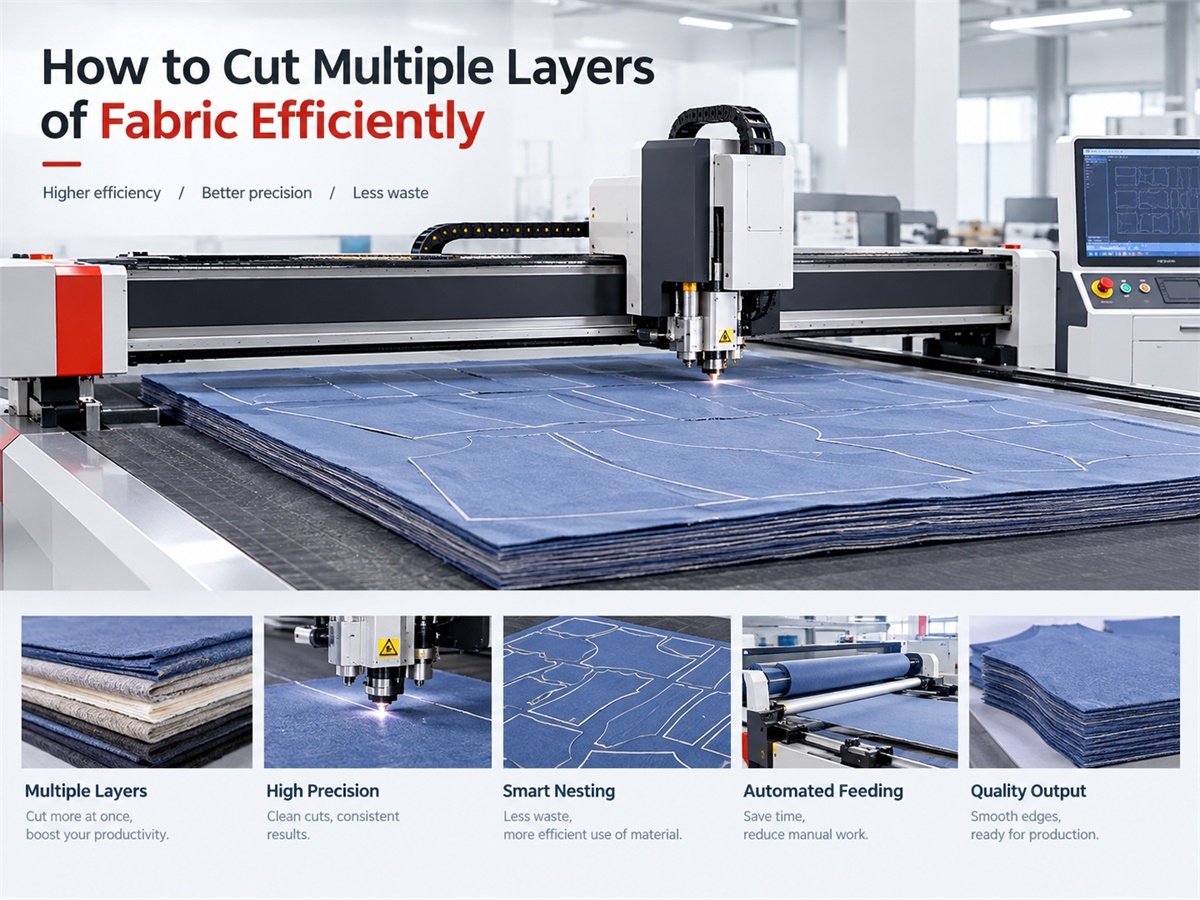
Cutting multiple layers of fabric is a common requirement in garment manufacturing, textile production, upholstery, and other industries that process fabric in large quantities. Compared with cutting one layer at a time, multi-layer cutting can significantly improve production efficiency, reduce repetitive work, and help manufacturers meet tight delivery schedules.
However, stacking more fabric layers does not automatically mean higher productivity. Fabric thickness, material properties, cutting technology, blade or laser performance, and material positioning all affect the final result.
This guide explains how to cut multiple layers of fabric efficiently, compares common industrial cutting methods, and helps manufacturers choose the right fabric cutting machine for their production needs.
1. Why Cut Multiple Layers of Fabric?
Multi-layer fabric cutting allows manufacturers to cut several fabric pieces in a single operation. It is particularly useful for businesses producing clothing, uniforms, sportswear, home textiles, and upholstered furniture.
The main benefits include:
-
Higher production efficiency: Multiple fabric layers can be processed during one cutting cycle.
-
Reduced labor requirements: Operators spend less time repeating the same cutting operations.
-
Consistent pattern dimensions: Properly aligned layers help maintain consistent shapes across production batches.
-
Better batch production: Large quantities of fabric components can be prepared more efficiently.
-
Improved production planning: Automated cutting systems can help manufacturers maintain a more predictable workflow.
The actual productivity improvement depends on the number of layers, fabric type, cutting speed, setup time, and the accuracy required for each component.
2. Choose the Right Fabric Cutting Method
Different cutting technologies are suitable for different fabric structures and production requirements. Before deciding how to cut multiple layers, manufacturers should understand the advantages and limitations of each method.
Manual Fabric Cutting
Manual cutting with scissors or handheld tools is suitable for samples, small orders, and simple cutting tasks.
However, cutting multiple layers manually can be difficult because the upper and lower layers may shift. Thick stacks also require more physical effort, making it harder to maintain consistent dimensions.
Manual cutting is generally not the best choice for high-volume production requiring repeatable accuracy.
Straight Knife Fabric Cutting Machine
A straight knife cutting machine is widely used in garment factories. Its vertically moving blade can cut through stacked fabric, making it suitable for straight lines, curves, and various garment patterns.
Advantages include:
-
Suitable for relatively thick fabric stacks.
-
Capable of cutting many layers in one operation.
-
Flexible for different garment patterns.
-
Generally practical for large-scale apparel production.
However, blade deflection, fabric compression, operator technique, and the geometry of the cutting path can affect accuracy. The lower layers may not match the upper layers perfectly if the stack is too thick or poorly secured.
Band Knife Cutting Machine
Band knife machines use a continuous blade and are often used for precision cutting of fabric blocks and pre-cut stacks.
They can provide good accuracy for suitable materials, but operators must move the fabric against the blade. This method requires appropriate safety procedures and is less convenient for fully automated, complex pattern cutting.
CNC Knife Cutting Machine
CNC knife cutting machines use computer-controlled cutting heads to follow digital patterns.
They are suitable for applications requiring flexible pattern changes, accurate contours, and automated cutting workflows. Depending on the machine configuration, they can process single layers or selected multi-layer stacks.
Their main limitation is that maximum cutting thickness and practical throughput depend on the cutting head, material, and machine design.
CO2 Laser Fabric Cutting Machine
A CO2 laser cuts fabric using a focused laser beam rather than a mechanical blade. It is particularly useful for intricate patterns, detailed contours, and automated textile cutting.
Laser cutting offers several advantages:
-
No mechanical blade wear or sharpening.
-
Easy switching between digital cutting patterns.
-
High precision for suitable fabrics.
-
Automated cutting with compatible feeding systems.
-
Clean, sealed edges on many synthetic fabrics, depending on material composition and processing parameters.
However, a standard CO2 laser fabric cutting machine is generally better suited to single-layer cutting than conventional multi-layer stack cutting. The upper layer can absorb or deflect much of the laser energy, while lower layers may receive insufficient energy. Excessive power or repeated exposure can also cause scorching, melting, or fire hazards.
For manufacturers specifically seeking high-volume multi-layer cutting, mechanical cutting systems are often more suitable. For automated cutting of individual fabric layers, a laser system may offer better flexibility.
3. Prepare the Fabric Before Cutting
Even the best cutting machine cannot compensate for poorly prepared material. Proper preparation helps reduce waste and improve consistency.
Step 1: Check Fabric Characteristics
Identify the fabric’s thickness, elasticity, surface texture, and fiber composition before selecting the cutting method.
For example:
-
Cotton and woven fabrics may be suitable for conventional multi-layer knife cutting.
-
Stretch fabrics require careful tension control to prevent dimensional changes.
-
Polyester and other synthetic fabrics may respond well to laser cutting when processed with appropriate parameters.
-
Thick upholstery fabrics may require specialized blades or heavy-duty cutting equipment.
Always test unfamiliar materials before starting production.
Step 2: Spread the Fabric Evenly
Fabric layers should be laid flat without folds, wrinkles, or excessive tension.
Uneven spreading can cause pattern distortion, inconsistent dimensions, and unnecessary material waste. Stretch fabrics deserve particular attention because tension during spreading may cause the material to contract or expand after cutting.
For large production runs, an automatic fabric spreading machine can help maintain consistent layer alignment and reduce manual labor.
Step 3: Align the Fabric Layers
Accurate alignment is essential when cutting multiple layers.
Make sure the fabric edges and pattern direction are consistent throughout the stack. If the material has a directional texture, print, nap, or one-way pattern, all layers must follow the required orientation.
Misalignment can lead to mismatched components even when the cutting machine itself is accurate.
Step 4: Select an Appropriate Stack Height
More layers do not always mean greater productivity.
An excessively thick stack can increase cutting resistance, cause blade deflection, reduce accuracy, and make it harder to maintain consistent results across the full thickness.
Determine the practical stack height through testing. The correct limit depends on fabric compression, material thickness, machine capacity, cutting tool geometry, and required tolerances.
4. How to Improve Multi-Layer Fabric Cutting Efficiency
Manufacturers can improve production efficiency by optimizing both the cutting operation and the surrounding workflow.
Optimize the Number of Fabric Layers
Start by identifying the maximum stack height that produces acceptable cutting quality.
Then compare the time required to spread, cut, unload, and inspect different stack heights. A machine cutting more layers per cycle may still be less productive if it requires slower cutting speeds or more rework.
Measure total output in usable pieces per hour rather than relying solely on the machine’s advertised cutting speed.
Use Digital Pattern Nesting
Pattern nesting arranges cutting shapes efficiently within the available fabric width.
Effective nesting can reduce offcuts and improve material utilization. It is especially valuable for garment factories that process many pattern sizes and component shapes.
For automated production, use compatible CAD/CAM software to generate cutting files and optimize the arrangement of components.
Automate Fabric Feeding
Manual spreading and repositioning can consume a substantial amount of production time.
An automatic fabric feeding system can reduce repetitive handling and help maintain consistent material positioning. When combined with digital cutting software, it can support a more continuous production workflow.
For manufacturers using laser cutting technology, an automatic fabric feeding laser cutting machine can be a suitable option for processing fabric rolls and cutting digital patterns in sequence.
Explore Dowin’s fabric auto-feeding laser cutting machines to learn more about automated textile cutting solutions.
Minimize Setup and Changeover Time
Frequent pattern changes can reduce the productivity of any cutting system.
To improve efficiency:
-
Prepare digital patterns before production begins.
-
Group similar materials and cutting jobs when practical.
-
Standardize material loading and unloading procedures.
-
Store commonly used cutting parameters.
-
Inspect the first batch before proceeding with a large production run.
These improvements can reduce downtime without requiring a complete equipment upgrade.
Monitor Cutting Quality
Fast cutting is only useful when the resulting pieces meet production requirements.
Regularly inspect the top, middle, and bottom layers of a stack. Check for incomplete cuts, frayed edges, dimensional differences, fabric distortion, and unwanted heat damage.
Recording these results helps operators identify the best combination of stack height, cutting speed, and machine settings.
5. Laser Cutting vs. Knife Cutting for Multiple Fabric Layers
For manufacturers deciding between laser and mechanical cutting, the key question is whether they need to cut a stack of fabric simultaneously or process individual layers automatically.
| Comparison | Knife Cutting | CO2 Laser Cutting |
|---|---|---|
| Multi-layer stack cutting | Generally well suited | Generally limited |
| Intricate contours | Depends on blade and machine | Well suited for suitable fabrics |
| Blade maintenance | Required | No mechanical cutting blade |
| Synthetic fabric edges | May fray, depending on fabric | Can seal edges on suitable synthetics |
| Natural fabric edges | Depends on blade and material | May fray or discolor |
| Digital pattern changes | Depends on system | Convenient with compatible software |
| Automated roll processing | Available on suitable systems | Available on suitable systems |
| Heat-sensitive materials | No laser heat exposure | Requires careful testing |
For conventional garment production involving many stacked layers, straight knife or suitable CNC mechanical cutting equipment is often the more practical choice.
For intricate patterns, small components, synthetic fabrics, and flexible digital production, CO2 laser cutting can be a better option when the fabric is compatible with laser processing.
The two technologies serve different needs. Manufacturers should select equipment according to actual production requirements rather than assuming one method is universally superior.
6. Common Problems When Cutting Multiple Layers of Fabric
Uneven Cutting at the Bottom of the Stack
Possible causes: Excessive stack height, blade deflection, insufficient cutting capacity, or unsuitable blade condition.
Solutions: Reduce the number of layers, check blade sharpness, stabilize the fabric stack, and verify that the machine can handle the selected material and thickness.
Fabric Layers Shifting During Cutting
Possible causes: Poor alignment, excessive fabric tension, inadequate stack stabilization, or slippery material surfaces.
Solutions: Improve spreading accuracy, use suitable clamping or holding methods, and avoid stretching the fabric during preparation.
Frayed Edges
Possible causes: Fabric construction, blunt blades, or unsuitable cutting parameters.
Solutions: Select the appropriate blade and cutting method for the material. For compatible synthetic fabrics, test laser cutting to determine whether thermal edge sealing improves the result.
Excessive Material Waste
Possible causes: Poor pattern nesting, incorrect fabric alignment, or repeated cutting errors.
Solutions: Optimize pattern placement, verify fabric width, and inspect the first pieces before completing a large batch.
Low Production Efficiency
Possible causes: Excessive manual handling, frequent setup changes, inappropriate stack height, or an unsuitable machine.
Solutions: Evaluate the complete workflow, including spreading, cutting, unloading, inspection, and material handling. Automation can improve productivity when it addresses the actual bottleneck.
7. How to Choose the Right Industrial Fabric Cutting Machine
Before purchasing a fabric cutting machine, consider these five factors.
1. Production volume
Small workshops may need flexible equipment for different orders, while large garment factories often benefit from high-capacity stack cutting or automated roll-processing systems.
2. Fabric type
Consider whether you process cotton, polyester, nylon, spandex blends, upholstery textiles, or technical fabrics. Different materials require different cutting methods.
3. Required cutting thickness
If your main goal is to cut dozens of fabric layers simultaneously, prioritize equipment specifically designed and rated for multi-layer cutting. Do not assume a laser machine can handle the same stack height as a mechanical cutter.
4. Pattern complexity
Straight cuts and conventional garment components may be efficiently handled by mechanical systems. Intricate digital patterns may favor CNC knife or laser cutting, depending on the fabric and production requirements.
5. Labor and automation
Consider whether automatic spreading, roll feeding, digital nesting, or unloading systems would reduce your actual production bottlenecks.
For factories processing fabric rolls and requiring flexible pattern cutting, Dowin’s automatic fabric cutting equipment is worth evaluating as part of an automated textile production workflow.
8. Frequently Asked Questions
Can you cut multiple layers of fabric with a laser?
Laser cutting can process multiple layers under certain conditions, but conventional CO2 fabric lasers are generally not the first choice for thick fabric stacks. Laser energy may not cut the lower layers consistently, and excessive heat can damage the material. Always conduct material-specific tests and follow the machine manufacturer’s operating limits.
What machine is best for cutting multiple layers of fabric?
A straight knife fabric cutting machine is a common choice for conventional garment manufacturing because it can cut through relatively thick fabric stacks. CNC mechanical cutting systems may be preferable when automated patterns and repeatability are important. The best option depends on the fabric, stack height, cutting accuracy, and production volume.
How many layers of fabric can a cutting machine cut at once?
There is no universal number. The practical limit depends on fabric thickness, density, compressibility, blade geometry, machine capacity, and required cutting quality. Check the manufacturer’s specifications and test the maximum stack height with the actual production material.
Is laser cutting faster than knife cutting for fabric?
It depends on the job. Knife cutting is often more productive when cutting many layers simultaneously. Laser cutting can be advantageous for intricate patterns, automated processing, and suitable synthetic materials. Compare complete production time, including setup, feeding, cutting, handling, and quality inspection.
How can I prevent fabric layers from shifting during cutting?
Spread the fabric evenly, avoid excessive tension, align the layers carefully, and use suitable holding or clamping methods. For automated cutting, verify that the feeding and positioning system maintains consistent material alignment.
Is automatic fabric feeding worth the investment?
Automatic feeding can be worthwhile for factories processing fabric rolls regularly, particularly when manual loading and repositioning limit production output. Evaluate labor savings, material utilization, cutting capacity, maintenance, and the expected production volume before investing.
Conclusion
Cutting multiple layers of fabric efficiently requires more than choosing a fast cutting machine. Fabric preparation, stack height, pattern nesting, cutting technology, and material handling all influence production output and cutting quality.
For high-volume garment manufacturing, mechanical cutting machines are often the preferred solution for cutting thick fabric stacks in a single operation. For automated roll processing and intricate patterns, CNC knife or CO2 laser cutting systems may offer greater flexibility, depending on the material and application.
The most effective approach is to match the cutting technology to your actual fabric, required layer count, and production workflow. Testing the complete process before purchasing equipment can help reduce material waste, improve consistency, and deliver better long-term productivity.
Post time: Oct-15-2026
