
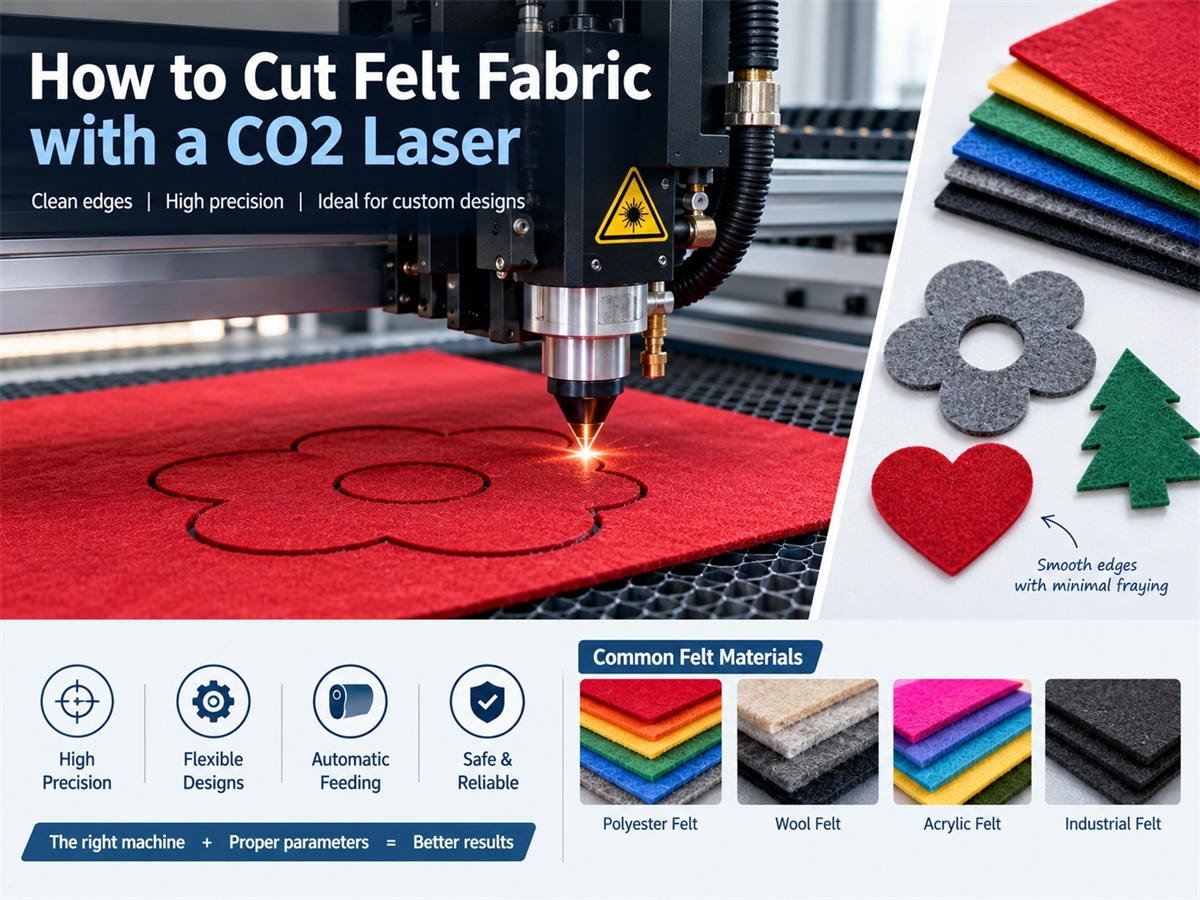
Felt fabric is widely used in crafts, automotive interiors, acoustic panels, protective pads, toys, decorations, and industrial components. However, cutting felt with traditional scissors or knives can be time-consuming when manufacturers need intricate shapes, consistent dimensions, or large production volumes.
A CO2 laser cutting machine offers an alternative by using a focused laser beam to cut felt according to a digital design. It is particularly useful for producing detailed patterns, custom shapes, lettering, and repeated components without requiring a physical cutting die.
However, not all felt materials respond to laser cutting in the same way. Polyester felt, wool felt, acrylic felt, and industrial felt can have different cutting characteristics depending on their composition, density, and thickness.
This guide explains how to cut felt fabric with a CO2 laser, how to choose suitable cutting parameters, and how to improve edge quality and production efficiency.
1. Can You Cut Felt Fabric with a CO2 Laser?
Yes. Many types of felt can be cut with a CO2 laser, especially polyester felt and certain synthetic industrial felts.
A CO2 laser concentrates energy on a narrow cutting path. The heat separates the material along the programmed contour, allowing the machine to produce complex shapes and fine details.
Compared with manual cutting, laser processing offers several practical advantages:
-
High cutting precision: Suitable for detailed patterns, small holes, lettering, and irregular contours.
-
Repeatable results: Digital cutting files help maintain consistent dimensions across multiple pieces.
-
No mechanical blade contact: The material is not compressed by a conventional cutting blade during processing.
-
Flexible production: Designs can be modified without manufacturing a new cutting die.
-
Automation potential: Compatible machine configurations can process repeated patterns and continuously fed materials.
One important consideration is that laser cutting is a thermal process. Depending on the felt composition and cutting settings, the edges may become fused, darkened, hardened, or discolored.
For applications that require a soft edge or a specific surface appearance, testing the actual felt material is essential.
2. Which Types of Felt Are Suitable for CO2 Laser Cutting?
The composition of felt is one of the most important factors when selecting a cutting method.
Polyester felt
Polyester felt is commonly used in crafts, packaging, automotive components, decorative products, and industrial applications.
Many polyester felts can be processed using a CO2 laser. However, because polyester is thermoplastic, excessive heat may melt the fibers and create hard or fused edges.
For manufacturers producing repeated shapes or intricate patterns, laser cutting can be a practical option when the resulting edge quality meets the application requirements.
Wool felt
Wool felt is made primarily from natural wool fibers. Its cutting behavior differs from synthetic felt, and the finished edges may show discoloration or charring if the laser settings are unsuitable.
Wool felt should be tested carefully, particularly when appearance, color consistency, and softness are important.
Acrylic felt
Acrylic felt is used in crafts, decorations, accessories, and some industrial products. It may be laser cut under suitable conditions, but the result depends on the precise fiber composition, dyes, additives, and material construction.
Always verify the manufacturer’s material information before processing.
Industrial felt
Industrial felt can be manufactured from polyester, wool, aramid, and other fibers. It is used for filtration, sealing, insulation, polishing, cushioning, and protective applications.
For thick or dense industrial felt, cutting performance depends on material thickness, density, machine configuration, and the required dimensional tolerance.
Special attention is necessary when processing technical felts containing unknown fibers, coatings, adhesives, or flame-retardant treatments.
Safety note: Do not laser cut PVC-containing materials. Some materials and additives can release hazardous fumes when heated. Confirm the full material composition and consult the laser machine manufacturer’s safety guidance before processing.
3. How to Cut Felt Fabric with a CO2 Laser
The basic workflow involves material preparation, digital design, parameter testing, cutting, and quality inspection.
Step 1: Prepare the felt
Place the felt flat on the cutting bed. Remove wrinkles and ensure that the material does not move during processing.
For thicker felt, check that the material has a consistent thickness across the cutting area. Uneven surfaces can affect focus and cutting consistency.
Step 2: Prepare the cutting design
Create the required shapes in compatible design software and import the file into the laser cutting software.
Common applications include decorative shapes, logos, lettering, acoustic panel patterns, gaskets, protective pads, and textile components.
For batch production, arrange the shapes efficiently on the material to reduce waste. Maintain sufficient spacing between adjacent cuts to avoid unnecessary heat accumulation.
Step 3: Set the laser parameters
Select the appropriate power, speed, focus, and air-assistance settings for the specific felt.
Start with a small test sample instead of immediately cutting a full sheet. The optimal settings for thin polyester felt may not work for dense industrial felt.
Step 4: Run a test cut
Cut a simple shape that includes both straight lines and curves. Inspect the material for incomplete cuts, excessive melting, discoloration, and changes in edge flexibility.
Adjust one parameter at a time so that the effect of each change can be evaluated.
Step 5: Inspect the finished parts
Check the dimensions, edge quality, and surface condition. For industrial applications, also verify that the cutting process has not compromised the material’s functional properties.
Once the settings are validated, save the parameters for repeat production using the same material and machine configuration.
4. Recommended CO2 Laser Settings for Felt
There is no universal laser setting for all felt fabrics. The appropriate parameters depend on the material’s composition, thickness, density, color, and required cutting speed.
| Parameter | Recommended approach |
|---|---|
| Laser type | CO2 laser |
| Laser power | Select according to thickness and cutting requirements |
| Cutting speed | Establish through sample testing |
| Focus | Maintain the focus position specified by the machine manufacturer |
| Air assistance | Adjust to control debris and support stable cutting |
| Cutting bed | Use a suitable, clean bed with adequate support and extraction |
| Exhaust system | Provide appropriate smoke and fume extraction |
How to optimize the settings
If the felt does not cut through: Check focus, material thickness, and laser output before testing a slower speed or a suitable power adjustment.
If the edges are excessively melted: Test reducing heat input, including adjusting power and speed. The correct adjustment depends on whether the material is melting, charring, or simply not separating cleanly.
If the edges are dark or discolored: Test alternative settings on a fresh sample and examine whether the discoloration originates from the fiber, dye, or surface treatment.
If the cutting results vary across the sheet: Check material flatness, thickness variation, focus consistency, and the stability of the cutting system.
The goal is to find a setting that delivers complete separation, acceptable edge quality, and reliable repeatability rather than simply maximizing cutting speed.
5. How to Prevent Burning and Melting When Cutting Felt
Burning and melting are two different problems. Burning or charring is more common with some natural fibers, while thermoplastic synthetic fibers may soften, shrink, or fuse along the cut.
The following methods can help improve the results.
Use the minimum effective laser energy
Excessive heat can damage the surrounding material and produce unwanted edge changes. Test settings that provide complete cutting without unnecessary energy input.
Avoid excessive repeated passes
Repeated passes may increase heat accumulation and cause discoloration or deformation. Optimize the parameters for a reliable cut whenever possible.
Maintain a flat cutting surface
Uneven felt can create inconsistent focus distances and different cutting results across the material. Secure the fabric appropriately without stretching or deforming it.
Optimize the cutting path
Closely spaced contours and small internal details may concentrate heat in a limited area. Efficient nesting and suitable cutting-path sequencing can help reduce localized heat buildup.
Keep the cutting bed and extraction system clean
Accumulated debris can create fire risks and interfere with consistent processing. Follow the equipment manufacturer’s cleaning, maintenance, and fire-prevention procedures.
Test the finished edge against the application
A fused edge may be acceptable for some decorative or industrial components but unsuitable for products that require softness or flexibility. Evaluate the result according to the actual product specification.
6. CO2 Laser Cutting vs. Knife Cutting for Felt
Both laser cutting and mechanical knife cutting can be useful for felt processing. The right choice depends on the material, design complexity, production volume, and edge-quality requirements.
| Comparison | CO2 laser cutting | Mechanical knife cutting |
|---|---|---|
| Cutting method | Thermal processing | Physical blade |
| Complex contours | Well suited to intricate digital designs | Depends on the machine and blade configuration |
| Edge characteristics | May produce fused, hardened, or discolored edges | Generally avoids heat-related edge changes |
| Blade maintenance | No mechanical cutting blade | Blades require inspection and replacement |
| Design changes | Usually handled by updating the digital file | Also flexible with compatible digital cutting systems |
| Thick felt | Depends on thickness and machine capability | May be suitable with an appropriate cutting system |
| Batch production | Can be automated | Can also be automated |
For synthetic felt, a laser may offer an advantage when the application accepts a thermally processed edge and requires intricate shapes.
For wool felt or applications that demand soft, uncharred edges, mechanical cutting may be preferable.
For thick industrial felt, both methods should be evaluated using real samples. Cutting depth, dimensional accuracy, material compression, and edge quality can all affect the final decision.
7. What Can You Make with a Felt Laser Cutting Machine?
A CO2 laser cutting machine can process many felt products when the material is compatible with laser processing.
Felt crafts and decorations
Laser cutting is useful for flowers, ornaments, letters, shapes, appliqués, and decorative accessories. Digital designs make it easier to produce customized patterns and small production batches.
Automotive felt components
Felt components used in automotive interiors may include cushioning pieces, protective layers, and selected acoustic or insulation components.
Material specifications and automotive requirements should be verified before choosing laser cutting for production.
Acoustic panels
Felt acoustic products often use repeated geometric patterns, custom contours, or decorative cutouts. Laser cutting can simplify the production of these shapes, provided the material’s composition and fire-performance requirements are suitable.
Industrial pads and gaskets
Certain industrial felts are used for sealing, cushioning, polishing, and protection. Laser cutting may be appropriate when the dimensions and edge condition satisfy the component’s technical requirements.
Custom textile products
Manufacturers producing bags, accessories, promotional items, and personalized textile products can use digital laser cutting to accommodate frequent design changes without investing in dedicated dies.
8. How to Choose a CO2 Laser Cutting Machine for Felt
Selecting the right equipment requires considering both cutting performance and the complete production workflow.
Laser power and working area
Choose a machine based on the thickest felt you need to process, the size of your parts, and your target output. A larger machine is not automatically more productive if your material or production volume does not require it.
Cutting accuracy
Evaluate dimensional repeatability, contour quality, and the machine’s ability to handle small details. Test the smallest features in your actual cutting files.
Material handling
For small batches, manual loading may be sufficient. For manufacturers processing large quantities or continuous rolls, automatic feeding can reduce material handling and improve workflow efficiency.
Software and nesting
Look for software that supports your design files and enables efficient nesting. Better material utilization can reduce waste, particularly when processing expensive technical felt.
Extraction and fire protection
Choose equipment with appropriate fume extraction, accessible emergency controls, and suitable fire-prevention measures. Never leave a laser cutting process unattended unless the equipment and operating procedures explicitly support that practice.
For manufacturers processing textile materials in batches, Dowin’s automatic fabric laser cutting machine range is a relevant starting point for evaluating automated fabric-cutting solutions. Confirm compatibility with your specific felt material, required cutting thickness, and production workflow before selecting a configuration.
9. Common Problems When Laser Cutting Felt
| Problem | Possible cause | Recommended action |
|---|---|---|
| Incomplete cuts | Incorrect focus, insufficient energy, or excessive speed | Check focus and adjust parameters through testing |
| Melted synthetic fibers | Excessive localized heat | Reduce heat input and evaluate edge flexibility |
| Blackened edges | Charring, material sensitivity, or unsuitable settings | Test fresh samples and inspect the material composition |
| Uneven cutting depth | Inconsistent thickness or focus | Improve material flatness and verify focus |
| Strong smoke or odor | Material composition, additives, or inadequate extraction | Stop processing if material safety is uncertain; verify composition and extraction |
| Dimensional variation | Material movement, shrinkage, or inconsistent feeding | Improve material handling and validate repeatability |
Do not assume that every problem can be solved by changing laser power alone. Material composition, machine condition, focus, ventilation, and cutting-path design can all influence the result.
Frequently Asked Questions
Can a CO2 laser cut polyester felt?
Yes, many polyester felts can be cut using a CO2 laser. Because polyester is thermoplastic, excessive heat may cause melting or fused edges. Test the specific felt thickness and composition before production.
Does laser cutting felt prevent fraying?
Laser cutting can fuse the edges of some synthetic felts, which may reduce loose fibers. However, the result depends on the material and settings. Wool and other natural-fiber felts may behave differently.
What thickness of felt can a CO2 laser cut?
The maximum practical thickness depends on the laser power, machine configuration, felt density, and required edge quality. Test the thickest material you intend to process before purchasing equipment or committing to production.
Is laser cutting better than die cutting for felt?
Laser cutting is flexible for custom shapes and frequently changing designs. Die cutting can be effective for high-volume production with stable designs. The most economical method depends on production quantity, setup costs, material utilization, and required quality.
Can a laser cutting machine cut wool felt?
Some wool felts can be laser processed, but they may be susceptible to charring and discoloration. Test the material carefully, and consider mechanical cutting if a clean, soft edge is essential.
Can a CO2 laser engrave felt as well as cut it?
Depending on the felt composition and machine configuration, a CO2 laser may be used for surface marking or engraving as well as cutting. The appearance and depth of the mark should be evaluated on a sample before processing finished products.
Is laser cutting felt safe?
It requires suitable ventilation, material verification, and fire-prevention measures. Some synthetic fibers, coatings, adhesives, and flame-retardant additives can generate hazardous fumes. Confirm the composition before cutting, never laser cut PVC-containing materials, and follow the equipment manufacturer’s safety instructions.
Conclusion
A CO2 laser cutting machine can be an effective tool for processing many types of felt fabric, particularly when production requires intricate shapes, consistent dimensions, and flexible digital designs.
The most important factors are material composition, thickness, laser parameters, edge-quality requirements, and adequate extraction. Synthetic felt may develop fused edges, while wool and other natural-fiber felts can be more susceptible to charring.
Before selecting a machine, test the actual felt you intend to process and compare the results with mechanical cutting. For manufacturers handling larger production volumes, an appropriately configured automatic fabric laser cutting system may also help streamline material handling and improve production consistency.
Post time: Oct-16-2026
