
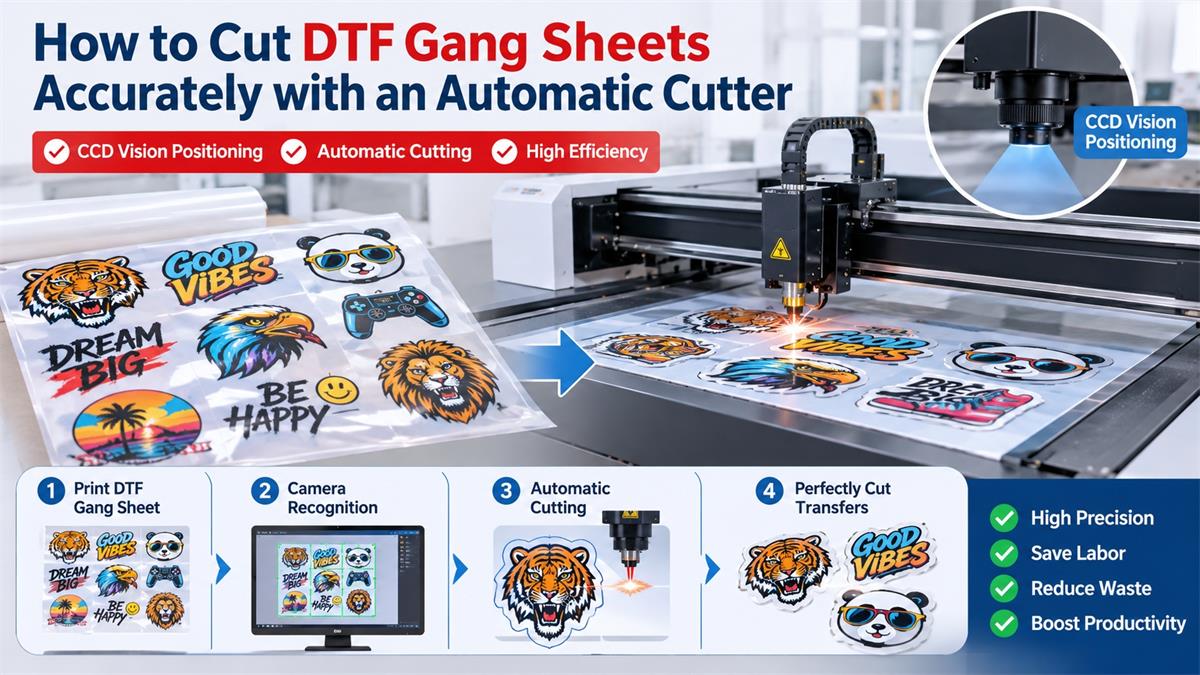
DTF gang sheets allow print shops to arrange multiple logos, graphics, names, and transfer designs on a single sheet of PET film. This approach helps maximize material usage and reduce printing costs. However, once printing is complete, accurately cutting every individual design becomes another production challenge. For businesses handling large gang sheet orders, an automatic DTF film cutting machine can make this process faster and more consistent.
Unlike simple straight-line trimming, gang sheet cutting often involves multiple irregular shapes, different design sizes, and closely arranged graphics. How can print shops maintain accurate cutting positions without spending hours on manual work? Let’s look at the practical considerations.
1. Why Is Cutting DTF Gang Sheets So Challenging?
A DTF gang sheet may contain dozens of individual designs arranged together to maximize the usable printing area. After printing, each design needs to be separated or trimmed according to its intended outline.
Several problems commonly occur during manual cutting:
- Uneven cutting edges: Cutting around irregular logos and graphics by hand requires considerable skill.
- Incorrect positioning: Small deviations can damage printed designs, particularly when graphics are arranged close together.
- Time-consuming operations: Cutting dozens or hundreds of individual designs manually takes considerable time.
- Inconsistent results: Different operators may produce different cutting results.
- Material waste: Cutting mistakes can damage neighboring designs and reduce the usable area of a gang sheet.
These issues become more serious when print shops receive bulk orders or operate multiple DTF printers. The printing process may be fast, but manual cutting can prevent the business from completing orders on time.
2. How Does an Automatic DTF Cutter Recognize Gang Sheet Designs?
Automatic DTF laser cutting machines equipped with CCD cameras use vision positioning technology to identify printed designs and their corresponding cutting paths.
A typical workflow involves the following steps:
- Prepare the cutting file: Create the cutting outlines corresponding to the printed gang sheet designs.
- Load the printed film: Place the printed PET film on the machine’s working area or automatic feeding system.
- Camera recognition: The CCD vision system captures the printed graphics or registration features and identifies their positions.
- Position correction: The cutting software matches the detected positions with the programmed cutting paths.
- Automatic cutting: The laser follows the corrected contours to separate individual designs.
- Collect finished transfers: Remove the cut designs or use the machine’s configured unloading system.
The main advantage of CCD positioning is that the cutting process does not have to rely entirely on manually aligning every design. This is particularly useful when gang sheets contain multiple graphics with different shapes and dimensions.
3. How to Improve DTF Gang Sheet Cutting Accuracy
Even with an automatic cutter, accurate results depend on several factors. Buying a machine with a camera is not enough; the entire printing and cutting workflow must be properly configured.
Use Accurate Cutting Contours
Each printed design should have a corresponding cutting outline. The outline needs to match the intended finished shape while maintaining an appropriate margin around the printed graphic.
For example, a gang sheet containing small logos, large graphics, and lettering requires different contour paths. Incorrectly prepared cutting files can result in the laser cutting through printed artwork or leaving excessive unwanted film around the design.
Maintain Consistent Film Feeding
Film movement is another important factor. If the PET film shifts, wrinkles, or feeds unevenly, the printed designs may no longer match their original cutting coordinates.
An automatic feeding system helps maintain a more consistent material-handling process, especially when processing long rolls or multiple batches of printed film.
Configure CCD Vision Positioning Correctly
Camera recognition is essential when cutting printed gang sheets with multiple designs. The vision system needs to identify the relevant graphics or registration features and match them with the cutting file.
Buyers should confirm which recognition method the machine supports, whether it can handle their actual gang sheet layouts, and how it compensates for film positioning deviations.
Optimize Laser Cutting Parameters
DTF transfer films are relatively thin, so excessive laser energy can cause unwanted melting, discoloration, or damage to the material.
Laser power, cutting speed, focus, and other parameters should be tested according to the actual PET or TPU film. The goal is to achieve a clean separation without damaging the printed design or release film.
Before starting mass production, always test different design sizes and cutting patterns using actual printed samples.
4. Why Choose Laser Cutting Instead of Manual or Blade Cutting?
Traditional scissors and blade cutters can handle basic DTF gang sheet trimming. However, they become less efficient when the production process involves complicated contours and large quantities.
Automatic CO2 laser cutting offers several advantages:
- Non-contact cutting: The laser cuts without applying mechanical pressure to the flexible film.
- Complex contour processing: It can follow irregular outlines, small graphics, and customized shapes.
- Consistent cutting paths: Digital cutting files help maintain repeatable results across batches.
- Reduced manual handling: Automatic feeding and positioning reduce repetitive operator tasks.
- Flexible production: Different gang sheet layouts can be processed by changing the cutting files rather than replacing physical blades.
One important consideration is that laser cutting and blade cutting work differently. Buyers should test the complete DTF transfer structure to confirm whether the required cutting depth and finished edges are suitable for their application.
5. Choosing an Automatic DTF Gang Sheet Cutting Machine
The best machine depends on your gang sheet width, daily production volume, design complexity, and factory workflow. Two important factors are the effective cutting area and the vision positioning configuration.
Dowin 9070 Automatic DTF Film Laser Cutter
The Dowin 9070 DTF film laser cutter is designed for automatic contour cutting of printed DTF transfer film.
Its vision positioning system helps recognize printed designs and match cutting paths. With automatic feeding configurations, it can support more continuous production compared with manual sheet handling.
It is worth considering for DTF print shops that process regular batches of gang sheets and want to reduce manual trimming operations.
Dowin 1215 Large-Format DTF Film Cutting Machine
For businesses handling larger gang sheets or requiring a larger processing area, the Dowin 1215 DTF and TPU film cutting machine provides a 1200 × 1500 mm working area.
Its main configuration includes:
- 1200 × 1500 mm working area.
- Dual 160W CO2 laser heads.
- Industrial CCD camera positioning.
- Automatic feeding system.
- Servo motor and rack-and-pinion transmission.
- Applications for DTF film, TPU film, UV stickers, and other flexible materials.
The 1215 is suitable for larger-format production environments processing 60 cm, 90 cm, and 120 cm film widths, subject to the actual feeding and material configuration.
For print shops running multiple printers or processing large batches of gang sheets, its larger working area offers more flexibility for production layouts.
6. Common Mistakes to Avoid When Cutting DTF Gang Sheets
Even with automatic equipment, some production mistakes can affect the finished results.
- Using incorrect cutting files: Always make sure the contour file matches the printed artwork.
- Ignoring film movement: Unstable feeding can cause misalignment between printed designs and cutting paths.
- Setting excessive laser power: Excessive heat can damage thin transfer films.
- Ignoring small design details: Small lettering and narrow gaps require careful parameter testing.
- Skipping sample tests: Test different film types, artwork sizes, and cutting patterns before full production.
A well-organized workflow combines accurate artwork preparation, stable film feeding, reliable camera recognition, and optimized laser parameters.
Conclusion: Make DTF Gang Sheet Cutting More Efficient
Cutting DTF gang sheets accurately is an important part of commercial transfer production. As order quantities increase, manual cutting becomes increasingly difficult to manage, especially when dealing with irregular graphics and tightly arranged designs.
An automatic DTF laser cutter equipped with CCD vision positioning and automatic feeding can help print shops improve cutting consistency, reduce repetitive labor, and increase production capacity.
Whether you are processing standard gang sheets with a 9070 or looking for a larger-format solution with the 1215, the right machine should match your actual film width, cutting files, and daily production requirements.
Looking for an automatic DTF gang sheet cutting solution? Contact Dowin and provide your gang sheet samples, film width, and daily production target. We can help evaluate the appropriate laser cutting configuration for your business.
Frequently Asked Questions
1. Can an automatic laser cutter cut individual designs on a DTF gang sheet?
Yes. With suitable CCD vision positioning and corresponding contour cutting files, an automatic laser cutter can recognize and cut individual designs arranged on a printed gang sheet.
2. Does a DTF gang sheet cutter need a CCD camera?
CCD positioning is highly useful for cutting printed designs because it helps identify their actual positions and align the cutting paths. It is particularly valuable when processing multiple designs on one sheet.
3. Can a CO2 laser cutter cut DTF PET film?
Yes. CO2 laser systems can process suitable DTF PET films. However, laser parameters must be tested to avoid excessive heat and unwanted damage to the transfer material.
4. What is the difference between gang sheet trimming and contour cutting?
Gang sheet trimming separates a large printed sheet into smaller sections, while contour cutting follows the individual outlines of printed designs. Some production workflows require both operations.
5. Which Dowin machine is suitable for DTF gang sheet cutting?
The 9070 is worth considering for automatic DTF film contour cutting, while the 1215 offers a larger 1200 × 1500 mm working area for larger-format production. The final choice depends on film width, cutting layout, and production volume.
6. Can an automatic DTF cutter process different gang sheet designs?
Yes. Different cutting files can be used for different gang sheet layouts. The vision positioning system helps match the cutting paths with the printed designs, provided the artwork and recognition method are properly configured.
“`
Post time: Nov-12-2026
