
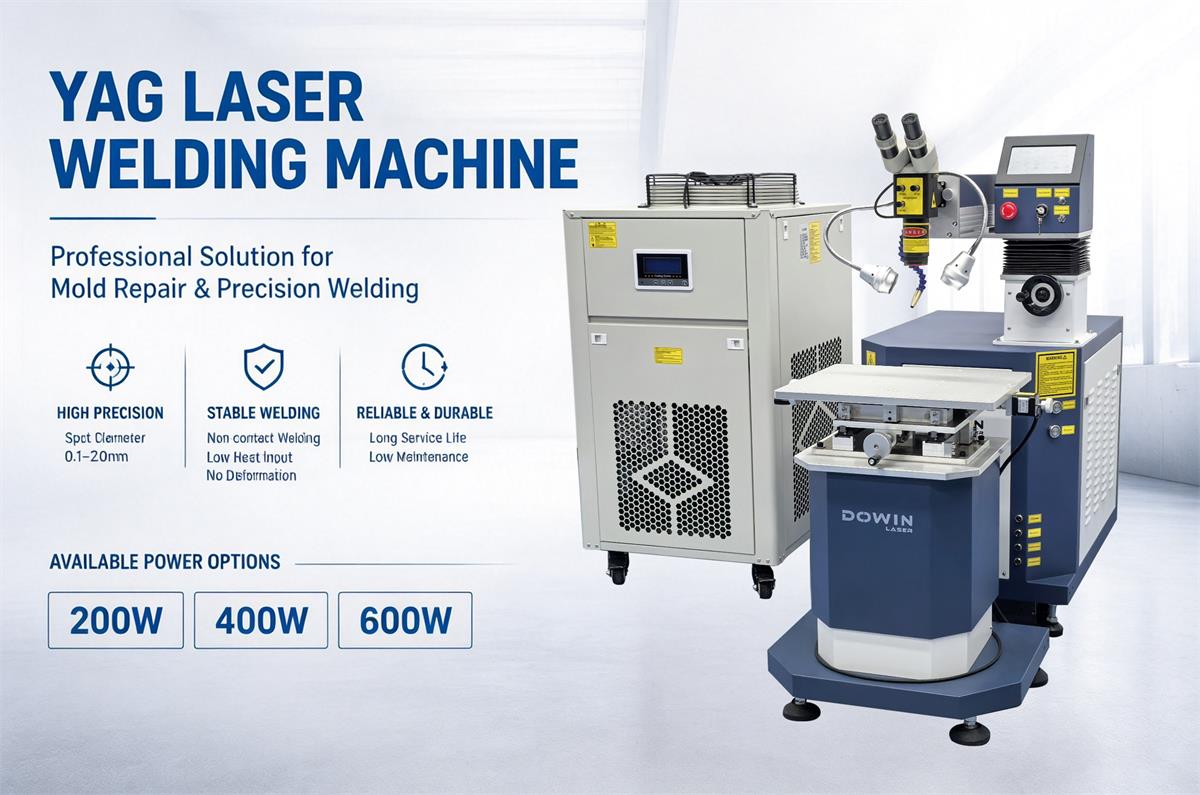
Choosing the right laser power for mold repair welding is essential for achieving good penetration, minimizing heat distortion, and maintaining the dimensional accuracy of the mold.
A common mistake is to assume that a higher-power laser is always better. In reality, mold repair is a precision welding application. The ideal laser power depends on the mold material, defect size, repair depth, filler wire, spot size, and required welding speed.
Does Higher Laser Power Mean Better Mold Repair?
Not necessarily.
A high-power laser can provide greater welding capacity, but excessive energy can introduce unnecessary heat into the mold. This may result in:
-
Mold distortion
-
Excessive penetration
-
Larger heat-affected areas
-
Changes in material properties
-
Damage to fine mold features
-
Difficult post-welding finishing
For precision mold repair, the objective is to use enough energy to achieve stable fusion without overheating the surrounding material.
What Determines the Required Laser Power?
Several factors should be considered when selecting a mold repair laser welding machine.
1. Mold Material
Different steels require different welding conditions.
Common mold materials include:
-
H13 tool steel
-
P20 mold steel
-
S136 stainless mold steel
-
718 mold steel
-
SKD11 tool steel
-
Other hardened tool steels
Hardness and heat-treatment condition can also influence the appropriate welding parameters.
For example, repairing hardened H13 requires different process control from repairing a softer, annealed steel.
2. Repair Depth
The depth of the defect is one of the most important factors.
A shallow scratch may require only a small amount of deposited material, while a deep crack or missing corner requires multiple layers of filler material.
For deeper repairs, the machine needs sufficient energy to achieve reliable fusion between each deposited layer and the substrate.
However, this does not mean simply increasing the power to maximum. Layer thickness and welding parameters should be controlled together.
3. Repair Area
A tiny cavity defect and a large worn surface have very different energy requirements.
For fine repairs, a lower-energy, highly controlled laser can be advantageous.
For larger buildup areas, higher average power can improve productivity.
This creates an important distinction:
Small precision repair → prioritize energy control and spot size
Large buildup repair → prioritize power and deposition productivity
4. Filler Wire Diameter
Filler-wire diameter also affects the required laser energy.
Thin wire requires less energy to melt, while larger wire requires more energy.
If the laser energy is too low, the filler may not melt consistently.
If the energy is excessive, the substrate may receive unnecessary heat.
Therefore, laser power should always be considered together with wire diameter and feeding speed.
Pulsed Laser Power vs Continuous Laser Power
When comparing mold welding machines, it is important to understand that laser power ratings are not directly comparable across different laser technologies.
A pulsed Nd:YAG mold welding machine may be specified using average power, pulse energy, pulse duration, and frequency.
For example, a machine may be described as a 200W or 300W pulsed laser, but the actual welding behavior depends on parameters such as:
-
Pulse energy
-
Pulse duration
-
Pulse frequency
-
Spot diameter
-
Peak power
A fiber laser may instead be primarily specified by continuous output power.
Therefore, comparing a 300W pulsed YAG machine directly with a 300W continuous-wave fiber laser based only on the wattage can be misleading.
Typical Power Ranges for Mold Repair
There is no universal power range that works for every mold repair application. However, precision mold welding machines are commonly available in configurations around 100W, 200W, 300W, 400W, and higher, depending on the technology and application.
A rough application-oriented guide is:
| Application | Typical Focus |
|---|---|
| Fine scratches and tiny defects | Low energy, small spot |
| Small cracks and edge repair | Controlled pulse energy |
| Medium material buildup | Moderate power and wire feeding |
| Larger worn areas | Higher average power |
| High-volume repair | Higher productivity and automation |
These should be treated as machine-selection guidelines rather than fixed welding parameters. Actual settings need to be established through material and application testing.
What About 200W, 300W, and 400W?
For many mold repair workshops, these are common configurations to compare.
200W Laser Welding Machine
A 200W pulsed system can be suitable for precision repair involving relatively small defects, fine edges, and localized mold damage.
Its advantage is controllable heat input rather than maximum deposition speed.
300W Laser Welding Machine
A 300W system provides a useful balance between precision and productivity.
It can be considered when a workshop repairs a wider range of mold defects and needs more welding capacity without moving immediately to a much larger system.
400W and Higher
Higher-power configurations can be useful for larger repair areas, deeper buildup, or higher productivity.
However, higher power does not eliminate the need for precise parameter control.
For very small defects, excessive energy can actually make the repair more difficult.
Don’t Ignore Spot Size
Laser power and spot size work together.
A concentrated beam can deliver high energy density to a small area, while a larger spot distributes the energy over a wider surface.
For precision mold repair, adjustable spot size is valuable because the operator may need to switch between:
-
Fine crack repair
-
Edge rebuilding
-
Surface buildup
-
Larger worn areas
A machine with flexible spot-size control can therefore be more practical than simply choosing the highest available power.
How Does Welding Speed Affect Power Selection?
If you increase welding speed while keeping all other parameters unchanged, the energy delivered to each unit of material can decrease.
Conversely, slower movement generally increases heat input.
This means that laser power should not be considered independently from welding speed.
A simplified way to think about the process is:
Higher power + slower speed = greater heat input
Lower power + faster speed = lower heat input
The actual relationship is more complex because pulse energy, frequency, spot overlap, material absorption, and filler deposition also matter.
How to Choose Laser Power for H13 Mold Repair
H13 is frequently used for demanding molds and dies.
When repairing H13, consider:
-
Existing hardness
-
Heat-treatment condition
-
Defect depth
-
Defect location
-
Filler material
-
Required final hardness
-
Post-welding machining requirements
For a small chipped edge, a precision pulsed laser may be preferable to using excessive power.
For deeper material buildup, a higher-capacity system may provide better productivity.
The correct approach is to develop parameters specifically for the H13 grade and condition rather than selecting power based only on the steel name.
The Best Way to Select Laser Power
The most reliable method is to perform a sample welding test.
Provide the laser welding machine supplier with:
-
Mold material
-
Material hardness
-
Mold thickness
-
Defect type
-
Defect dimensions
-
Repair depth
-
Filler-wire specification
-
Required surface finish
The test should evaluate more than whether the laser can melt the filler.
Check:
-
Penetration
-
Fusion quality
-
Cracking
-
Porosity
-
Heat-affected area
-
Hardness
-
Dimensional stability
-
Machinability
-
Polishing quality
A successful mold repair is one that can return to production—not simply one that looks good immediately after welding.
Should You Choose the Highest-Power Machine?
Usually, no.
If your primary work involves precision injection mold repair, a machine with excellent control over pulse energy, spot size, frequency, and welding position may be more valuable than a machine with maximum power.
Higher power becomes more important when:
-
Repair areas are larger
-
Deposited material volume is high
-
Thick filler wire is required
-
Welding speed is a priority
-
Repair volume is high
For small precision defects, control is often more important than raw power.
Frequently Asked Questions
What laser power is best for mold repair?
There is no single best power. The correct choice depends on the mold steel, defect size, repair depth, filler wire, and required productivity.
Is 200W enough for mold repair?
A 200W pulsed laser can be suitable for many precision mold repair applications, particularly localized defects and fine repairs. The actual suitability should be verified with a sample test.
Is 300W better than 200W for mold welding?
A 300W machine can provide greater welding capacity and productivity, but it is not automatically better for every precision repair. The appropriate choice depends on your typical repair workload.
Can too much laser power damage a mold?
Yes. Excessive heat input can increase the risk of distortion, excessive penetration, microstructural changes, and damage to delicate mold features.
Should I choose YAG or fiber laser for mold repair?
For small and highly precise mold repairs, pulsed Nd:YAG is a strong option because of its controllable pulse energy. Fiber lasers can be advantageous for higher-speed or larger-area applications.
Final Takeaway
The right laser power for mold repair welding is determined by the entire welding process, not by wattage alone.
For precision mold repair, pay attention to pulse energy, pulse duration, spot size, frequency, welding speed, filler wire, and mold material. A 200W, 300W, or 400W machine can each be the right choice for different applications.
The best purchasing strategy is to test your actual mold material and repair defects before buying. This allows you to determine whether the machine provides the required penetration and deposition rate while maintaining low heat input and good post-welding finishing quality.
Post time: Sep-07-2026
