
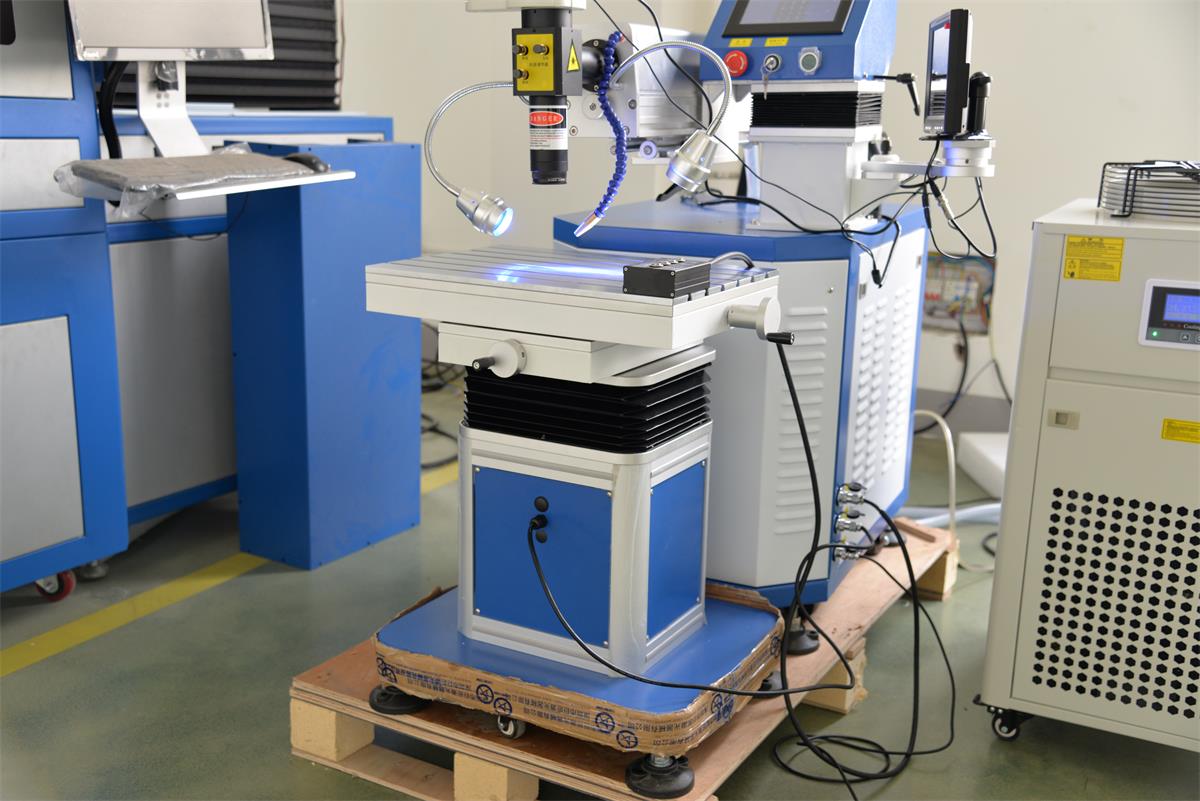
Mold repair requires more than simply adding metal to a damaged area. Cracks, worn edges, scratches, pits, and broken corners often occur in areas where dimensional accuracy is critical. A suitable laser welding machine for mold repair can add filler material precisely while keeping heat input and distortion under control.
However, not every laser welder is suitable for mold repair. Laser power, pulse energy, spot size, laser source, motion system, and filler-wire compatibility all affect the final repair quality.
This guide explains the key factors to consider before buying a mold repair laser welding machine.
What Types of Mold Damage Can Laser Welding Repair?
Laser welding is commonly used for localized mold damage, including:
-
Cracks and small fractures
-
Worn edges and corners
-
Scratches and dents
-
Casting defects and pits
-
Dimensional wear
-
Broken fine features
-
EDM or machining errors
-
Local material removal during mold modification
The main advantage is that the operator can deposit a controlled amount of material only where it is needed. The repaired area can then be machined, polished, or EDM-finished to restore the original geometry.
1. Choose the Right Laser Source
For mold repair, pulsed Nd:YAG laser welding machines have traditionally been widely used because they provide precise pulse control and relatively low heat input.
A pulsed laser is particularly useful when repairing:
-
Precision injection molds
-
Small cavities
-
Thin edges
-
Fine textures
-
Sharp corners
-
Hardened tool steels
-
Small cracks
Fiber laser welding machines can also be suitable for certain mold applications, especially when higher welding speed or continuous welding is required.
For highly precise mold repair, however, the ability to control pulse energy, pulse duration, frequency, and spot size is often more important than simply choosing the highest laser power.
2. Consider Laser Power and Pulse Energy
One common mistake when selecting a mold welding machine is focusing only on the wattage.
For example, a machine advertised as 200W, 300W, or 400W does not automatically tell you whether it is suitable for your particular mold repair application.
For pulsed laser welding, you should also consider:
-
Maximum pulse energy
-
Pulse duration
-
Pulse frequency
-
Laser spot diameter
-
Peak power
-
Stability of the laser output
A small precision repair may require much less energy than repairing a large worn area.
More power is not always better. Excessive heat can increase the risk of discoloration, distortion, excessive penetration, or damage to delicate mold features.
3. Check the Spot Size and Welding Precision
Mold repair often involves very small areas. A laser welding machine should therefore provide a sufficiently small and controllable welding spot.
A smaller spot allows the operator to:
-
Target damaged areas accurately
-
Reduce unnecessary heat
-
Repair narrow edges
-
Build up small corners
-
Control the amount of deposited material
This is particularly important for molds containing fine cavities, ribs, textures, or sharp parting-line features.
When comparing machines, ask the manufacturer for actual spot-size specifications and, more importantly, request a welding test using your own mold material.
4. Look at the X/Y/Z Motion System
The motion system determines how accurately the laser can be positioned over the repair area.
A 3-axis laser mold welding machine provides controlled movement along X, Y, and Z axes and is suitable for many conventional mold repair applications.
For more complex repair work, additional positioning or rotary capabilities may be useful.
When evaluating the motion system, check:
-
Travel range
-
Positioning accuracy
-
Table load capacity
-
Movement smoothness
-
Control method
-
Ease of positioning under the microscope
A stable mechanical system is essential when repairing small defects because even a small movement can affect the weld location.
5. Make Sure the Machine Supports Filler Wire
Mold repair is often performed by adding compatible filler material layer by layer.
The machine should allow accurate feeding or manual positioning of suitable welding wire according to the application.
Common considerations include:
-
Wire diameter
-
Wire feeding stability
-
Filler material compatibility
-
Feeding angle
-
Feeding speed
-
Operator control
The filler material should be selected according to the mold steel and the required hardness, machinability, polishing performance, and wear resistance.
6. Choose a Machine With Good Microscope Visibility
Precision mold welding is difficult to perform accurately without clear magnification.
A suitable mold repair laser welder normally provides a microscope or optical viewing system that allows the operator to see the damaged area clearly during welding.
Good optical visibility helps the operator control:
-
Laser position
-
Weld pool
-
Filler wire
-
Repair boundaries
-
Layer thickness
-
Heat-affected areas
For fine mold repair, the optical system can be just as important as the laser itself.
7. Match the Machine to Your Mold Materials
Before purchasing a machine, identify the materials you regularly repair.
Common mold materials include various tool steels, stainless steels, and hardened steels. Different materials have different thermal characteristics and welding behavior.
Ask the supplier to test your actual material rather than relying only on generic demonstration samples.
A useful test should evaluate:
-
Weld penetration
-
Crack formation
-
Heat-affected area
-
Surface hardness
-
Machinability
-
Polishing quality
-
Dimensional stability
This gives you a much more realistic indication of whether the machine is suitable for your workshop.
8. Consider YAG vs Fiber Laser for Mold Repair
Both technologies can be useful, but their strengths are different.
| Feature | Pulsed YAG | Fiber Laser |
|---|---|---|
| Fine mold repair | Excellent | Good to excellent |
| Heat control | Excellent | Good |
| Small-area repair | Excellent | Good |
| Precision welding | Excellent | Excellent |
| High-speed welding | Moderate | Excellent |
| Delicate mold features | Very suitable | Application dependent |
| Typical use | Precision repair | Repair and production welding |
For small, highly controlled mold repairs, a pulsed YAG laser welding machine is often a strong choice. For applications that require higher welding speed or broader production capabilities, fiber laser technology may be worth considering.
The correct choice ultimately depends on the actual mold materials, defect size, and repair process.
9. Don’t Buy Based Only on Laser Power
A machine with a higher nominal power may appear more attractive, but mold repair is primarily a precision application.
Instead of asking only:
How many watts is the machine?
Ask:
-
What is the minimum controllable pulse energy?
-
What spot sizes are available?
-
How stable is the laser output?
-
Can it weld my mold steel?
-
What filler-wire sizes can it use?
-
How accurately can the worktable move?
-
Is the microscope suitable for fine repair?
-
Can the supplier provide a sample test?
These questions are much more useful when comparing laser welding machines for mold repair.
10. Test Your Mold Before Buying
The most reliable way to choose a mold laser welding machine is to perform a sample test.
Send the supplier:
-
Mold material
-
Hardness information
-
Damaged mold sample or photos
-
Defect dimensions
-
Required repair depth
-
Filler-wire specification
-
Required surface finish
The supplier can then determine appropriate laser parameters and demonstrate the repair result.
A successful test should not only show that the laser can melt the material. It should demonstrate whether the repaired area can subsequently be machined, polished, EDM-finished, and returned to production.
Frequently Asked Questions
What laser is best for mold repair?
For precision mold repair, pulsed Nd:YAG laser welding is a proven option because it provides precise control of pulse energy and heat input. Fiber laser systems can also be suitable depending on the application.
What power laser is needed for mold repair?
There is no single power rating for every mold. Precision repairs may use relatively low pulse energy, while larger repairs require more energy and higher productivity. The mold material and defect size should determine the machine configuration.
Can laser welding repair hardened molds?
Yes. Laser welding can be used to repair many hardened tool steels, but the welding parameters and filler material must be matched to the specific steel and hardness condition.
Will laser welding distort a mold?
Laser welding produces a relatively small heat-affected area compared with many conventional welding processes. However, distortion is still possible if excessive energy or unsuitable parameters are used.
Is laser welding better than TIG for mold repair?
For small, precise mold defects, laser welding generally provides better control over heat input and weld location. TIG can remain useful for larger or less precision-critical repairs.
Final Takeaway
Choosing a laser welding machine for mold repair should be based on precision, heat control, laser parameters, motion accuracy, optical visibility, and compatibility with your mold materials—not simply the advertised wattage.
For precision mold repair involving cracks, worn edges, fine cavities, and small dimensional defects, a pulsed laser mold welding machine with accurate pulse control, microscope viewing, stable X/Y/Z positioning, and suitable filler-wire support is a practical configuration.
The safest buying strategy is simple: test your actual mold before purchasing the machine. A successful sample repair can tell you far more than a specification sheet.
Post time: Sep-02-2026
