
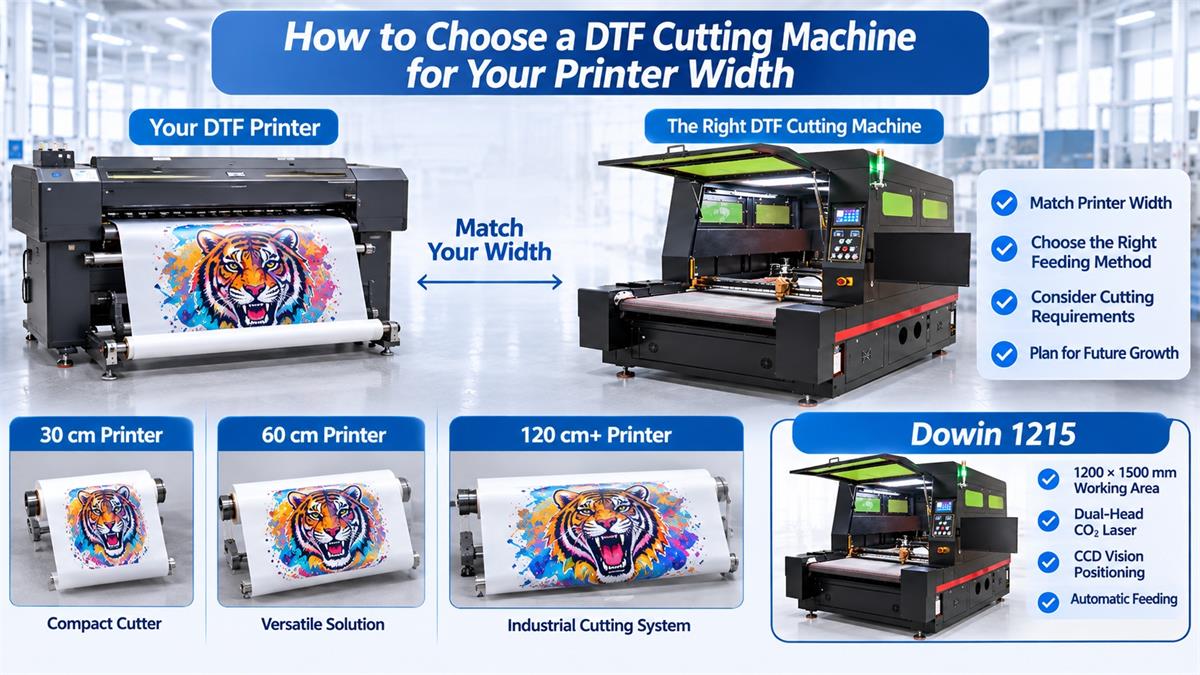
Choosing a DTF cutting machine is not just about selecting the largest working area. The cutting machine must match your printer’s film width, feeding method, production volume, and cutting requirements. For example, the Dowin 1215 Automatic DTF and TPU Film Laser Cutting Machine provides a 1200 × 1500 mm working area, automatic feeding, and dual-head CO2 laser cutting. Understanding how printer width relates to cutting machine capacity will help you avoid unnecessary equipment costs and production bottlenecks.
1. Why Does Printer Width Matter When Choosing a DTF Cutter?
DTF printing machines are available in different widths, commonly including 30 cm, 60 cm, and wider industrial configurations. The width of the printed film directly affects how the cutting machine needs to handle the material.
If your cutting machine cannot accommodate the film width produced by your printer, you may need to split the material, change the production layout, or perform additional manual operations.
There are several important factors to consider:
- Maximum film width: The cutting machine must accommodate the actual width of your printed film.
- Usable cutting width: The effective cutting area may be smaller than the machine’s advertised working width.
- Feeding structure: Roll-fed and sheet-fed machines have different material handling requirements.
- Cutting layout: Multiple designs arranged across the film require sufficient working width.
- Future production: Your cutting equipment should ideally support potential upgrades to wider printers.
A common purchasing mistake is comparing only the nominal printer width and the cutting machine’s advertised dimensions. You should also check the maximum material width, usable cutting area, and feeding clearance.
2. Common DTF Printer Widths and Their Cutting Requirements
Different printer widths create different requirements for downstream cutting equipment. The following examples provide a practical starting point for equipment selection.
30 cm DTF Printer
A 30 cm DTF printer is commonly used by small printing businesses, customized apparel shops, and startups.
Its relatively narrow film width makes material handling easier, and a compact cutting machine may be sufficient for many applications.
Recommended cutting machine considerations:
- Working width suitable for 30 cm film.
- Compact material feeding structure.
- Support for customized graphic cutting.
- Reasonable investment for smaller production volumes.
If your business mainly produces small batches of customized transfers, there is usually no need to purchase an oversized industrial cutting system immediately.
60 cm DTF Printer
The 60 cm DTF printer is widely used in commercial printing businesses because it provides a balance between production capacity and equipment cost.
As order quantities increase, manually separating printed film becomes increasingly time-consuming. A compatible automatic cutting machine can help reduce handling work and improve the finishing workflow.
Recommended cutting machine considerations:
- Working width that accommodates the actual film width and feeding requirements.
- Automatic feeding for roll-based production.
- CCD vision positioning for printed graphic recognition.
- Support for different cutting layouts.
For a 60 cm printer, a cutting machine with additional width capacity may provide more flexibility when processing multiple designs or handling future production changes.
120 cm or Wider Industrial DTF Printer
Wide-format DTF printing systems are designed for larger production requirements. They can process wider film rolls and may support higher-volume manufacturing workflows.
These printers require cutting equipment with sufficient material width, stable feeding, and an appropriate working area.
Recommended cutting machine considerations:
- Industrial working width compatible with the printer output.
- Stable automatic feeding and material alignment.
- Suitable cutting head configuration.
- CCD positioning for customized printed patterns.
- Continuous production capability.
For this type of production, selecting a cutter that is too narrow can create unnecessary material handling steps and reduce the efficiency of the entire finishing department.
3. How to Calculate the Required Cutting Width
Before purchasing a DTF cutting machine, determine the actual width of the material that needs to be processed.
A practical selection method is:
Required cutting width = Actual film width + Necessary positioning and feeding allowance
For example, suppose your DTF printer produces film with an actual width of 600 mm. You should not automatically choose a cutting machine with a nominal 600 mm working width.
You need to confirm whether the full 600 mm can be positioned and processed within its effective cutting area. If the machine requires additional margins for feeding, alignment, or mechanical clearance, the usable width may be insufficient.
Consider the following example:
| Printer Film Width | Cutting Machine Requirement | Selection Advice |
|---|---|---|
| 300 mm | At least 300 mm usable capacity | Compact cutter may be sufficient |
| 600 mm | At least 600 mm usable capacity | Check feeding and alignment margins |
| 1200 mm | At least 1200 mm usable capacity | Consider industrial wide-format equipment |
These are simplified examples, not universal machine specifications. Always confirm the manufacturer’s effective cutting width and maximum supported material width before placing an order.
4. Should You Choose a Flatbed or Roll-to-Roll DTF Cutter?
Printer width is only one part of the selection process. The material feeding method is equally important.
Flatbed DTF Cutting Machine
A flatbed cutter processes material on a flat working surface. The film is positioned on the cutting area, and the cutting head follows the programmed paths.
Its advantages include:
- Stable positioning for sheet-based materials.
- Flexible processing of different graphic layouts.
- Suitable for customized orders and irregular shapes.
- Compatibility with vision positioning on suitable models.
Flatbed systems are suitable for businesses that frequently change artwork layouts or process individual sheets.
Roll-to-Roll DTF Cutting Machine
A roll-to-roll cutter feeds continuous film from a roll through the machine. This structure is useful when the DTF printer produces long rolls and the factory needs to automate material handling.
Its advantages include:
- Automatic roll feeding.
- Reduced manual sheet loading.
- Better integration with continuous printing workflows.
- Suitable for larger production batches.
Some industrial laser cutting machines combine a flat cutting area with automatic feeding. This provides a flexible solution for processing roll-fed film while maintaining a flat working surface during cutting.
5. Why CCD Vision Positioning Is Important for Wide DTF Film
When processing wider DTF film, the number of graphics and their positions across the material can become more complicated.
Small positioning deviations may affect the relationship between the printed artwork and the cutting path. This is especially important when processing customized graphics with irregular contours.
A CCD vision positioning system helps address this issue through several steps:
- The camera captures images of the printed film.
- The vision software identifies registration marks or printed graphic features.
- The system calculates the actual positions of the detected patterns.
- The control system adjusts the cutting paths according to the supported recognition method.
- The laser head follows the adjusted cutting paths.
This process helps reduce manual alignment and improves the consistency of printed contour cutting.
For manufacturers processing different designs across wide film rolls, vision positioning can be a valuable feature. However, actual recognition accuracy depends on camera calibration, software capabilities, print quality, and material stability.
6. Matching Cutting Capacity to Your Future Production
Buying a cutting machine based only on your current printer width can create problems when production expands.
For example, a business starting with one 60 cm DTF printer may later add another printer or upgrade to a wider industrial model.
If the original cutting machine cannot accommodate the increased film width, the factory may need to purchase another cutter or reorganize its production process.
Before investing, consider the following questions:
- Will you continue using the same printer width over the next few years?
- Are you planning to add wider DTF printers?
- Will you process different film widths on the same cutting machine?
- Do you need to cut customized graphics or only separate printed sheets?
- Will your daily production volume increase?
A machine with some additional capacity can provide useful flexibility, but purchasing an unnecessarily large system also increases investment costs and floor-space requirements. The goal is to match the equipment to a realistic production plan.
7. Dowin 1215 Industrial DTF Film Laser Cutting Machine
For DTF manufacturers looking for a wider industrial cutting platform, Dowin offers the 1215 automatic DTF and TPU film laser cutting machine.
The machine features a 1200 × 1500 mm working area, a dual-head 160W CO2 laser configuration, CCD vision positioning, and an automatic feeding system.
Its main configuration highlights include:
- Working area: 1200 × 1500 mm.
- Laser system: Dual-head 160W CO2 laser configuration.
- Positioning: CCD vision recognition.
- Feeding: Automatic material feeding.
- Drive system: Servo motor configuration.
- Applications: DTF film, suitable TPU film, UV stickers, and other compatible flexible materials.
The 1200 mm working dimension provides a wider cutting platform than many compact DTF finishing machines. However, buyers should distinguish between working area dimensions and maximum roll width. The actual supported material width must be confirmed according to the feeding configuration.
For businesses upgrading from smaller DTF printers to wider production equipment, this type of industrial platform is worth evaluating.
Learn more about the Dowin 1215 Industrial DTF and TPU Film Laser Cutting Machine.
8. Common Mistakes When Choosing a DTF Cutting Machine
Mistake 1: Choosing a Machine with the Same Nominal Width as the Printer
A machine’s advertised working width does not always equal its maximum supported film width. Check the effective cutting area and material feeding clearance.
Mistake 2: Ignoring the Feeding Method
A machine may have sufficient cutting width but still require manual loading of individual sheets. If your printer produces continuous rolls, automatic feeding may be more important than a slightly larger working area.
Mistake 3: Focusing Only on Maximum Cutting Speed
Actual production efficiency depends on artwork complexity, cutting paths, camera recognition, material movement, and loading time. Request a sample test using your actual production files.
Mistake 4: Ignoring Future Equipment Upgrades
If you expect to move from 60 cm printing to wider industrial production, consider whether your cutting equipment can accommodate that change.
Mistake 5: Not Testing Your Actual DTF Film
Different PET films and coatings may respond differently to laser processing. Always test cutting quality, edge condition, material deformation, and residue before purchasing.
Frequently Asked Questions
1. Should my DTF cutting machine be wider than my printer?
Not necessarily, but its effective cutting width must accommodate the actual printed film. Additional capacity can provide flexibility for material positioning and future production changes.
2. Can a 60 cm DTF printer work with a 120 cm cutting machine?
Yes. A wider cutting machine can process narrower film as long as its feeding system and positioning setup support that material width. The larger working area may also provide room for different layouts.
3. Is a 1200 mm working area suitable for a 1200 mm DTF printer?
Not automatically. You must confirm whether the machine’s effective cutting width and maximum roll width accommodate the printer’s actual output. Feeding clearance and material alignment requirements also matter.
4. What is the difference between working width and maximum material width?
Working width refers to the effective area available for processing material. Maximum material width refers to the largest film width the feeding system can physically accommodate. These dimensions may differ.
5. Does a wider DTF cutting machine always produce more output?
No. A wider cutting area allows larger material layouts, but actual output depends on cutting speed, graphic arrangement, feeding cycles, recognition time, and the number of cutting heads.
6. Can one DTF cutter work with different printer brands?
In many cases, yes. Compatibility depends more on film width, feeding requirements, file formats, and cutting software than on the printer brand itself. Confirm these details with the equipment manufacturer.
Conclusion
Choosing the right DTF cutting machine for your printer width requires more than matching two numbers on product specifications. You need to consider actual film width, effective cutting area, feeding structure, vision positioning, and production volume.
For small DTF printing businesses, a compact cutter may be sufficient. For commercial printing factories handling wider film rolls and increasing order quantities, an industrial automatic laser cutting system can provide greater production flexibility.
Before making a purchase, provide your supplier with your printer model, actual film width, daily production volume, and cutting requirements. This makes it easier to select a machine that fits your current workflow and future production plans.
Post time: Nov-10-2026
