
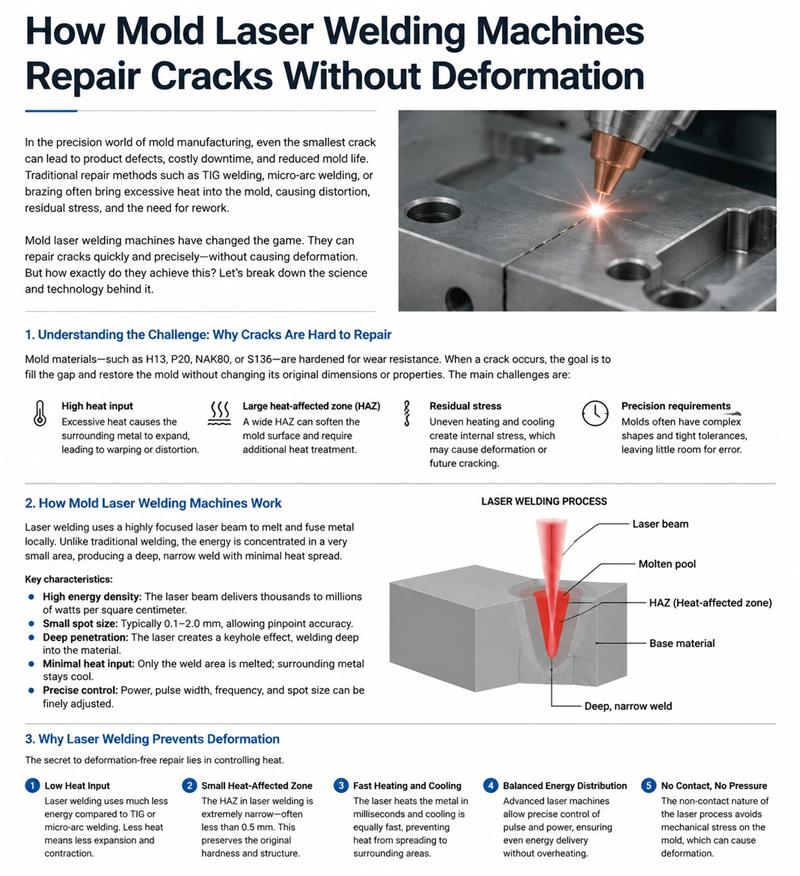
Mold cracks are a common challenge in precision manufacturing. From injection molding to die-casting, even minor surface cracks can lead to product defects, operational delays, and increased maintenance costs. Traditional repair methods, such as TIG welding or brazing, often introduce excessive heat, causing deformation, residual stress, and extended downtime. Mold laser welding machines offer a solution, providing precise repairs that restore mold integrity without compromising its geometry.
This article explores how mold laser welding machines repair cracks without causing deformation, why this technology is superior to conventional methods, and the technical principles that ensure repair precision.
Understanding the Challenge: Why Cracks Are Difficult to Repair
Mold materials, including tool steels like H13, P20, NAK80, or S136, are engineered for hardness and wear resistance. When a crack develops, repairing it requires balancing three critical factors:
- Controlled heat input – Excessive heat can cause surrounding metal to expand and warp.
- Minimizing heat-affected zone (HAZ) – Large HAZs can soften adjacent areas and lead to structural instability.
- Maintaining precise tolerances – Many molds have complex shapes with tight dimensions; even slight deformation can impact part quality.
Traditional welding often fails to meet these requirements. Broad heat distribution, high filler material usage, and slow cooling introduce distortions and stress concentrations. Post-weld machining or polishing can further alter dimensions, sometimes making the mold unusable.
Mold laser welding machines overcome these challenges by controlling heat and material deposition with unmatched precision.
Focused Energy for Precision Repairs
The primary reason laser welding prevents deformation is focused energy delivery. Unlike arc welding, which distributes heat over a broad area, laser welding concentrates thousands to millions of watts per square centimeter onto a small spot. This narrow beam:
- Penetrates deeply into the crack without overheating surrounding regions.
- Creates a deep, narrow weld that fully fuses the material while maintaining the mold’s original shape.
- Limits the heat-affected zone, often less than 0.5 mm, preserving hardness and dimensional stability.
By controlling the energy concentration, laser welding allows operators to repair only the damaged area, preventing thermal expansion or contraction from spreading beyond the crack.
Layered Filler Deposition
Mold laser welding machines use precise, layered filler deposition. Instead of flooding the crack with excess material, the machine builds up the repair gradually:
- Small amounts of compatible filler metal are applied layer by layer.
- Each layer is melted and fused using the laser beam, forming a homogeneous structure.
- The process continues until the crack is completely filled, maintaining alignment with the original mold geometry.
This controlled approach avoids overfilling, reduces the need for grinding or polishing, and ensures the repaired mold retains its original tolerances.
Rapid Heating and Cooling
Another key factor preventing deformation is the rapid heating and cooling cycle of laser welding. The focused laser heats the crack area in milliseconds, creating a molten pool only where necessary. Almost immediately, the material cools and solidifies, preventing thermal stress from propagating to adjacent regions.
In traditional welding, slower heating and cooling rates often cause uneven contraction, introducing stress and distortion. Laser welding minimizes these effects, allowing molds to retain structural integrity and precise surface geometry after repair.
Automation and CNC Guidance for Accuracy
Modern mold laser welding machines often integrate CNC guidance, robotic arms, and vision systems. This allows:
- Precise following of digital mold schematics.
- Consistent weld placement, even on complex geometries.
- Avoidance of human errors that could alter alignment or introduce excessive heat.
For molds with intricate features, automation ensures repairs are applied exactly where needed, maintaining the mold’s original functionality and reducing the risk of deformation.
No Contact, Minimal Mechanical Stress
Laser welding is a non-contact process, meaning no mechanical pressure is applied to the mold during repair. Traditional welding methods, especially mechanical or clamping approaches, can introduce additional stress that deforms the mold. The non-contact nature of laser welding eliminates this risk, preserving the mold’s structural integrity while allowing repairs in delicate or high-precision areas.
Post-Processing Simplification
Because laser welding produces smooth, even layers with minimal distortion, post-processing is often minimal. This reduces the need for grinding, polishing, or additional machining, which can otherwise alter mold dimensions or cause surface irregularities. Manufacturers benefit from faster turnaround, improved product quality, and reduced labor costs.
Conclusion
Mold laser welding machines provide a high-precision solution for repairing cracks without deformation. By combining focused energy, controlled filler deposition, rapid heating and cooling, CNC-guided automation, and non-contact processing, these machines preserve the mold’s geometry and integrity while restoring full functionality.
For manufacturers dealing with high-precision molds, laser welding not only reduces downtime and repair costs but also extends mold life and ensures consistent production quality. Adopting this technology allows shops to maintain tight tolerances, minimize material waste, and improve overall efficiency—a clear advantage over traditional welding methods.
In today’s competitive manufacturing environment, the ability to repair molds quickly, accurately, and without deformation can be the difference between meeting production goals and facing costly delays. Mold laser welding machines deliver this capability, making them indispensable tools for modern mold maintenance.
Post time: May-06-2026
