
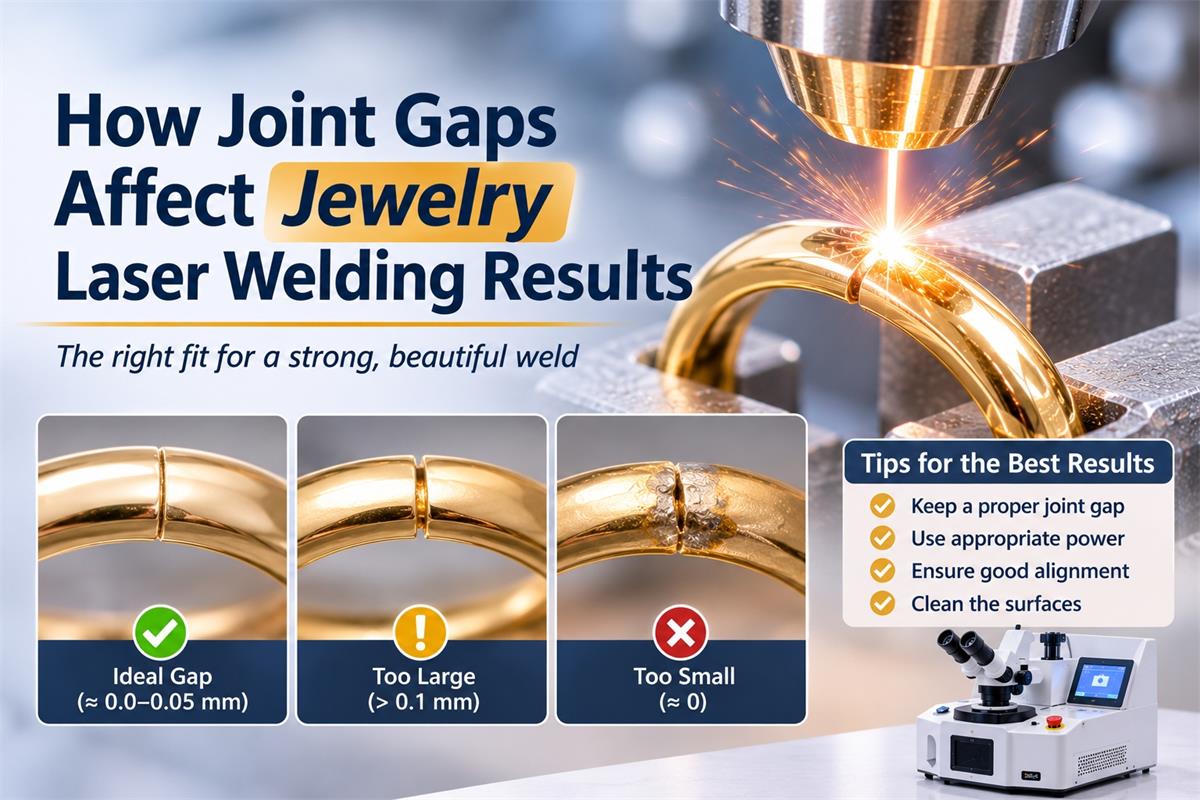
Joint gaps are one of the most overlooked factors affecting jewelry laser welding quality. Even when using a high-quality laser welding machine, a small gap between two metal components can lead to incomplete fusion, porosity, weak connections, and excessive spatter. This is particularly important when repairing delicate gold chains, ring bands, earring posts, and small decorative components. In this guide, we explain how joint gaps affect welding results and how jewelry technicians can improve joint preparation for more reliable repairs.
Learn more about Dowin 150W Jewelry Spot Laser Welding Machine and explore its applications for precision jewelry repair.
1. What Is a Joint Gap in Jewelry Laser Welding?
A joint gap is the space between two metal components that are supposed to be connected by welding.
For example, when repairing a broken gold chain, the two ends of the link should be positioned close enough to allow the molten metal to fuse them together.
If the ends are separated by an excessive distance, the laser may melt one side without properly connecting the other.
In jewelry manufacturing and repair, joint gaps commonly occur in:
- Gold and silver chain connections.
- Ring resizing joints.
- Earring post connections.
- Small decorative metal components.
- Prong and setting repairs.
Unlike larger industrial welding applications, jewelry welding often involves very small components. Even a minor positioning error can significantly affect the final result.
2. Three Ways Joint Gaps Affect Jewelry Laser Welding
A. Excessive Gaps Cause Weak Welds
When the gap between two components is too large, the molten metal may not bridge the entire joint.
This can result in incomplete fusion or a connection that looks acceptable on the surface but breaks easily under mechanical stress.
For example, a gold chain link may appear welded after polishing, but the connection can separate when the chain is pulled.
Solution: Bring the two metal edges closer together before welding. If material is missing, use compatible filler material rather than relying on excessive laser energy to bridge the gap.
B. Uneven Gaps Cause Inconsistent Welding
Sometimes one side of a joint is tightly fitted while the other side has a visible opening.
This uneven contact creates different melting conditions along the same joint. One area may achieve sufficient penetration, while another remains poorly fused.
It is particularly common when joining thin ring bands or small decorative components that are difficult to position accurately.
Solution: Check the entire joint under a microscope before welding. Adjust the component position and use suitable fixtures or tweezers to maintain consistent contact.
C. Large Gaps Increase Porosity and Spatter Risk
When the joint opening is too large, the molten metal may become unstable. Depending on the material, gap geometry, and welding parameters, this can contribute to material ejection, irregular weld pools, and small pores.
Repeatedly applying more laser energy does not necessarily solve the problem. Excessive energy may instead cause burn-through, excessive melting, or additional spatter.
Solution: Improve joint fit-up first. Adjust pulse energy and duration only after the components are correctly positioned.
3. What Happens When the Joint Gap Is Too Large?
The following table summarizes common welding problems associated with different joint conditions.
| Joint Condition | Possible Welding Result | Recommended Action |
|---|---|---|
| Tight and uniform fit | More consistent fusion | Proceed with tested parameters |
| Small uneven gap | Inconsistent penetration | Improve alignment |
| Excessive gap | Weak or incomplete joint | Reposition or add compatible filler |
| Missing material | Incomplete joint or excessive material loss | Use suitable filler material |
| Misaligned components | Uneven weld geometry | Secure the components before welding |
There is no single acceptable gap size for every jewelry application. The appropriate joint fit depends on metal thickness, alloy composition, laser spot diameter, pulse energy, and the geometry of the component.
4. How to Prepare Jewelry Parts Before Laser Welding
Good joint preparation is often more important than simply increasing laser power.
Step 1: Clean the Metal Surface
Remove oil, polishing compounds, oxidation, and old solder residues where appropriate. Contaminated surfaces can interfere with stable melting and contribute to porosity.
Step 2: Align Both Components
Make sure the two metal edges are correctly positioned. For small parts, tweezers and positioning fixtures can help maintain contact.
Step 3: Inspect the Joint Under a Microscope
Check whether the gap is uniform along the welding area. A microscope makes it easier to identify small openings that may not be visible to the naked eye.
Step 4: Select Suitable Welding Parameters
Choose the pulse energy, duration, and spot diameter according to the material thickness and joint condition. Do not compensate for poor alignment by applying excessive energy.
Step 5: Test the Weld
Perform a test on matching scrap material whenever possible. Inspect the weld for complete fusion, cracks, pores, and excessive material buildup.
5. Practical Examples: How Joint Gaps Affect Different Jewelry Parts
Gold Chain Repair
Fine gold chain links have very small contact areas. If the two broken ends are not properly aligned, the laser may melt one end without connecting the other.
Position the ends carefully and use controlled pulses to complete the connection.
Ring Resizing
During ring resizing, a section of the band may be removed or additional gold inserted. If the joint edges do not match, the resulting gap can create a weak seam.
Trim and align the edges properly. For larger openings, use compatible gold filler material to restore the missing volume.
Earring Post Welding
An earring post must have sufficient contact with the decorative base. If the post is tilted or only touches one edge, the connection may be weak.
Use accurate positioning and inspect the contact area before applying laser pulses.
6. Why Microscope Positioning Matters in Jewelry Laser Welding
Small jewelry components are difficult to position accurately with the naked eye. A slight movement can change the joint gap and affect the final welding result.
This is why microscope observation is an important feature when selecting a jewelry laser welding machine.
Dowin’s 150W desktop jewelry laser welding machine is equipped with a microscope and LED shadowless lighting, helping operators observe small joints and position the laser accurately.
It is suitable for applications such as:
- Gold and silver chain repair.
- Ring resizing and crack repair.
- Earring post welding.
- Small decorative component connections.
- Precision repair of precious metal jewelry.
For workshops that frequently handle small jewelry parts, microscope positioning can make joint inspection and laser alignment easier. It does not replace proper joint preparation, but it helps reduce positioning errors.
Learn more about Dowin 150W Jewelry Spot Laser Welding Machine and explore its applications for precision jewelry repair.
7. Frequently Asked Questions
Q1: Can a jewelry laser welder fill a gap between two metal parts?
Yes, small gaps may sometimes be bridged using suitable filler material. However, large gaps should generally be corrected through proper fitting or material replacement rather than excessive laser energy.
Q2: Does a larger joint gap always produce a weaker weld?
Not necessarily in every welding process, but excessive gaps generally make jewelry laser welding more difficult. The result depends on the material, joint design, filler material, and welding parameters.
Q3: How can I check whether a jewelry joint gap is too large?
Inspect the joint under a microscope before welding. Look for visible openings, uneven contact, and misalignment. Test the joint on matching scrap material when developing a new repair process.
Q4: Can I increase laser power to compensate for a large gap?
This is generally not recommended. Higher energy may increase melting and spatter without guaranteeing proper fusion. Correct the joint geometry first and use compatible filler material when necessary.
Q5: Why is microscope positioning important for small jewelry welding?
A microscope allows technicians to inspect small contact areas, identify uneven gaps, and position the laser more accurately. This is especially useful for chain links, earring posts, and delicate ring components.
Conclusion
Joint gaps have a direct influence on jewelry laser welding quality. Excessive gaps, uneven contact, and poor alignment can lead to incomplete fusion, weak connections, porosity, and excessive spatter.
Before adjusting laser power, technicians should first inspect the joint, clean the material, and ensure accurate positioning. For larger gaps or missing material, compatible filler material may be necessary.
For jewelry repair workshops, a pulsed YAG laser welding machine with microscope positioning provides a practical solution for handling small and delicate components.
Contact Dowin to learn more about jewelry laser welding machines and request a sample welding test.
“`
Post time: Nov-20-2026
