
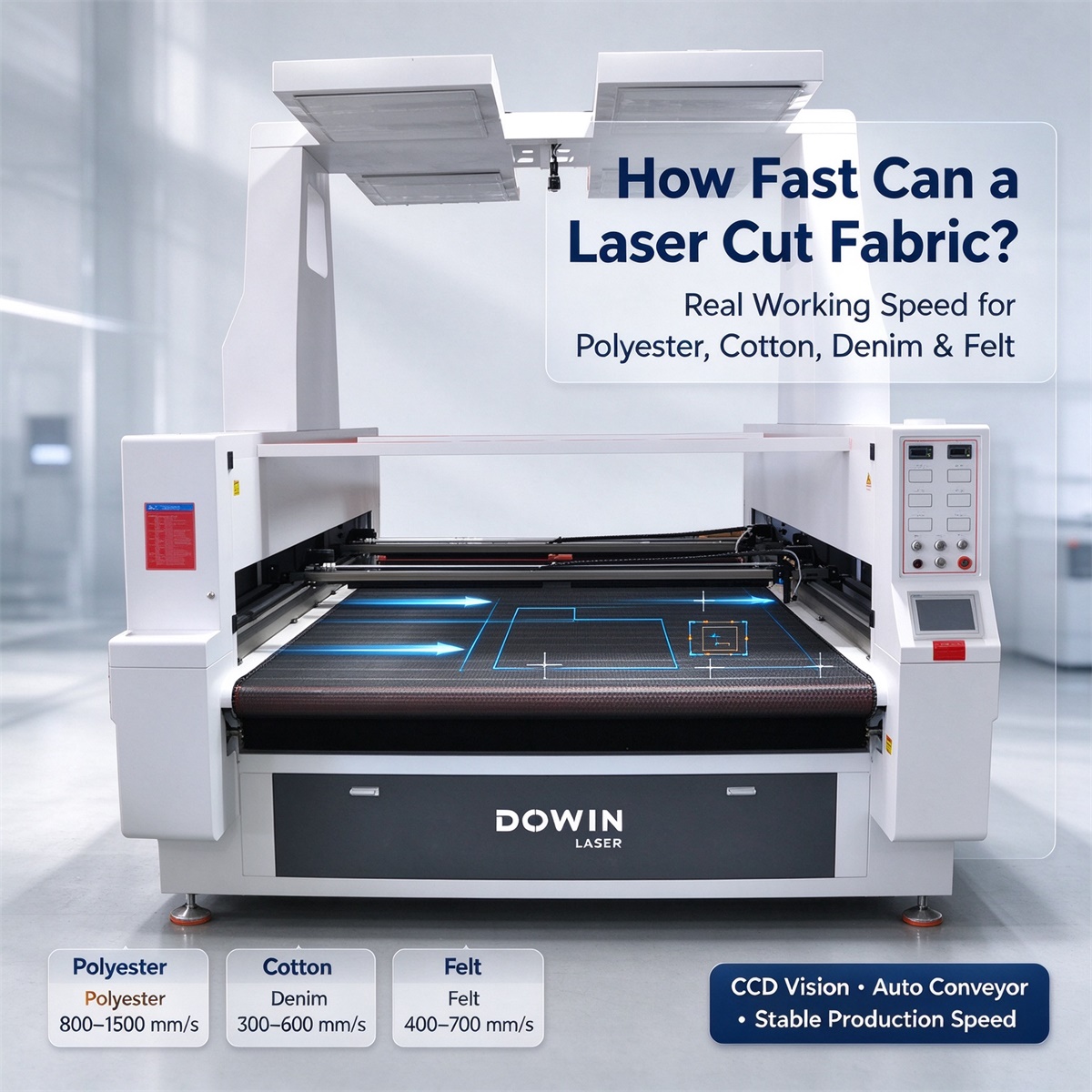
Wondering how fast a CO2 laser cutter cuts fabric? Learn typical cutting speeds for polyester, cotton, denim, felt, plus factors affecting throughput for small business and textile production. Target SEO keywords: laser cutting machine fabric cutting speed, CO2 laser fabric cutting speed, how fast can laser cut fabric, textile laser cutter throughput, conveyor laser cutting speed for fabric
If you’re shopping for a fabric CO2 laser cutter, speed is one of the numbers that matters most to your bottom line. Many buyers only compare laser wattage, but cutting speed directly determines how many pieces you can finish per day, your labor cost, and whether the machine can keep up with your order volume.
Fabric laser cutting is fundamentally different from cutting rigid materials like acrylic or wood. Textiles are thin and heat-sensitive, so fabric cutting usually runs at much higher speeds. However, maximum speed is not always usable speed — you still need clean, sealed edges without charring, burning or distortion.
Below we break down realistic cutting speeds by fabric type, laser wattage, and explain the key factors that speed up (or slow down) your textile cutting jobs.
Typical Fabric Laser Cutting Speed Reference (CO2 Laser)
Note: These are practical working speeds, not empty machine maximum travel speed. Assumes proper air assist, honeycomb/conveyor table, good exhaust, well-focused laser. Single layer, standard nesting.
40W CO2 Laser (Hobby & Light Craft)
- Polyester, spandex, thin lining: 300–600 mm/s
- Felt, thin non-woven: 200–400 mm/s
- Light cotton: 150–300 mm/s
- Lace, silk (ultra-delicate): 100–200 mm/s
Limitation: Even though the motion system can go faster, the low power forces you to slow down to get full penetration. Not suitable for high-volume production.
60W CO2 Laser (Small Business Bestseller)
- Polyester sportswear, sublimation fabric: 600–1000 mm/s
- Felt patches, woven labels: 400–700 mm/s
- Light cotton, poplin: 300–500 mm/s
- Light fleece: 250–400 mm/s
This is the sweet spot for custom apparel shops. You get fast cycle times while still maintaining clean sealed edges on polyester.
80W – 100W CO2 Laser (Commercial Workhorse, Conveyor Type as shown)
This matches the roll-fed camera positioning laser cutter in your picture.
- Polyester, nylon, spandex: 800–1500 mm/s
- Fleece, medium canvas: 500–900 mm/s
- Light denim: 300–600 mm/s
- Neoprene, thick felt: 200–400 mm/s
With extra power headroom, you can run high speed without sacrificing cut quality. This machine can run continuously with automatic conveyor feeding for roll textiles. The vision camera automatically finds printed marks and aligns patterns, so you save huge time on manual positioning.
130W – 150W CO2 Laser (Industrial Roll-to-Roll Production)
- Synthetic fabrics: 1000–2000 mm/s
- Multi-layer stacked polyester: 400–800 mm/s
- Heavy canvas, upholstery: 300–600 mm/s
- Thick denim stacks: 150–350 mm/s
High wattage combined with stable power output lets production lines run at extreme speeds for mass garment, automotive textile and sofa fabric cutting.
Speed Difference: Synthetic Fabric vs Natural Fabric
This is a critical rule many new operators miss: ✅ Synthetic fabrics (polyester, spandex, nylon) — fastest to cut. Polyester melts and seals the edge instantly. You can push the speed high, using only moderate laser power. Less heat stays in the material, minimal burning risk. This is why sportswear factories achieve very high throughput.
⚠️ Natural fabrics (cotton, linen) — slower. Cotton does not melt; it burns. If you run too fast, you get incomplete cuts. If you run too slow, scorch marks appear. Cotton always requires a careful balance of speed, power and strong air assist. You will never cut cotton as fast as polyester.
⚠️ Thick / dense fabrics (denim, neoprene, canvas) — slowest. Dense material needs more energy to penetrate, so you have to drop speed. Stacked multi-layer cutting will also cut your speed significantly.
What Factors Control Fabric Laser Cutting Speed?
- Laser Wattage Higher wattage gives you more power reserve. You can keep a high feed speed while still cutting through the fabric. But high wattage is not a magic fix for thin delicate fabrics — too much power at high speed can still blow holes or warp the material.
- Vision Camera & Conveyor System (like your machine) A fixed flatbed laser requires manual loading, positioning and unloading. A CCD vision conveyor laser cutter automatically tracks printed patterns, continuously feeds roll fabric, and cuts without stopping. Even if the cutting head speed is similar, the overall production efficiency can be 2–4 times higher than flatbed models. This is the biggest upgrade for print-on-demand and sublimation textile businesses.
- Air Assist Pressure Good compressed air blows away smoke and molten residue. Proper air assist allows you to run faster with less charring. Weak air assist forces you to slow down to avoid burnt edges.
- Cut Path & Nesting Lots of tiny, intricate shapes with sharp corners will reduce average speed. The laser head must decelerate around corners. Simple large shapes run much closer to the maximum speed. Efficient nesting software reduces waste and cuts total travel distance.
- Fabric Dyes & Coatings Some dark dyes or chemical treatments absorb laser energy much more easily. The same fabric type from two suppliers may need completely different speed and power settings. Always test scraps first.
- Single Layer vs Stacked Layers Every extra layer slows the machine down. Cutting 4 layers of polyester may require half the speed of single-layer cutting.
Real-World Throughput Example
Let’s use a common case: Sublimation polyester patches on a 100W CCD conveyor laser cutter (the machine in your photo):
- Shape: 10 cm simple logo patch
- Cutting speed: ~900 mm/s
- With vision recognition + continuous roll feeding
- Output: hundreds of patches per hour, only limited by design density.
If you cut the same patches on a 60W flatbed laser with manual positioning, your pieces per hour will drop sharply because of loading and alignment time.
FAQ for Google Rich Snippet
Q: What is the maximum speed a laser can cut fabric? A: Motion systems can reach over 2000 mm/s, but practical working speed for clean cuts is usually 300–1500 mm/s, depending on fabric and laser power. Synthetic fabrics run fastest.
Q: Can a vision conveyor laser cut fabric faster than a flatbed laser? A: Yes. While the cutting head speed may be similar, the auto-feeding and automatic pattern recognition eliminate manual alignment time, greatly boosting total production output.
Q: Why is cotton laser cutting slower than polyester? A: Cotton is natural fiber and burns instead of melting. It is easier to scorch, so operators must use lower speed and carefully tuned parameters.
Final Takeaway
When vendors quote “max speed”, always ask for real working cutting speed for your fabric, not just the idle movement speed.
- For thin polyester patches and printed sublimation fabric: A CCD conveyor CO2 laser (80W–100W) delivers the best combination of fast cutting speed and automatic workflow.
- For cotton and denim: Expect slower speeds and stricter parameter testing. Speed and edge quality must be balanced — the fastest cut is worthless if the edges are charred or distorted.
If you are looking for this high-efficiency vision conveyor fabric laser cutter, our DOWIN CCD camera positioning CO2 laser cutting machine shown in the picture is built exactly for this scenario. Equipped with a top-mounted CCD camera system, it automatically scans printed sublimation patterns, marks and outlines on roll fabric. The auto conveyor continuously feeds material without repeated manual positioning. Available in 60W, 80W and 100W CO2 power options, it gives you flexible speed tuning for polyester, spandex, felt, light denim and woven labels. Compared with ordinary flatbed laser cutters, it removes tedious loading, measuring and alignment work. Whether you produce custom patches, sportswear sublimation blanks or home textile accessories, it keeps stable high cutting speed while delivering consistent, clean sealed edges, greatly lifting your hourly throughput and reducing labor cost. It is the ideal upgrade for print-on-demand, embroidery studios and small-to-medium textile workshops.
Post time: Oct-21-2026
