
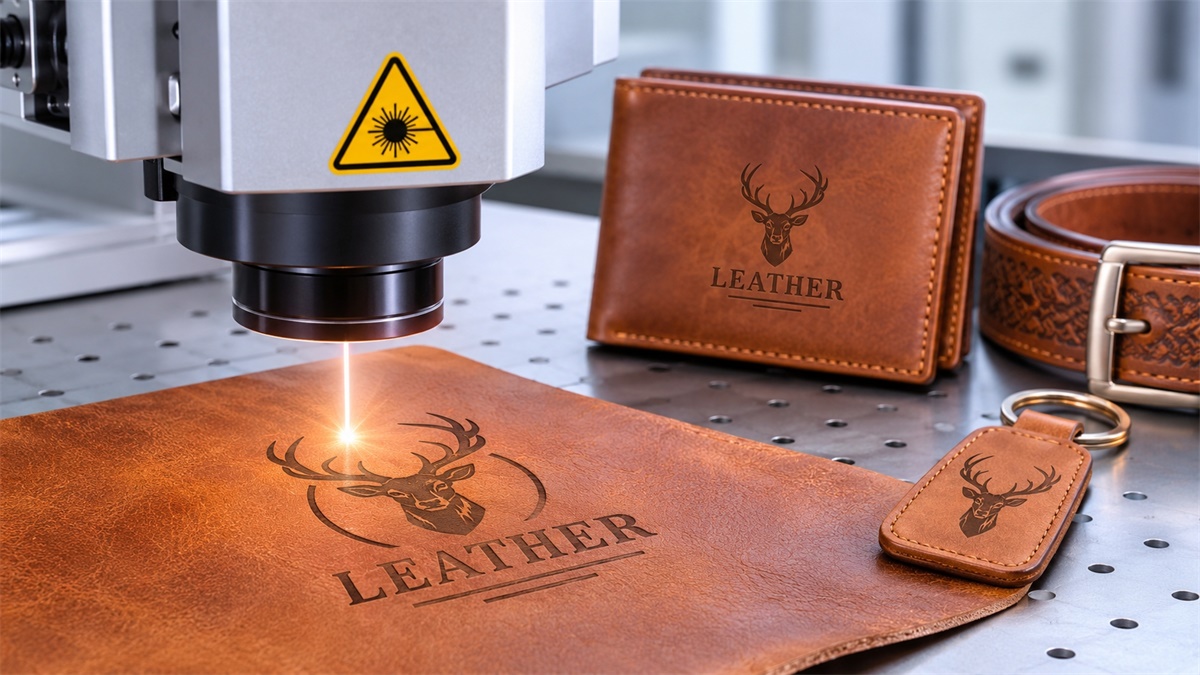
Leather is widely used in footwear, handbags, wallets, belts, upholstery, and fashion accessories, where permanent logos, decorative patterns, and personalized designs add value to finished products. A CO2 laser marking machine offers a non-contact way to create these designs without traditional printing plates, ink, or mechanical engraving tools. By controlling laser power, speed, and focus, manufacturers can achieve different marking effects on leather surfaces. For manufacturers exploring suitable equipment, Dowin’s laser marking machine collection includes CO2 laser marking solutions for non-metallic materials such as leather, fabric, and wood.
1. How Does CO2 Laser Marking Work on Leather?
A CO2 laser marking machine uses a laser beam with a wavelength of approximately 10.6 μm. This wavelength is strongly absorbed by many non-metallic materials, including leather.
The marking process works through localized thermal energy. When the focused laser beam reaches the leather surface, the material absorbs the energy and undergoes controlled heating. Depending on the leather composition and laser settings, the surface may become darker, lighter, or slightly recessed.
The marking system uses a computer-controlled galvanometer scanner to move the laser beam along a programmed path. This allows the machine to reproduce logos, text, numbers, decorative patterns, and other digital designs.
The basic process involves four steps:
-
Design preparation: Create a logo, pattern, or text using compatible graphic software.
-
Parameter setting: Configure laser power, marking speed, frequency, and other processing parameters.
-
Laser scanning: The galvanometer directs the focused beam across the leather surface.
-
Surface modification: Localized heating changes the surface appearance, producing the desired marking effect.
Unlike ink printing, laser marking does not require ink cartridges or direct contact with the leather. The result is created by modifying the material itself.
2. What Happens to Leather During CO2 Laser Marking?
The marking effect depends on how the leather reacts to the laser’s thermal energy. Different leather materials can produce significantly different results.
Common effects include:
-
Dark marking: Laser heating creates a darker contrast on suitable leather surfaces.
-
Light marking: Removing or changing the surface finish can expose a lighter layer underneath.
-
Surface engraving: Higher energy input can remove some surface material and create a shallow recessed pattern.
-
Texture effects: Controlled laser processing can produce contrasting textures and decorative details.
The objective is not necessarily to remove a large amount of material. For most leather products, manufacturers want clear visual contrast while maintaining the original flexibility and structural integrity.
A good marking result should have consistent color, clean edges, readable details, and minimal unwanted scorching around the design.
3. Which Types of Leather Can Be Laser Marked?
Not all leather reacts to CO2 laser energy in the same way. The material’s composition, surface coating, tanning process, and thickness all influence the final result.
|
Leather type |
Potential marking result |
Processing considerations |
|---|---|---|
|
Genuine leather |
Dark or contrasting marks |
Requires testing for natural variations |
|
Vegetable-tanned leather |
Often produces clear brown or dark marks |
Suitable for decorative engraving tests |
|
Full-grain leather |
Natural surface contrast |
Preserve the original grain texture |
|
Top-grain leather |
Surface-dependent contrast |
Coatings may affect the result |
|
PU leather |
Varies by formulation |
Check material safety and laser compatibility |
|
Synthetic leather |
Varies significantly |
Test the coating and polymer composition |
|
Suede leather |
Surface texture changes |
Control heat to avoid excessive damage |
|
Leatherette |
Depends on surface composition |
Confirm that the material is laser-safe |
Important: Avoid assuming that every synthetic leather product is suitable for laser processing. Some artificial leather contains PVC or other chlorine-containing materials that can release hazardous gases when exposed to laser heat. Always identify the material composition and obtain appropriate safety confirmation before processing.
For genuine leather, natural differences in thickness, moisture, tanning, and surface treatment can also lead to variations in marking color. Sample testing is essential before mass production.
4. What Factors Affect Leather Laser Marking Quality?
Achieving consistent results requires more than selecting a suitable CO2 laser. Several processing variables influence the final appearance.
Laser Power
Laser power determines how much energy reaches the leather surface.
-
Lower power can produce subtle surface color changes.
-
Medium power may create stronger contrast and more visible patterns.
-
Higher power can cause deeper engraving, excessive darkening, or surface damage.
The appropriate power depends on the leather type, thickness, surface finish, and desired marking effect.
Marking Speed
Marking speed controls how long the laser interacts with each area.
-
Higher speed reduces heat accumulation and may produce lighter marks.
-
Lower speed increases energy exposure and may produce darker or deeper effects.
If the speed is too low, the leather may become excessively dark or develop unwanted burn marks.
Laser Frequency
Frequency affects the distribution of laser pulses and the resulting surface appearance. Different frequency settings can produce different textures and marking characteristics.
The best setting should be determined through sample testing rather than relying on a universal parameter.
Focus Position
Correct focusing is essential for achieving sharp edges and consistent details.
An incorrectly focused beam may produce blurred patterns, uneven marking depth, or inconsistent line widths.
For manufacturers processing leather products with small text, fine logos, or detailed patterns, maintaining accurate focus is particularly important.
5. What Designs Can Be Created on Leather?
One of the main advantages of CO2 laser marking is its ability to reproduce complex digital graphics without manufacturing custom engraving tools.
Common applications include:
Brand logos and product identification
Leather manufacturers can mark company logos, brand names, product numbers, and customized labels directly onto leather products.
Decorative patterns
Geometric designs, floral patterns, textures, and artistic graphics can be reproduced for fashion accessories and handcrafted products.
Personalized products
Names, initials, dates, and customized messages are popular for wallets, belts, keychains, and gifts.
Leather patches and labels
Laser marking can create decorative designs and identification information on leather patches used in clothing, footwear, and accessories.
Detailed artwork
The computer-controlled marking process supports complex patterns, fine lines, and digital images, depending on the material and machine configuration.
6. CO2 Laser Marking vs. Traditional Leather Marking Methods
Manufacturers can choose from several methods for adding designs to leather. Each has different production requirements.
|
Processing method |
Main advantages |
Limitations |
|---|---|---|
|
CO2 laser marking |
Non-contact, flexible designs, no ink |
Requires material testing and fume extraction |
|
Screen printing |
Suitable for repeated colored graphics |
Requires screens and inks |
|
Hot stamping |
Strong decorative and branding effects |
Requires dies and heat |
|
Mechanical engraving |
Physical material removal |
Tool contact and mechanical limitations |
|
Inkjet printing |
Supports different colors and variable data |
Requires ink and suitable surface preparation |
CO2 laser marking is particularly useful when manufacturers need to change designs frequently, process customized orders, or reproduce detailed patterns without preparing new physical tools.
However, it is not a direct replacement for every printing or stamping process. If the product requires full-color graphics or a particular metallic finish, traditional methods may be more appropriate.
7. How to Choose a CO2 Laser Marking Machine for Leather
Selecting the right machine depends on the size of the leather products, required marking quality, and expected production volume.
Choose the Appropriate Laser Source
CO2 laser marking machines commonly use two types of laser sources:
-
RF metal tube: Often used for applications requiring stable beam performance, fine details, and relatively small marking areas.
-
Glass laser tube: Available in higher power configurations and suitable for larger marking areas and certain high-throughput applications.
The choice should depend on the actual processing requirements rather than laser power alone.
Consider the Marking Area
For wallets, small leather labels, and belts, a relatively compact marking area may be sufficient.
For larger leather panels, upholstery materials, or multiple products processed in one cycle, a larger working area can improve production efficiency.
Evaluate Marking Speed
If the machine is used for customized products, flexibility and marking accuracy may be more important than maximum speed.
For batch production, manufacturers should evaluate marking speed together with graphic complexity, product positioning, and loading time.
Check Software Compatibility
The marking software should support commonly used graphic formats and allow operators to adjust processing parameters.
Dowin’s CO2 laser marking systems support formats including PLT, BMP, JPG, PNG, DXF, and other commonly used graphics formats, depending on the configuration.
Consider Fume Extraction
Leather processing produces smoke and airborne residues. A suitable extraction and filtration system is necessary to maintain a safer working environment and prevent contamination of optical components.
8. Dowin CO2 Laser Marking Machines for Leather Processing
Dowin offers CO2 laser marking machines designed for processing non-metallic materials, including leather, textiles, acrylic, wood, and other suitable materials.
Two configurations are worth considering for different leather processing requirements.
DW-30CO2 CO2 Laser Marking Machine
View DW-30CO2 CO2 Laser Marking Machine
The DW-30CO2 uses an RF CO2 laser source, with 35W and 60W configurations listed on the product page.
Key specifications include:
-
Laser source: Davi / CDR RF metal tube
-
Laser power: 35W / 60W
-
Marking area: 110 × 110 mm or 200 × 200 mm
-
Control card: BJJCZ
-
Software: EZCAD
-
Marking speed: Up to 7,000 mm/s
-
Applications: Leather, denim, acrylic, wood, textiles, and other non-metallic materials
This configuration is worth evaluating for smaller leather products, logos, labels, and detailed decorative marking.
DW-100CO2 Big Power Glass Tube CO2 Laser Marking Machine
View DW-100CO2 Glass Tube CO2 Laser Marking Machine
For manufacturers processing larger leather products or requiring a larger working area, the DW-100CO2 is another option.
Its listed configuration includes:
-
Laser source: RECI W4 glass CO2 tube
-
Laser power: 100W–130W
-
Working area: Up to 400 × 400 mm
-
Optional dynamic focusing: Up to 1200 × 1200 mm
-
Galvanometer: Sino-Galvo 2808
-
Software: EZCAD
-
Cooling: S&A CW-5200 water chiller
The larger marking area makes this configuration worth considering for larger leather panels and batch processing.
A practical recommendation: Before choosing between these configurations, send Dowin actual leather samples and your required logo or pattern. The marking contrast, surface condition, processing speed, and material safety should all be evaluated before confirming the machine configuration.
Explore the complete Dowin Laser Marking Machine collection for additional options.
9. Common Problems in CO2 Laser Marking on Leather
Even when using a suitable machine, manufacturers may encounter several processing problems.
|
Problem |
Possible cause |
Recommended adjustment |
|---|---|---|
|
Excessive darkening |
Too much laser energy |
Increase speed or reduce power |
|
Uneven marking |
Inconsistent leather surface or focus |
Check material consistency and focusing |
|
Blurred edges |
Incorrect focus or unsuitable parameters |
Recheck focal position and settings |
|
Weak contrast |
Insufficient energy or unsuitable leather finish |
Test different power and speed combinations |
|
Excessive smoke |
Excessive heat or poor extraction |
Adjust parameters and improve ventilation |
|
Surface deformation |
Excessive thermal exposure |
Reduce energy input and test again |
A useful production practice is to create a parameter test matrix before starting mass production. Test several combinations of power and speed on the same leather batch, then compare the results under consistent lighting conditions.
This makes it easier to establish repeatable processing parameters.
10. Safety Considerations When Laser Marking Leather
Leather laser processing requires appropriate safety precautions.
-
Install an effective fume extraction system.
-
Identify the leather composition before processing.
-
Never laser process unknown synthetic materials without confirming their chemical safety.
-
Avoid PVC-containing materials unless specifically confirmed safe for the intended laser process.
-
Keep the working area clean to reduce the accumulation of combustible residues.
-
Use an enclosed laser processing system with appropriate interlocks and laser protection.
-
Follow the machine manufacturer’s operating and maintenance instructions.
Leather is an organic material, and excessive laser exposure can cause scorching or ignition. Operators should never leave an active laser process unattended.
11. Frequently Asked Questions
Can a CO2 laser marking machine mark genuine leather?
Yes. CO2 laser marking machines can process many types of genuine leather. The resulting appearance depends on the tanning process, surface finish, moisture content, and laser parameters.
Does CO2 laser marking damage leather?
It can if the laser energy is too high or the processing speed is too low. Proper parameter adjustment helps minimize unwanted burning, deformation, and excessive material removal.
Can a CO2 laser engrave logos on leather wallets?
Yes. CO2 laser marking is suitable for creating logos, names, decorative patterns, and other graphics on many leather wallets. A suitable marking area and accurate positioning are important for consistent results.
Is CO2 laser marking permanent on leather?
The laser changes the leather surface rather than simply applying ink. Therefore, the resulting mark is generally durable. However, actual wear resistance depends on the leather type, surface treatment, and marking depth.
What is the difference between CO2 laser marking and CO2 laser cutting on leather?
CO2 laser marking modifies the leather surface to create patterns, text, or logos. CO2 laser cutting uses sufficient energy to penetrate and separate the material along a cutting path.
Although both processes use CO2 laser technology, their machine configurations, processing parameters, and production objectives can be different.
Can CO2 lasers mark PU leather?
Some PU leather materials can be processed with CO2 lasers, but the results vary according to their chemical composition and coatings. Manufacturers should confirm material safety and conduct sample tests before production.
Is a higher-power CO2 laser better for leather marking?
Not necessarily. Higher power does not automatically produce better marking quality. For fine logos and decorative details, beam quality, focusing accuracy, scanning speed, and parameter control are equally important.
Conclusion
CO2 laser marking works on leather by converting laser energy into localized heat, modifying the material surface to create permanent visual patterns, logos, and text.
For leather manufacturers, the technology offers flexibility in design, non-contact processing, and the ability to handle customized as well as batch production.
However, the final result depends heavily on leather composition and processing parameters. Choosing the right machine should always begin with actual material testing rather than relying solely on advertised laser power or marking speed.
If you are planning to mark leather wallets, handbags, belts, patches, or larger leather panels, contact Dowin Laser to discuss your material samples and processing requirements.
Post time: Nov-02-2026
