
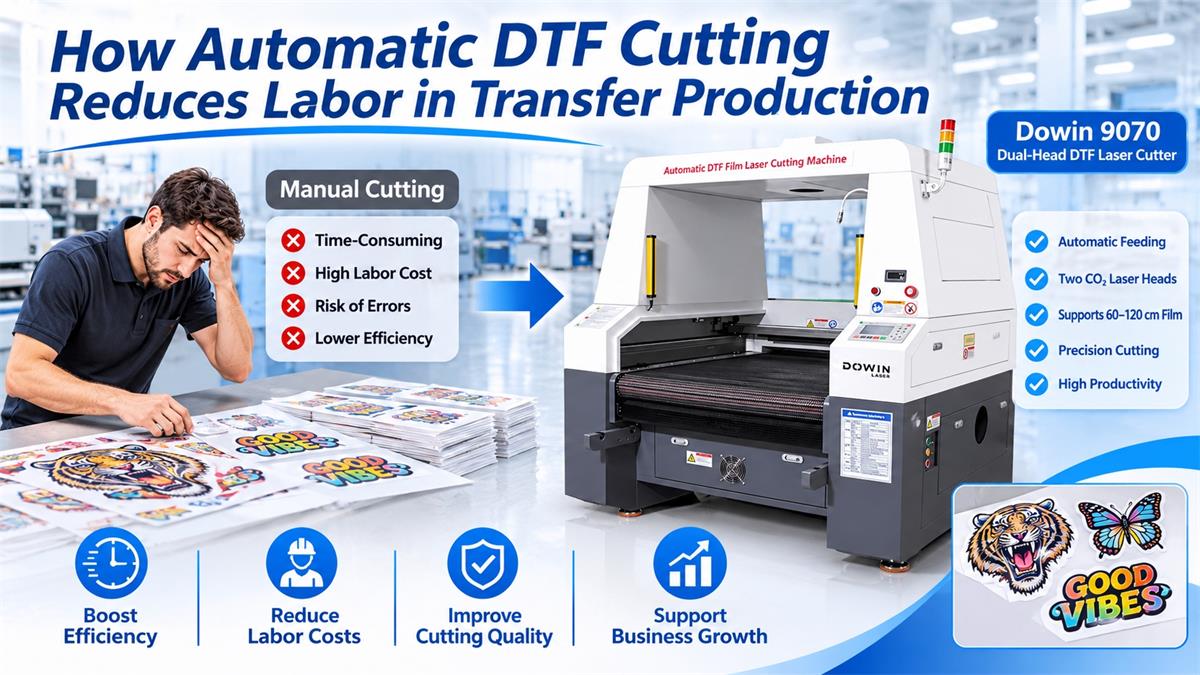
As DTF printing businesses receive more orders, manual film cutting can become one of the biggest sources of labor consumption in the production process. Employees must repeatedly position printed film, separate individual designs, measure cutting lines, and organize finished transfers. An automatic DTF cutting machine like the Dowin 9070 Dual-Head DTF Film Laser Cutter uses automatic feeding and two CO2 laser heads to process PET and TPU transfer film, helping manufacturers reduce repetitive manual work and improve production efficiency. But how much labor can automation actually save, and which production tasks can be eliminated?
1. Why Does Manual DTF Cutting Require So Much Labor?
Printing is only one part of DTF transfer production. After printing and powder curing, the film still needs to be processed before individual transfers can be prepared for customers.
In many small and medium-sized factories, these operations are still performed manually.
A typical manual cutting workflow includes:
- Collecting printed DTF film from the printer.
- Positioning and aligning the film on a cutting table.
- Measuring the required separation distances.
- Cutting individual designs using manual tools.
- Checking whether the cuts are straight and consistent.
- Separating, sorting, and collecting finished transfers.
Each operation may appear simple, but repeating it hundreds or thousands of times creates a considerable labor burden.
The problem becomes more obvious when a factory operates multiple DTF printers. Printing output increases, but manual cutting capacity may remain unchanged.
As a result, finished printed film starts accumulating while employees struggle to keep up with downstream processing.
2. Five Ways Automatic DTF Cutting Reduces Labor
1. Automatic Feeding Reduces Manual Material Handling
One of the most time-consuming tasks in manual cutting is repeatedly loading, positioning, and adjusting printed film.
With an automatic feeding system, the machine transports the material into the cutting area according to its configured workflow.
Operators no longer need to manually position every section of film before cutting. Instead, they can focus on monitoring the machine, checking material conditions, and preparing subsequent production tasks.
For factories processing long PET film rolls, automatic feeding can significantly reduce repetitive material handling.
2. Automatic Laser Cutting Replaces Repetitive Manual Cutting
Manual cutting requires employees to follow cutting lines repeatedly. The workload increases when production involves multiple designs, different dimensions, and large quantities.
An automatic CO2 laser cutting machine follows programmed cutting paths. Once the cutting file and parameters are configured, the machine performs the cutting operation automatically.
This reduces the need for operators to manually handle cutting tools and repeat the same cutting movements throughout the working day.
It also provides greater consistency because the cutting process follows programmed paths rather than depending entirely on individual operator skills.
3. Dual Laser Heads Improve Cutting Productivity
For factories processing large quantities of DTF transfers, cutting capacity is another important consideration.
A dual-head laser system can process two cutting paths simultaneously when the artwork layout and machine configuration allow it.
Compared with a single-head system performing the same suitable cutting tasks, this arrangement can improve processing efficiency and reduce the time required for repetitive cutting operations.
The Dowin 9070 uses a two-head CO2 laser configuration designed for PET and TPU film processing.
For production managers, the benefit is not simply having two laser heads. It is the ability to complete more cutting work within the available production time without requiring additional operators for every cutting task.
4. Automatic Processing Reduces Repeated Positioning Work
Manual cutting often requires workers to check material positions and adjust the film before each operation.
These repeated actions consume time, particularly when processing long film rolls or large batches.
An automatic cutting workflow reduces the number of manual interventions required between cutting cycles.
Depending on the machine configuration, operators can prepare the cutting files, configure the feeding process, and supervise multiple production stages instead of continuously handling individual pieces of film.
5. More Consistent Cutting Reduces Rework
Manual cutting quality can vary between operators and production shifts. Incorrect dimensions, uneven separation, or damaged graphics may require additional inspection and rework.
Automatic laser cutting uses programmed paths to maintain consistent cutting positions throughout a job.
Although material movement, cutting parameters, and file preparation still need to be controlled, automation can reduce errors associated with repetitive manual cutting.
Less rework means fewer additional labor hours spent correcting production problems.
3. Manual DTF Cutting vs. Automatic Laser Cutting
The difference becomes clearer when comparing the two workflows.
| Production Task | Manual Cutting | Automatic Laser Cutting |
|---|---|---|
| Material loading | Repeated manual handling | Automatic feeding system |
| Film positioning | Manual alignment | Configured automatic feeding |
| Cutting operation | Operator performs each cut | Programmed laser cutting |
| Cutting consistency | Depends on operator skills | Follows programmed paths |
| Batch processing | More repetitive labor | Automated processing workflow |
| Operator responsibility | Continuous manual cutting | Setup, supervision, and inspection |
| Production expansion | Often requires more workers | Can increase output without proportional labor growth |
Automatic cutting does not mean a factory can operate without employees. Material preparation, machine setup, quality inspection, maintenance, and finished-product handling are still necessary.
The main advantage is reducing the amount of repetitive manual work required for each production batch.
4. How Much Labor Can an Automatic DTF Cutter Save?
There is no fixed labor-saving percentage that applies to every DTF factory. The actual result depends on order volume, film width, cutting complexity, feeding speed, and the existing production workflow.
However, businesses can estimate the potential savings by analyzing how much time employees currently spend on cutting operations.
Consider this simplified example:
| Labor Activity | Manual Workflow | Automated Workflow |
|---|---|---|
| Film positioning | Repeated manual work | Reduced through automatic feeding |
| Cutting individual designs | Operator performs cutting | Machine performs programmed cutting |
| Cutting alignment | Manual adjustment | Configured machine positioning |
| Production monitoring | Continuous manual operation | Operator supervises the machine |
| Finished product handling | Manual collection | Still requires collection and inspection |
To estimate labor savings, record the number of employee-hours currently spent on cutting each day and compare it with the expected operating hours after automation.
Monthly Labor Hours Saved = (Manual Cutting Hours − Automated Cutting Hours) × Working Days
For example, if a factory currently spends 12 employee-hours per day on manual cutting and automation reduces this to 5 employee-hours, the potential saving is 7 employee-hours per day.
Over 26 working days, that represents 182 employee-hours per month.
This is an illustrative calculation, not a guaranteed Dowin 9070 production result. Actual savings should be verified through a sample production test.
5. Why Two Laser Heads Matter in Industrial DTF Production
When a DTF factory handles large orders, cutting speed directly influences how much work can be completed during a production shift.
A dual-head cutting configuration offers several potential advantages:
- Parallel processing: Two laser heads can work on separate suitable cutting paths simultaneously.
- Higher processing capacity: More cutting operations can be completed within the same period when the layout supports parallel operation.
- Reduced production pressure: Faster cutting can help prevent printed film from accumulating at the finishing stage.
- Better equipment utilization: The cutting station can handle larger batches without relying entirely on manual labor.
However, two laser heads do not automatically mean twice the production speed. Actual output depends on the cutting layout, head spacing, acceleration, laser parameters, and machine control system.
For buyers, the best approach is to ask the manufacturer to demonstrate both heads processing your actual DTF artwork.
6. Which DTF Businesses Benefit Most from Automatic Cutting?
Automatic cutting equipment is not necessary for every small printing business. Its value becomes greater as production volume and labor requirements increase.
Growing DTF Print Shops
Businesses receiving more orders each month may find that manual cutting is becoming increasingly difficult to manage. Automation helps increase finishing capacity without adding the same amount of repetitive labor.
Wholesale DTF Transfer Manufacturers
Wholesale suppliers often process large batches of printed transfers. Automatic feeding and programmed cutting can help standardize repetitive production operations.
Factories Operating Multiple DTF Printers
When several printers operate simultaneously, downstream cutting can become a production bottleneck. An industrial automatic cutter helps balance printing and finishing capacity.
Garment and Textile Production Businesses
Manufacturers processing different transfer designs and large quantities of PET or TPU film can benefit from automatic cutting systems that support flexible cutting paths and batch processing.
7. Dowin 9070 Dual-Head Automatic DTF Film Laser Cutting Machine
For DTF manufacturers looking to reduce manual cutting work, Dowin offers the 9070 automatic DTF and TPU film laser cutting machine.
The 9070 is designed for industrial PET and TPU film processing, combining automatic material feeding with a dual-head CO2 laser cutting configuration.
Key configuration highlights:
- Laser system: Two CO2 laser heads.
- Material width: Supports 60–120 cm PET film configurations.
- Compatible materials: PET DTF film, TPU film, and suitable heat-transfer materials.
- Feeding method: Automatic material feeding.
- Cutting capability: Batch cutting and programmed complex-pattern processing.
- Applications: DTF transfer production and other compatible flexible film cutting applications.
Unlike manual cutting tables, the 9070 is designed to automate material feeding and repetitive laser cutting operations. Its dual-head configuration provides additional processing capacity for suitable cutting layouts.
For manufacturers processing large quantities of transfer film, this can help reduce repetitive operator tasks and make production scheduling easier.
The machine is particularly worth evaluating if your factory currently relies on manual separation or needs to increase cutting capacity alongside existing DTF printers.
Explore the Dowin 9070 Automatic DTF and TPU Film Laser Cutting Machine for more product information.
8. What Should You Consider Before Automating DTF Cutting?
Reducing labor is important, but an automatic cutter must also fit your existing production environment.
1. Match the Machine to Your Film Width
Check whether the machine supports the film widths produced by your existing DTF printers. The 9070 supports 60–120 cm PET film configurations, but you should confirm the exact configuration required for your production.
2. Check Your Cutting Requirements
Determine whether you mainly need straight-line separation, individual graphic cutting, or complex contour cutting. Your artwork and cutting files must be compatible with the machine’s software workflow.
3. Evaluate Actual Production Speed
Ask the manufacturer to test your typical artwork and measure the complete production cycle, including feeding, positioning, cutting, and material handling.
4. Consider Operator Training
Automatic equipment still requires trained operators who understand material loading, software settings, cutting parameters, and routine maintenance.
5. Test Different Film Materials
DTF PET film and TPU film can have different processing characteristics. Request samples to check cutting quality, edge condition, deformation, and residue before purchasing.
Frequently Asked Questions
1. How does automatic DTF cutting reduce labor costs?
It reduces repetitive tasks such as manual film positioning, measuring, and cutting. Operators can focus on machine supervision, quality inspection, and other production activities.
2. Can one operator manage an automatic DTF cutting machine?
Depending on the machine configuration and production workflow, one trained operator may supervise the cutting process. Actual staffing requirements depend on material preparation, loading, collection, and production volume.
3. Is a dual-head DTF laser cutter faster than a single-head machine?
It can process suitable cutting paths in parallel, increasing potential productivity. However, actual speed depends on artwork layout, head configuration, cutting parameters, and machine movement.
4. Can automatic laser cutting process continuous DTF film rolls?
Yes, machines equipped with compatible automatic feeding systems can process roll-fed film. The supported material width and feeding configuration should be confirmed before purchase.
5. Does automatic DTF cutting eliminate manual work completely?
No. Operators are still needed for material preparation, machine setup, production monitoring, quality inspection, and finished-product handling. Automation mainly reduces repetitive cutting and positioning work.
6. Is automatic DTF cutting suitable for small printing businesses?
It depends on order volume and labor costs. Small businesses with limited production may not need industrial automation immediately, while growing print shops can benefit when manual cutting becomes a bottleneck.
Conclusion
Labor costs in DTF transfer production are not determined by printing speed alone. Manual film handling, positioning, cutting, and sorting can consume a significant amount of employee time, especially as order quantities increase.
An automatic DTF cutting machine helps address these problems through automatic feeding, programmed laser cutting, and, where configured, dual-head parallel processing.
For DTF factories handling 60–120 cm PET film and suitable TPU materials, the Dowin 9070 offers an industrial solution worth considering when upgrading from manual cutting to automated production.
The best investment is not simply the machine with the highest advertised speed. It is the system that reduces your actual labor workload, fits your existing printers, and allows your business to process more orders with a more efficient production team.
Post time: Nov-11-2026
