
Choosing between a flatbed DTF cutting machine and a roll-to-roll DTF cutting machine depends on your production workflow, film handling requirements, and daily order volume. Industrial solutions such as the Dowin 1215 Automatic DTF and TPU Film Laser Cutting Machine combine automatic material feeding with laser cutting, helping printing businesses reduce manual handling and process different cutting patterns. But are flatbed and roll-to-roll systems really competing technologies? Understanding how they work will help you choose the right equipment.
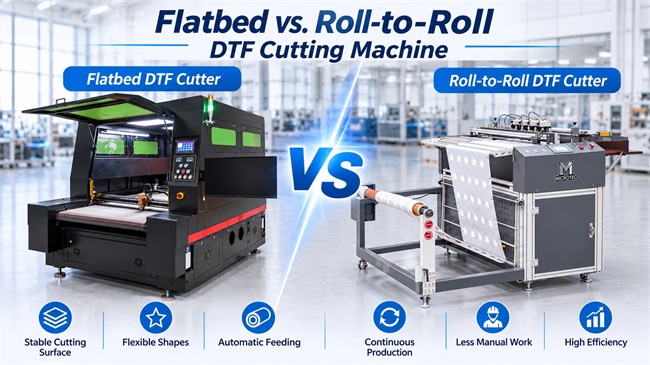
1. What Is a Flatbed DTF Cutting Machine?
A flatbed DTF cutting machine uses a flat working surface to hold printed film during the cutting process. The cutting head moves along the X and Y axes to follow programmed cutting paths.
Depending on the machine design, the film can be loaded as individual sheets or supplied through an automatic feeding system. Vacuum suction or other material-holding mechanisms help keep the film stable during cutting.
Typical features include:
- Flat cutting area for stable material positioning.
- Digital cutting paths for different graphic shapes.
- CCD camera positioning on suitable models.
- Automatic or manual material loading.
- Full-cut, contour-cut, or other programmed operations depending on the cutting tool.
Flatbed systems are particularly useful for businesses processing individual DTF sheets, customized graphics, and different artwork layouts.
Advantages of Flatbed DTF Cutting
1. Stable material positioning
A flat working surface helps prevent thin PET film from moving or curling during cutting. This is important when following small graphic contours or registration marks.
2. Flexible cutting patterns
Operators can load different artwork layouts and adjust cutting paths through the control software without changing physical cutting dies.
3. Suitable for customized orders
For print shops handling small batches, multiple designs, and different transfer sizes, flatbed cutting provides flexibility.
2. What Is a Roll-to-Roll DTF Cutting Machine?
A roll-to-roll DTF cutting machine is designed to process continuous film supplied from a roll. Instead of manually loading every individual sheet, the machine feeds the material through its working area.
Depending on the configuration, the finished film can be cut into individual pieces, collected on a conveyor, or rewound into another roll.
Typical features include:
- Automatic roll loading and feeding.
- Roll tension and material alignment control.
- Continuous material processing.
- Automatic cutting and collection systems.
- CCD registration or printed-pattern recognition on suitable models.
This type of equipment is particularly attractive to DTF factories that print continuously on wide PET film rolls and want to automate the finishing process.
Advantages of Roll-to-Roll DTF Cutting
1. Less manual material handling
Operators do not need to repeatedly position individual sheets. Automatic feeding helps reduce repetitive loading and unloading operations.
2. Better integration with production lines
A roll-fed cutter can be positioned after a DTF printing and curing process, creating a more organized production workflow.
3. Suitable for continuous production
For factories handling long film rolls and repetitive orders, automatic feeding can reduce interruptions and improve equipment utilization.
3. Flatbed vs. Roll-to-Roll DTF Cutting Machine: Key Differences
The following table compares their main characteristics from a production perspective.
| Comparison | Flatbed DTF Cutter | Roll-to-Roll DTF Cutter |
|---|---|---|
| Material loading | Individual sheets or automatic feeding | Continuous film rolls |
| Working method | Material positioned on a flat cutting area | Material moves through a feeding system |
| Production workflow | Sheet-based or automated | Continuous roll processing |
| Material positioning | Flat surface, vacuum or mechanical hold-down | Roll alignment and feeding control |
| Graphic cutting | Suitable for programmed contours | Suitable for programmed contours on compatible models |
| Automation | Depends on feeding configuration | Designed for automatic roll feeding |
| Best applications | Sheet cutting and customized batches | Continuous roll production |
| Material handling | Sheet loading or integrated roll feeding | Automatic roll handling |
An important distinction: Flatbed and roll-to-roll are not always mutually exclusive machine categories. Flatbed describes the cutting platform, while roll-to-roll describes the material feeding and collection method. Some industrial cutters combine a flat cutting area with automatic roll feeding and a conveyor system.
Therefore, buyers should compare the actual machine structure and workflow rather than relying only on the product name.
4. Which DTF Cutting Machine Is Better for Different Production Needs?
The best choice depends on the type of orders your business receives and how your printed film is supplied.
Choose a Flatbed DTF Cutter If:
- You mainly process individual printed film sheets.
- Your orders involve different graphic sizes and customized layouts.
- You need stable positioning for detailed contour cutting.
- Your daily production volume does not require continuous roll feeding.
- You frequently change artwork and cutting patterns.
Choose a Roll-to-Roll DTF Cutter If:
- Your DTF printer produces continuous film rolls.
- You process large quantities of similar transfer designs.
- You want to reduce manual film loading and unloading.
- You need automatic feeding and continuous production.
- You want to connect printing and cutting into a more efficient workflow.
For factories with growing order volumes, automatic feeding can become particularly valuable. However, a roll-fed system is not automatically faster for every job. Complex contour paths, graphic spacing, camera recognition, and material handling all influence actual production output.
5. Why CCD Vision Recognition Matters in DTF Cutting
Regardless of whether you choose a flatbed or roll-fed machine, printed-pattern recognition can make a significant difference in cutting accuracy.
During DTF printing, film may experience slight movement, stretching, or alignment deviations. If the cutting machine follows only the original digital file without recognizing the actual printed graphics, the cutting path may not perfectly match the artwork.
A CCD vision system addresses this problem by capturing images of printed registration marks or patterns and using the detected positions as references for cutting.
Its main benefits include:
- Automatic positioning: Reduces the need for manual alignment.
- Contour recognition: Helps the cutting head follow the actual printed graphic boundaries.
- Flexible artwork processing: Supports different designs and layouts within compatible software workflows.
- Reduced operator intervention: Makes repeated cutting jobs easier to manage.
For businesses processing customized DTF transfers, CCD positioning can be more valuable than simply increasing the mechanical movement speed of the machine.
6. Dowin Industrial DTF Film Laser Cutting Solution
For manufacturers who need automatic material feeding and flexible cutting capabilities, Dowin offers industrial CO2 laser cutting solutions for DTF and TPU film processing.
The Dowin 1215 is designed around an industrial laser cutting platform with an automatic material handling workflow. Its configuration combines a dual-head CO2 laser system, a large working area, and visual positioning capabilities.
Unlike basic manual sheet-cutting equipment, an industrial laser system can process programmed cutting paths without relying on a mechanical blade. This makes it suitable for manufacturers handling customized graphic shapes and different flexible film applications.
Potential applications include:
- DTF transfer film cutting.
- TPU film cutting.
- UV sticker and label cutting.
- Customized printed film processing.
- Other suitable flexible material applications.
For buyers comparing flatbed and roll-fed cutting equipment, the important consideration is not simply which category the machine belongs to. It is whether the complete system can handle your material feeding, positioning, cutting, and collection requirements.
Explore the Dowin 1215 Industrial DTF and TPU Film Laser Cutting Machine to learn more about its configuration and applications.
7. What Should You Check Before Buying a DTF Cutting Machine?
Before requesting quotations, evaluate the following factors carefully.
1. Film Width and Thickness
Check the maximum working width and the supported thickness range. Your machine should accommodate the film sizes used by your existing DTF printers.
2. Cutting Requirements
Determine whether you need straight-line cutting, individual graphic separation, full contour cutting, perforation, or multiple cutting operations.
3. Automatic Feeding
Ask whether the machine supports continuous roll feeding, automatic material alignment, and finished-product collection. These functions can have a significant impact on labor requirements.
4. Vision Positioning
If you process printed graphics, confirm whether the camera system can recognize your registration marks and handle your actual artwork layouts.
5. Material Testing
DTF PET film, TPU film, and other coated materials can behave differently during cutting. Request sample testing before purchasing, especially when evaluating laser processing. Check edge quality, deformation, residue, and cutting consistency.
6. Actual Production Speed
Do not rely exclusively on the maximum movement speed advertised by the manufacturer. Request a production test using your actual film, artwork, and cutting requirements.
Frequently Asked Questions
1. What is the main difference between flatbed and roll-to-roll DTF cutters?
A flatbed cutter describes a machine that processes material on a flat cutting surface, while a roll-to-roll cutter describes a system that feeds continuous material from a roll. Some industrial machines combine both features.
2. Can a flatbed DTF cutter process roll film?
Yes. Some flatbed cutting systems include automatic roll feeding and conveyor mechanisms. However, not every flatbed cutter supports roll processing, so buyers should check the machine configuration.
3. Is a roll-to-roll DTF cutter faster than a flatbed cutter?
Not necessarily. Roll-to-roll feeding can reduce material handling time, but actual cutting speed depends on the cutting path, artwork layout, material properties, positioning system, and machine configuration.
4. Which machine is better for small DTF printing businesses?
A basic flatbed cutter may be sufficient for businesses processing individual sheets and smaller customized orders. If the business regularly prints continuous rolls, an automatic roll-feeding system may provide better workflow efficiency.
5. Can an industrial laser cutter cut DTF and TPU film?
Suitable CO2 laser configurations can process DTF and TPU film. However, different film formulations and thicknesses require parameter testing to verify edge quality and cutting performance.
6. Does a DTF cutting machine need CCD vision positioning?
CCD positioning is particularly useful when cutting printed graphics that require accurate contour recognition. For simple straight-line cutting or predetermined separation, a vision system may not always be necessary.
Conclusion
Flatbed and roll-to-roll DTF cutting machines serve different production requirements, but they are not necessarily competing technologies.
Flatbed systems offer a stable working platform for sheet processing and customized cutting, while roll-to-roll systems focus on automatic material feeding and continuous production. Industrial machines that combine both approaches can offer additional flexibility for growing DTF factories.
Before choosing a machine, consider your actual film format, cutting patterns, daily output, and automation requirements. A well-matched cutting system can reduce manual work, improve production consistency, and help your business handle more DTF orders efficiently.
Post time: Nov-10-2026
