
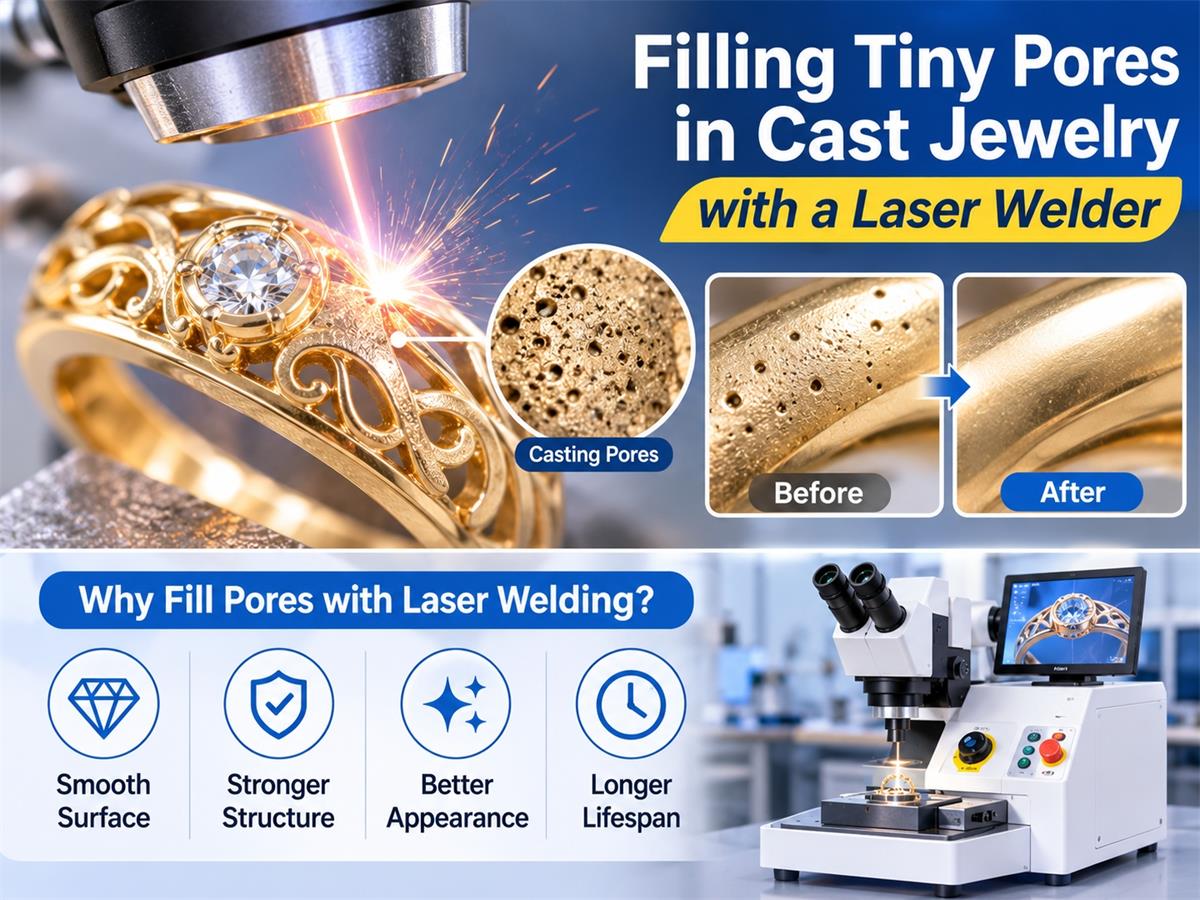
Tiny pores and pinholes are common defects in cast jewelry, especially in gold rings, silver pendants, and other detailed investment-cast pieces. Even when the overall casting looks good, small holes on the surface can reduce the visual quality and require additional finishing. A jewelry laser welding machine can help repair suitable surface porosity by adding compatible filler metal and melting it into the defective area with localized heat. For jewelry manufacturers and repair workshops, this offers a precise alternative to applying heat across a larger part of the finished piece.
1. Why Do Tiny Pores Appear in Cast Jewelry?
Porosity is one of the most frustrating defects in jewelry casting. A ring or pendant may look acceptable immediately after casting, but small holes can become visible during grinding, polishing, or final inspection.
Several factors can contribute to pores in cast jewelry:
- Gas porosity: Gas trapped in molten metal can form small rounded cavities as the metal solidifies.
- Shrinkage porosity: Insufficient feeding during solidification can leave small voids, especially in thicker sections or areas with uneven cooling.
- Investment or surface contamination: Residues and impurities can interfere with the metal surface and contribute to casting defects.
- Incorrect casting conditions: Metal temperature, mold temperature, vacuum conditions, and pouring technique can all influence casting quality.
- Alloy and material issues: Poorly controlled or contaminated metal can increase the risk of defects.
Not every visible hole is the same. Some are shallow surface pinholes, while others connect to deeper internal cavities. This distinction matters because a laser can repair an accessible surface defect, but it cannot reliably restore a casting that contains extensive internal porosity or a major structural void.
2. Can a Laser Welder Fill Tiny Pores in Gold and Silver Jewelry?
Yes. A pulsed jewelry laser welder can fill many small, accessible pores in cast gold and silver components. The operator directs a concentrated pulse at the defect and introduces a small amount of compatible filler metal when necessary.
The laser melts the filler and a controlled amount of the surrounding base metal, allowing them to fuse together. After cooling, the repaired area can be inspected and finished through careful filing and polishing.
Laser welding is useful for this type of work for three main reasons:
- Localized energy: The operator can target a tiny defect without heating the entire jewelry piece.
- Controlled material addition: Small amounts of filler can be deposited progressively rather than filling the hole with excessive solder.
- Precision under magnification: A microscope helps the operator locate small pores and control the welding position.
However, laser welding is not a universal solution for every casting defect. Deep shrinkage cavities, interconnected pores, and heavily contaminated areas may require more extensive repair or recasting.
3. How to Fill Tiny Casting Pores with a Jewelry Laser Welder
Step 1: Inspect the Defect
Examine the casting under magnification and determine the size, depth, and distribution of the pores. A single shallow pinhole is usually easier to repair than a group of connected cavities.
Check whether the defect is limited to the surface or appears to extend into the component. If the metal around the pore is weak, cracked, or extensively porous, filling the visible opening may only hide the problem temporarily.
Step 2: Clean the Repair Area
Remove polishing compound, oil, dirt, oxidation, and loose casting residues. Contaminants can cause unstable welding behavior, poor fusion, and additional surface defects.
For a pore that contains trapped residue, carefully expose clean metal before welding. Do not simply melt over the opening without checking what is inside.
Step 3: Prepare Compatible Filler Metal
Select filler wire that is compatible with the jewelry alloy. Gold karat, color, alloy composition, and silver or platinum grades should all be considered.
Using an unsuitable filler may create a visible color difference after polishing or lead to an inconsistent joint. For valuable jewelry, test the filler on a matching sample before repairing the finished piece.
Step 4: Adjust the Laser Welding Parameters
Start with conservative pulse energy and use a small, controlled spot. The objective is to melt the filler and achieve fusion with the surrounding metal without enlarging the defect or creating unnecessary heat buildup.
Important parameters include:
| Parameter | Recommended Approach | What to Control |
|---|---|---|
| Pulse energy | Start low and increase gradually | Prevent excessive melting and burn-through |
| Pulse duration | Adjust according to alloy and defect size | Control heat penetration |
| Frequency | Test on matching sample material | Avoid excessive heat accumulation |
| Spot diameter | Use a spot appropriate for the pore | Keep the weld localized |
| Filler wire | Match the base alloy as closely as practical | Maintain color and material compatibility |
There is no single parameter combination that works for every casting pore. A tiny hole in a thin silver pendant requires a different approach from a deeper defect in a thick gold ring. Always test on representative material before working on valuable jewelry.
Step 5: Add Filler in Small Increments
Position the laser at the edge or bottom of the prepared defect and introduce a small amount of filler metal. Apply controlled pulses to fuse the material with the surrounding base metal.
For a deeper but still repairable pore, build up the material gradually rather than trying to fill the entire cavity with one large deposit. This helps reduce excessive melting and makes it easier to control the final surface height.
Avoid repeatedly firing at the same location without allowing for appropriate cooling. Excessive heat can enlarge the hole, damage thin sections, or create a larger heat-affected area than necessary.
Step 6: Check the Repair and Polish
After welding, inspect the repaired area under magnification. Look for incomplete fusion, cracks, remaining pinholes, excessive filler, or discoloration.
Once the weld is sound, carefully remove excess material and polish the area to match the surrounding surface. Reinspect after polishing because a shallow remaining cavity may become visible again when the surface is leveled.
4. Which Jewelry Materials Can Be Repaired?
Laser filling can be used on different precious-metal alloys, but the welding response and finishing requirements vary by material.
Gold Casting
Gold rings, pendants, earrings, and other cast components are common applications. Yellow gold, white gold, and rose gold have different alloy compositions, so filler selection and welding parameters should be adjusted accordingly.
Silver Casting
Silver jewelry can develop visible pinholes after casting and polishing. Laser welding can help repair suitable surface defects, but silver’s thermal behavior requires careful parameter control. Excessive heat can make small repair areas difficult to manage.
Platinum Jewelry
Platinum components can also be laser welded with suitable equipment and compatible filler material. Because platinum has different thermal and melting characteristics from gold and silver, operators should use material-specific procedures and test settings.
In all cases, extensive internal porosity should be treated as a casting-quality problem rather than assumed to be a simple surface repair.
5. Laser Welding vs. Traditional Soldering for Casting Pores
Traditional soldering can be useful for some jewelry repairs, but it is not always convenient when dealing with tiny, isolated surface pores. Heating a larger area may affect nearby details and increase the amount of finishing required.
| Comparison | Laser Welding | Traditional Soldering |
|---|---|---|
| Heat application | Concentrated on a small area | Generally heats a wider area |
| Small defect repair | Suitable for localized pore filling | Can be less precise for isolated tiny pores |
| Filler application | Can be added in small increments | Usually involves solder placement and broader heating |
| Nearby details | Can reduce unnecessary heat exposure | May affect nearby components |
| Operator requirements | Requires laser parameter and positioning skills | Requires soldering and heat-control skills |
For small, localized defects, laser welding often provides better control over the repair area. Traditional soldering may remain appropriate for larger joints or situations where broader heating is acceptable. The correct method depends on the defect, metal, and finished jewelry design.
6. Choosing a Laser Welder for Jewelry Casting Repair
When selecting a machine for filling casting pores, do not focus on rated power alone. The most important practical features are stable pulse output, adjustable welding parameters, accurate spot positioning, and good visibility of the repair area.
For example, Dowin’s 150W jewelry spot laser welding machine is designed for precision jewelry welding and repair applications.
Its relevant features include:
- 150W YAG laser source: Designed for jewelry spot-welding applications.
- 0.2–2 mm adjustable spot diameter: Provides flexibility for different repair areas and welding tasks.
- Microscope observation: Helps operators position the laser accurately when working on small casting pores.
- LED shadowless lighting: Improves visibility around intricate jewelry details.
- Desktop configuration: Suitable for jewelry repair workshops and production environments.
For jewelry manufacturers, a microscope-equipped machine can be especially useful when repairing small pinholes that are difficult to identify and fill accurately with conventional tools.
Before purchasing, ask the supplier to demonstrate pore-filling samples using the same metal alloy and a comparable defect size to your actual production requirements. This is more useful than judging machine performance from rated power alone.
7. Common Mistakes When Filling Casting Pores
Welding Over Contamination
Oil, polishing compound, oxidation, and casting residues can interfere with fusion. Clean and prepare the defect before applying laser energy.
Using Too Much Filler
Excess filler creates a raised area that requires more grinding and polishing. Add material gradually and stop when the cavity is adequately filled.
Using Excessive Pulse Energy
Too much energy can enlarge a tiny pore or melt through a thin jewelry section. Begin with conservative settings and make adjustments based on test results.
Choosing the Wrong Filler Alloy
A filler with a different color or composition may remain visible after polishing. Match the jewelry alloy as closely as practical.
Repairing Deep Porosity as if It Were a Surface Defect
Filling the visible opening does not necessarily remove an internal void. For interconnected or extensive porosity, investigate the casting process and consider whether the component should be recast.
8. FAQ: Laser Welding Cast Jewelry Pores
Can a laser welder repair small holes in gold jewelry?
Yes. A pulsed laser welder can repair many small, accessible surface pores in gold jewelry by fusing compatible filler metal with the surrounding base metal. The defect must be properly cleaned and assessed before welding.
Can laser welding completely eliminate casting porosity?
No. Laser welding can repair suitable localized surface defects, but it does not guarantee the removal of deep or interconnected internal porosity. Severe defects may require recasting or other metallurgical solutions.
What filler wire should be used for gold casting repairs?
The filler should be compatible with the original gold alloy, including its karat and color. For example, yellow gold and rose gold generally require different alloy considerations. Test the filler before repairing valuable jewelry.
Can a 150W jewelry laser welder fill tiny casting pores?
A 150W pulsed YAG jewelry laser welder can be suitable for many small jewelry repair tasks, including appropriate surface-pore repairs. Actual results depend on pulse energy, spot size, material thickness, alloy composition, and operator technique.
Will the repaired pore still be visible after polishing?
A properly prepared and filled surface pore can often be polished to blend with the surrounding metal. However, incomplete fusion, incompatible filler, or a cavity that extends deeper than expected can leave a visible defect.
Is laser welding suitable for mass-production casting defects?
Laser welding can be useful for selective rework and high-value components, but it should not replace casting-process improvements. When the same porosity defect appears repeatedly, manufacturers should investigate melting, mold preparation, feeding, and solidification conditions.
Conclusion
Filling tiny pores in cast jewelry is a practical application of pulsed laser welding, especially when the defects are small, accessible, and limited to the surface. With proper cleaning, compatible filler metal, controlled pulse energy, and microscope-assisted positioning, operators can repair many casting imperfections while minimizing unnecessary heat exposure to the surrounding jewelry.
For jewelry manufacturers and repair workshops, choosing a stable YAG jewelry laser welder can improve the precision of small repair operations. Explore Dowin Jewelry Laser Welding Machines and request a sample test using your own cast gold or silver components.
Post time: Nov-18-2026
