
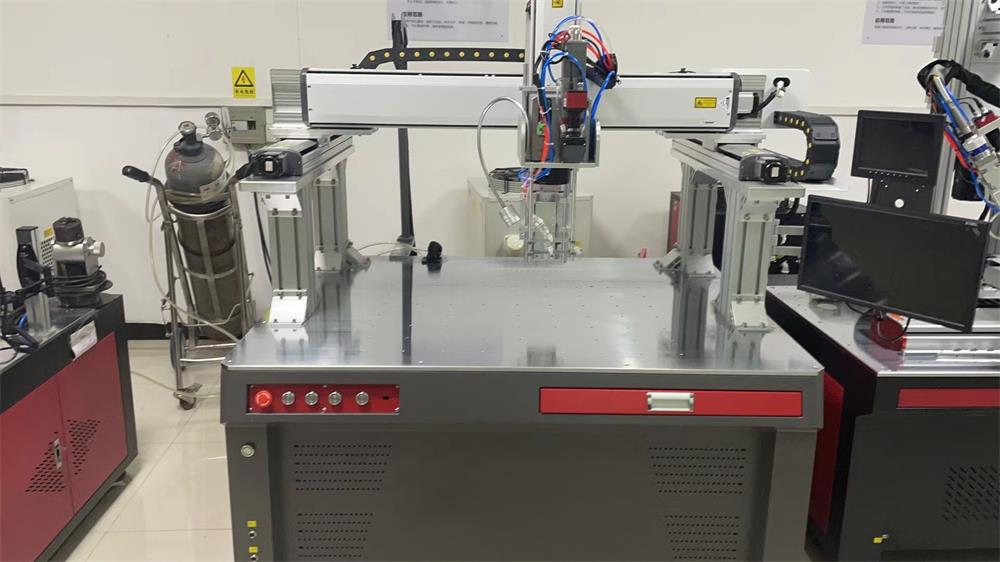
Why Fiber Laser Welding Became the Industry Standard
Laser welding isn’t new. But fiber lasers changed everything.
Today, fiber laser systems dominate battery manufacturing because they combine three critical advantages:
- High energy density → precise, deep welds
- Minimal heat-affected zone → protects sensitive cells
- Excellent beam stability → consistent quality at scale
In fact:
- Fiber lasers account for over 40–50% of battery welding market share
- They are the default choice in EV battery production lines worldwide
This is not a trend—it’s a technological consolidation.
The Real Technical Challenge: Welding Impossible Materials
Battery manufacturing involves materials that are notoriously difficult to weld:
- Copper (high reflectivity, high conductivity)
- Aluminum (low melting point, high thermal diffusion)
- Nickel (oxidation sensitivity)
Traditional welding methods struggle here.
Fiber lasers solve this through:
- High power density → overcomes reflectivity
- Controlled energy input → avoids overheating
- Precision spot size → enables micro-welding
This allows manufacturers to:
Weld dissimilar metals with high conductivity and minimal defects—something that was previously unreliable.
Where Fiber Laser Welding Is Used in Batteries
Fiber laser welding is not a single process—it’s embedded across the entire battery production chain:
1. Cell Tab Welding
Connecting thin metal tabs without damaging internal structures
→ Requires extreme precision
2. Busbar Welding
Linking cells to distribute current
→ Requires strong electrical conductivity
3. Module & Pack Assembly
Structural and electrical integration
→ Requires both strength and consistency
Battery pack welding alone accounts for ~38% of total application demand
Data Insight: Why This Market Is Exploding
The growth of fiber laser welding is directly tied to one force:
Electrification
- Global battery laser welding market: $2.17B (2024) → $4.42B by 2033
- CAGR: ~8–10% annually
- EV and energy storage demand are the primary drivers
Asia-Pacific leads adoption with ~48% market share, driven by large-scale battery manufacturing ecosystems
This is not incremental growth—it’s infrastructure-level expansion.
The Shift No One Explains: From Welding to Data
Modern fiber laser welding systems are no longer “machines.”
They are data systems with lasers attached.
New Capabilities:
- Real-time melt pool monitoring
- AI-driven defect detection
- Vision-guided alignment
- Digital traceability of every weld
Manufacturers now track:
- Weld penetration depth
- Temperature profiles
- Defect probabilities
Because:
In battery manufacturing, traceability equals safety.
A single defective weld can lead to:
- Thermal runaway
- Fire risks
- Product recalls
Fiber vs CO₂ vs Traditional Methods: The Hard Truth
CO₂ lasers and traditional welding still exist—but their role is shrinking.
- CO₂ lasers → larger heat zones, lower efficiency for metals
- Resistance welding → limited precision
- Ultrasonic welding → material limitations
Fiber lasers dominate because they align with three modern requirements:
- Miniaturization
- Automation
- High-volume production
The Real Bottleneck: Not Technology—Integration
Despite its advantages, fiber laser welding is not “easy.”
Challenges include:
- High capital investment
- Complex system integration
- Sensitivity to material variations
- Need for skilled operation
This creates a hidden barrier:
The advantage is not owning the machine—it’s mastering the process.
Breaking the Conventional Thinking
Most people assume:
Better batteries come from better chemistry.
That’s outdated.
The new reality:
Battery performance is increasingly defined by manufacturing precision, not just materials.
Because:
- Poor weld = higher resistance
- Higher resistance = heat
- Heat = degradation or failure
Final Insight: Fiber Laser Welding Is the Real “Battery Technology”
We tend to separate:
- Chemistry (R&D)
- Manufacturing (production)
But in reality, they are converging.
Fiber laser welding enables:
- Higher energy density (through tighter packing)
- Better safety (through consistent connections)
- Longer lifecycle (through stable joints)
It doesn’t just assemble batteries—it defines what batteries can become.
Closing Perspective
The future of batteries is not just:
- Solid-state
- Faster charging
- Higher capacity
It is also:
- More precise
- More traceable
- More manufacturable
And at the center of that transformation is one overlooked technology:
Fiber laser welding—the invisible backbone of electrification.
Post time: Apr-17-2026
