
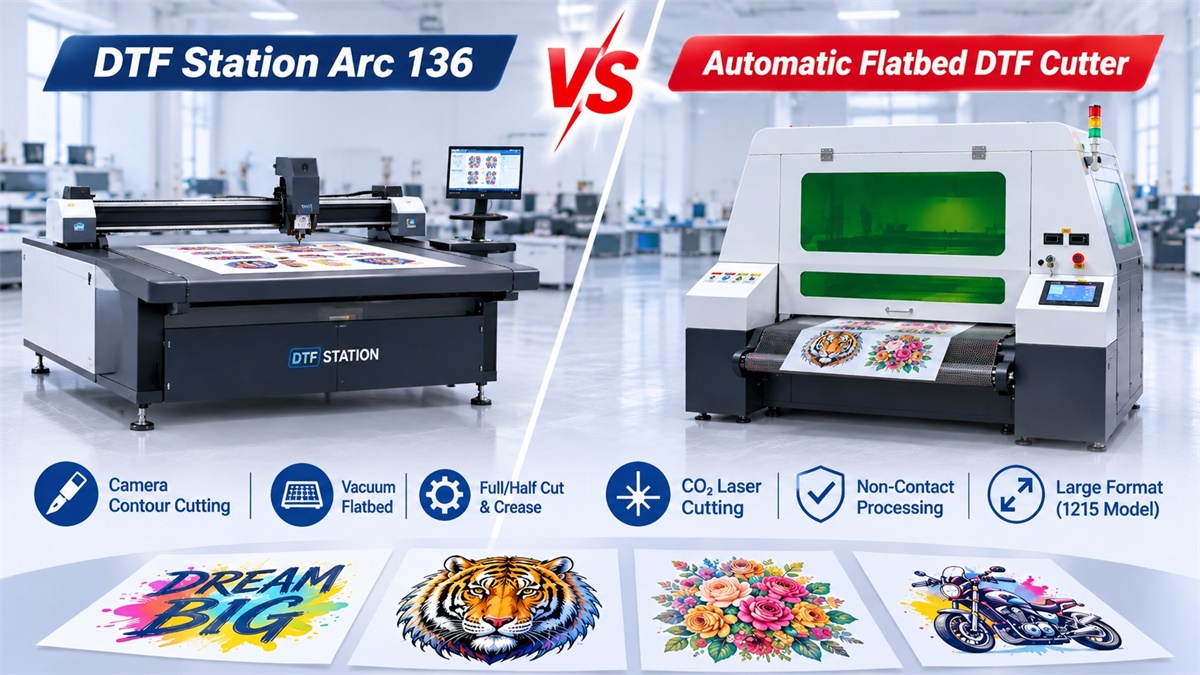
Choosing the right automatic DTF cutter is an important decision for growing transfer printing businesses. As production volumes increase, manual trimming becomes a bottleneck, especially when processing large gang sheets, custom graphics, and UV DTF stickers.
The DTF Station Arc 136 is an industrial flatbed cutter designed for automated DTF and UV DTF finishing. It uses camera-guided contour recognition, a vacuum platform, and mechanical cutting tools to process printed materials. However, businesses comparing automatic flatbed cutters should also consider CO2 laser cutting technology.
Dowin offers several alternatives, including the 9070 Automatic DTF Laser Cutter, the 9070 Enclosed DTF Laser Cutter, and the 1215 Large-Format DTF Laser Cutting Machine.
Although both technologies automate film cutting, their working principles, material handling methods, and production applications are different. This comparison explains what buyers should consider before investing in either system.
1. What Is the DTF Station Arc 136?
The DTF Station Arc 136 is a 36-inch-class industrial flatbed cutter developed for professional DTF and UV DTF production. It is designed to automate the process of cutting printed transfer sheets and customized graphics.
Unlike a conventional roll-to-roll vinyl cutter, the Arc 136 uses a flatbed working platform with camera tracking to recognize printed registration marks and follow cutting contours.
Its main features include:
- Approximately 90 cm (36-inch) media working width.
- Camera-based contour recognition.
- Vacuum flatbed platform for holding material in position.
- Full cut, half cut, and crease cutting functions.
- Cutting speed up to 100 cm/s (39.4 inches/s).
- Maximum cutting force of 9.8 N.
- Dual-tool configuration for different cutting operations.
- neoStampa RIP software integration.
- Automatic material handling and waste collection features, depending on configuration.
One of its practical advantages is the ability to perform different cutting operations on the same flatbed. For example, businesses producing stickers and packaging-related materials may benefit from full cutting, half cutting, and crease processing.
The Arc 136 is particularly suitable for established DTF printing factories that need an automated flatbed finishing system for larger-format production.
2. What Is an Automatic Flatbed DTF Laser Cutter?
An automatic flatbed DTF laser cutter uses a CO2 laser source to cut compatible printed films according to digital cutting paths. Instead of using a physical blade, it processes material through a focused laser beam.
Depending on the machine configuration, a camera or CCD vision system can identify printed graphics and registration marks, allowing the laser head to follow customized contours.
Dowin’s laser cutting solutions are designed for applications including:
- DTF PET transfer film contour cutting.
- TPU heat transfer logos and graphics.
- Custom garment labels and wash labels.
- UV DTF stickers and crystal labels.
- Customized textile decorations.
- Other compatible flexible film materials.
The biggest difference is the cutting method. A mechanical flatbed cutter uses blade pressure to separate the material, while a laser cutter uses concentrated heat without direct contact.
For businesses processing customized shapes and different film products, laser cutting offers a different production approach with digitally controlled cutting paths and no mechanical cutting blade.
However, laser processing is thermal. Material compatibility must be tested carefully, particularly when working with PET and TPU films that contain different coatings, adhesives, and printed layers.
3. DTF Station Arc 136 vs. Dowin Automatic DTF Laser Cutter
The following comparison highlights the major technical and operational differences between the two technologies.
| Comparison | DTF Station Arc 136 | Dowin Automatic DTF Laser Cutter |
|---|---|---|
| Cutting technology | Mechanical blade cutting | CO2 laser cutting |
| Machine structure | Industrial flatbed | Laser cutting platform |
| Positioning | Camera contour recognition | Camera / CCD vision positioning, depending on model |
| Material holding | Vacuum flatbed | Platform and feeding configuration, depending on model |
| Cutting method | Full cut, half cut, and crease | Laser contour cutting |
| Maximum cutting width | Approximately 90 cm | Depends on the selected model |
| Large-format option | 90 × 120 cm maximum sheet cutting size | 1215 model: 1200 × 1500 mm working area |
| Blade replacement | Required for mechanical cutting tools | No mechanical cutting blade |
| Thermal processing | No laser-related thermal effect | Yes, requires film compatibility testing |
| Additional applications | DTF, UV DTF, vinyl, stickers, and other compatible materials | DTF, TPU, UV stickers, garment labels, and other compatible materials |
It is important to understand that these machines are not direct replacements in every application. The Arc 136 offers multiple mechanical cutting operations, including crease cutting. Dowin laser machines focus on thermal contour cutting and compatible film processing.
For buyers, the best comparison should be based on actual cutting samples, material requirements, production volume, and the type of finished product.
4. Mechanical Flatbed Cutting vs. CO2 Laser Cutting
Mechanical Blade Cutting
The Arc 136 uses mechanical cutting tools to separate printed materials. Its vacuum platform helps hold the material flat during processing, while camera tracking identifies the printed contours.
This technology has several practical advantages:
- No laser-related heat exposure during cutting.
- Suitable for full cut, half cut, and crease operations.
- Vacuum holding helps stabilize flat materials.
- Suitable for a wide range of compatible sheet and roll materials.
- Can be integrated into an existing DTF printing workflow.
However, mechanical cutting tools experience wear during operation. Blade condition, cutting pressure, material thickness, and tool settings can all affect the final result.
CO2 Laser Cutting
CO2 laser cutting uses a focused beam to process compatible materials without physical blade contact.
Its main advantages include:
- No mechanical cutting blade to replace.
- Digitally controlled cutting paths.
- Non-contact processing without blade pressure.
- Suitable for customized shapes and complex contours.
- Different film-processing applications can be handled using appropriate laser parameters.
There are also limitations. Laser cutting can cause melting, discoloration, or deformation on unsuitable materials. Buyers should test the actual film and adhesive combination before purchasing equipment.
Another important consideration is that laser cutting does not automatically replace mechanical half-cutting and crease functions. If your products require these operations, confirm the required finishing process before choosing a laser system.
5. Which Dowin DTF Laser Cutter Should You Choose?
Dowin offers three configurations for different DTF and TPU film processing requirements. The right model depends on your working area, production environment, and expected output.
Dowin 9070 Automatic DTF Laser Cutter
The Dowin 9070 DTF Laser Cutter is designed for automatic laser contour cutting of printed DTF film.
Its main advantages include:
- CO2 laser cutting technology.
- Camera registration and contour recognition.
- Automatic loading and unloading options.
- Processing of compatible printed PET film and TPU materials.
- Digital cutting paths for customized graphics.
For businesses that mainly produce custom DTF transfers and want to move from mechanical cutting to laser contour processing, the 9070 is worth considering.
Dowin 9070 Enclosed DTF Laser Cutter
The 9070 Enclosed DTF Cutter features a fully enclosed laser working area.
Its main characteristics include:
- Fully enclosed machine structure.
- LED lighting and camera visibility.
- DTF PET film and compatible TPU film processing.
- Applications for UV stickers, crystal labels, and garment labels.
- A more controlled laser working environment.
For production facilities where laser enclosure, operator protection, and machine layout are important purchasing considerations, this configuration deserves attention.
Dowin 1215 Large-Format DTF Laser Cutting Machine
For larger production requirements, the Dowin 1215 DTF and TPU Film Laser Cutting Machine provides a significantly larger processing area.
Its main configuration includes:
- 1200 × 1500 mm working area.
- Dual 160W laser head configuration.
- Automatic feeding system.
- Industrial CCD camera positioning technology.
- Servo motor and industrial transmission system.
- Linear guide rails for stable machine movement.
The larger working area is useful for manufacturers processing multiple designs and larger material layouts. The dual-head configuration is designed for production environments requiring greater processing capacity.
Compared with a 90 cm-class flatbed cutter, the 1215 provides more room for larger-format processing. However, actual throughput depends on the cutting file, material, laser parameters, and production arrangement.
6. How to Choose the Right Automatic DTF Cutter
Before investing in an industrial DTF cutting machine, consider these five factors.
1. Cutting Accuracy and Artwork Complexity
For DTF transfers with irregular contours, small lettering, and detailed graphics, camera recognition and cutting-path accuracy are important.
Ask suppliers to demonstrate the cutting process using your own artwork rather than relying only on advertised mechanical resolution or positioning accuracy.
2. Full Cut, Half Cut, or Laser Contour Cutting?
Different products require different finishing operations. Sticker manufacturers may need kiss cutting and full cutting, while some packaging applications require crease processing.
Mechanical flatbed systems such as the Arc 136 offer dedicated blade-based operations. Laser systems provide digital contour cutting but should not be assumed to perform every blade-based function.
3. Material Compatibility
Consider the materials you process every day. DTF PET film, TPU film, vinyl, PVC, and UV DTF materials have different physical properties.
For laser machines, request actual sample tests to evaluate cutting edges, melting, deformation, and the effect on printed or adhesive layers.
4. Working Area and Production Volume
A 90 cm-class machine may be sufficient for many standard DTF production workflows. Larger manufacturers may prefer a 1200 × 1500 mm working area to accommodate bigger layouts and multiple designs.
Do not select a machine based only on its maximum advertised speed. Feeding, positioning, cutting time, unloading, and material arrangement all influence real production capacity.
5. Machine Integration and Factory Space
Consider how the cutter will work with your existing DTF printer, powder shaker, dryer, and heat press. Software compatibility and file transfer should also be confirmed before purchasing.
Industrial flatbed cutters and enclosed laser machines have different space, electrical, ventilation, and maintenance requirements. Plan these requirements before installation.
7. Final Verdict: DTF Station Arc 136 or Dowin Laser Cutter?
The DTF Station Arc 136 is an industrial mechanical flatbed cutter designed for automated DTF and UV DTF finishing. Its camera tracking, vacuum platform, dual-tool configuration, and full-cut, half-cut, and crease functions make it suitable for professional printing businesses that need versatile mechanical cutting.
Dowin takes a different approach with CO2 laser cutting technology. Its 9070 models provide automatic laser contour cutting in standard and enclosed configurations, while the 1215 offers a larger working area and dual laser heads for broader production requirements.
Here is a practical selection guide:
- For mechanical flatbed cutting and crease operations: Consider the DTF Station Arc 136.
- For automatic DTF laser contour cutting: Consider the Dowin 9070.
- For enclosed laser processing: Consider the Dowin 9070 Enclosed DTF Cutter.
- For larger-format dual-head laser production: Consider the Dowin 1215.
At Dowin, we manufacture CO2 laser cutting machines for DTF and TPU film applications. We recommend selecting equipment according to your actual film materials, artwork complexity, production capacity, and finishing requirements.
If you are comparing an industrial flatbed cutter with a laser cutting solution, send us your DTF film samples and cutting files. Our team can evaluate material compatibility and recommend a suitable Dowin machine configuration.
Frequently Asked Questions
Is the DTF Station Arc 136 a laser cutter?
No. The Arc 136 is a mechanical flatbed cutting machine. It uses cutting tools and camera tracking rather than a CO2 laser source.
What is the maximum cutting width of the Arc 136?
The Arc 136 is designed for approximately 90 cm (36-inch) media. Its published maximum sheet cutting size is 90 × 120 cm. Confirm the usable dimensions of your selected configuration with the supplier.
Can the Arc 136 perform both full cut and half cut?
Yes. The Arc 136 supports full cutting, half cutting, and crease operations, making it suitable for different finishing requirements.
What is the difference between a flatbed DTF cutter and a laser DTF cutter?
A mechanical flatbed cutter uses physical blades to cut the material, while a laser DTF cutter uses a focused CO2 laser beam. Mechanical systems can offer full-cut, kiss-cut, and crease functions, while laser systems provide non-contact digital contour cutting for compatible materials.
Can Dowin laser cutters process UV DTF stickers?
Dowin laser cutting machines can be configured for compatible UV sticker and crystal label applications. The actual material structure should be tested to confirm cutting quality and thermal compatibility.
Is the Dowin 1215 larger than the Arc 136?
Yes. The Dowin 1215 has a 1200 × 1500 mm working area, while the Arc 136 has a maximum sheet cutting size of approximately 900 × 1200 mm.
Does a CO2 laser cutter need blade replacement?
No mechanical cutting blade is required. However, laser sources, optical components, exhaust systems, and mechanical parts still require routine maintenance.
Which machine is better for high-volume DTF production?
It depends on the production process. The Arc 136 is suitable for high-volume mechanical flatbed finishing, especially when crease and half-cut operations are needed. Dowin laser systems are worth considering when digital contour cutting, compatible film processing, and larger-format laser production are priorities.
Post time: Nov-09-2026
