
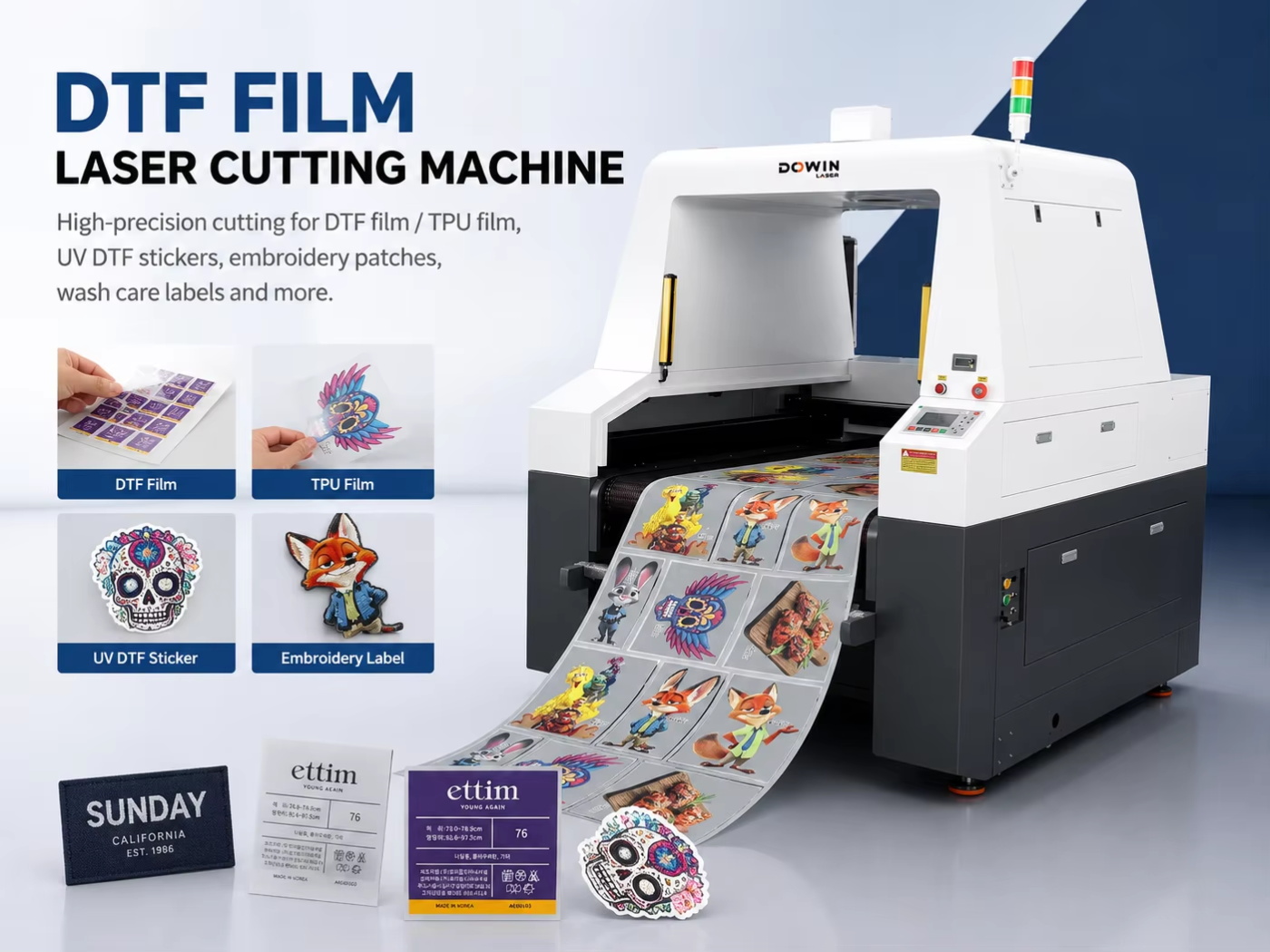
DTF printing has made custom apparel production faster and more flexible, but cutting printed DTF film can still become a bottleneck. Traditional cutting methods may work for small quantities, yet they can be less efficient when production volume increases or designs become more detailed.
A DTF laser cutter provides a more precise and automated alternative, helping DTF printing businesses improve the cutting stage without changing their existing printing workflow.
Why Replace Traditional DTF Film Cutting?
Traditional cutting methods often require blades, manual positioning, or additional handling. As designs become more complex, problems such as inaccurate cutting, film movement, and slower production can become more noticeable.
Laser cutting uses a focused laser beam instead of a physical blade. This allows the machine to follow digital cutting paths accurately and process small details that can be difficult for conventional cutting tools.
For businesses already using DTF printers, adding a laser cutter can create a more complete workflow:
DTF Printing → Powder Application → Curing → Laser Cutting → Finished DTF Transfer
This makes the laser cutter an efficiency upgrade rather than a completely separate production system.
Key Advantages of a DTF Laser Cutter
1. Precise Cutting
Laser cutting follows digital artwork and cutting paths with high accuracy. It is suitable for logos, lettering, small patterns, and other detailed DTF designs.
2. No Blade Wear
A laser cutter does not rely on a mechanical blade. There is no need to constantly replace or sharpen cutting blades, which can reduce routine maintenance.
3. Faster Production
For businesses producing large quantities of DTF transfers, automated laser cutting can reduce manual cutting work and improve production consistency.
4. Better for Complex Designs
Small text, curves, irregular shapes, and detailed patterns can be challenging for traditional cutting. Laser processing provides more flexible cutting control.
5. Easy Digital Workflow
Our DTF laser cutting machines can be integrated into a digital production workflow, allowing operators to move from printed transfer artwork to automated cutting with less manual handling.
DTF Laser Cutter vs. Traditional Cutting
| Feature | DTF Laser Cutter | Traditional Cutting |
|---|---|---|
| Cutting method | Laser beam | Physical blade |
| Small details | Excellent | Depends on blade and setup |
| Blade replacement | Not required | Required |
| Automation | High | Often more manual |
| Complex shapes | Easy to process | Can be more difficult |
| Production consistency | High | Operator dependent |
Who Should Consider a DTF Laser Cutter?
A DTF laser cutter is particularly useful for DTF printing companies, DTF transfer manufacturers, DTF printer distributors, custom apparel businesses, and garment manufacturers.
If your business is already producing DTF transfers in volume, laser cutting can help remove one of the manual steps between printing and finished transfer production.
At Dowin, we manufacture laser equipment for industrial and commercial applications. If you are unsure whether laser cutting is suitable for your DTF film, you can send us your film or cutting requirements for testing before choosing a machine.
FAQ About DTF Laser Cutters
Can a laser cutter cut DTF transfer film?
Yes. A properly configured laser cutter can process DTF transfer film with controlled laser parameters. The exact settings depend on the film structure, thickness, cutting speed, and laser configuration.
Is laser cutting better than blade cutting for DTF?
For detailed designs, repetitive production, and higher-volume work, laser cutting can provide better automation and consistency. Blade cutting can still be practical for simple, low-volume applications.
Will a DTF laser cutter damage the printed design?
With suitable laser power, speed, focus, and cutting parameters, the laser can be controlled to cut the required film layer while minimizing unwanted thermal effects around the design.
Can a DTF laser cutter be used for mass production?
Yes. Automated laser cutting is especially suitable for businesses that produce large numbers of DTF transfers and want to reduce manual cutting labor.
How do I choose the right DTF laser cutter?
Consider your daily production volume, film type, cutting size, design complexity, required automation, and available workspace. Testing your actual DTF film is the most reliable way to determine the appropriate configuration.
Conclusion
For DTF businesses looking to replace slow or labor-intensive traditional cutting, a DTF laser cutter offers a practical upgrade. Precise digital cutting, reduced blade maintenance, automation, and consistent processing make laser technology well suited to modern DTF transfer production.
If you are planning to upgrade your DTF production line, contact us with your DTF film samples or production requirements. We can recommend a suitable laser cutting solution and test the cutting results before you make a decision.
Post time: Sep-08-2026
