
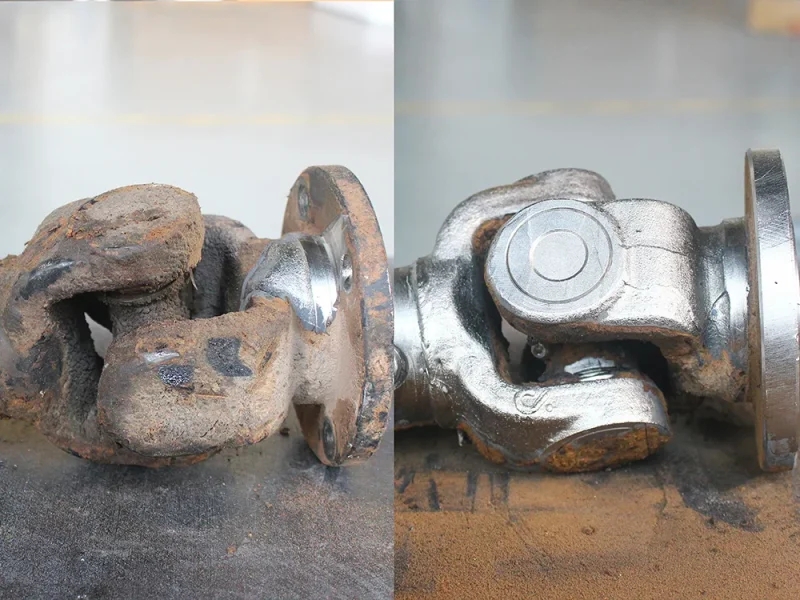
In industrial circles, few questions are asked more frequently than this one:
“If a laser can cut steel, why wouldn’t it damage metal during cleaning?”
The concern is logical—but it is based on a misunderstanding of how laser cleaning actually works. The truth is more nuanced, and far more revealing about the future of manufacturing.
The Short Answer (But Not the Whole Truth)
When properly configured, laser cleaning does not damage metal surfaces.
It removes rust, paint, oil, and oxides while leaving the base material intact.
But this answer is incomplete.
Because the real story is not “safe vs unsafe”—it is about control vs misuse.
Why Laser Cleaning Usually Doesn’t Damage Metal
1. Selective Energy Absorption (The Core Mechanism)
Laser cleaning works on a fundamental physical principle:
- Contaminants (rust, paint, grease) absorb laser energy easily
- Metals (steel, aluminum, copper) reflect or dissipate that energy
This creates a natural filtering effect:
The laser “sees” dirt differently than it sees metal.
As a result, contaminants heat up, break apart, and vaporize—while the underlying metal remains largely unaffected.
2. The “Ablation Threshold” Advantage
Every material has an energy threshold at which it begins to break down.
- Rust and coatings → low threshold
- Solid metals → high threshold
Laser cleaning operates in a narrow window:
Above the dirt threshold, below the metal threshold
This is why it behaves like a precision scalpel rather than a cutting blade.
3. Non-Contact Means No Mechanical Damage
Traditional cleaning methods introduce physical stress:
- Sandblasting → erosion and micro-scratches
- Chemical cleaning → corrosion and residue
- Mechanical scraping → deformation
Laser cleaning eliminates all of that:
- No friction
- No abrasion
- No surface wear
The result is zero mechanical degradation when parameters are correct.
4. Controlled Heat, Not Bulk Heating
A common misconception is that lasers “burn” metal.
In reality:
- Energy is delivered in short, localized bursts
- The beam is constantly moving
- Heat does not accumulate in the substrate
This prevents melting, warping, or structural change under normal conditions.
When Laser Cleaning Can Damage Metal
This is where most marketing narratives stop—but this is where real engineering begins.
1. Incorrect Parameter Settings
If power, speed, or focus are misconfigured:
- Energy may exceed the metal’s threshold
- Local overheating can occur
- Surface etching or discoloration may appear
Even authoritative sources note that improper settings can lead to surface effects like etching.
2. Continuous Exposure in One Spot
Holding the beam too long in one area can:
- Accumulate heat
- Cause micro-melting
- Alter surface texture
This risk is higher with continuous wave (CW) lasers, which deliver uninterrupted energy.
3. Material Sensitivity Differences
Not all metals behave the same:
- Steel → highly tolerant
- Aluminum → more sensitive to heat
- Copper/brass → reflective but tricky
For sensitive materials, pulsed lasers are preferred because they limit heat penetration.
4. Wrong Application Scenarios
Laser cleaning is designed for surface-level removal.
If used for:
- Deep corrosion
- Thick multi-layer coatings
- Structural restoration
…it may require aggressive settings that increase risk.
The Bigger Industry Insight: Why This Question Exists
The confusion comes from mixing two completely different technologies:
| Application | Laser Type | Purpose |
|---|---|---|
| Cutting | High-power continuous | Melt and penetrate metal |
| Welding | Focused thermal | Fuse materials |
| Cleaning | Controlled, selective | Remove surface contaminants |
Same tool.
Different physics.
Different outcomes.
What the Data and Industry Adoption Reveal
Across automotive, aerospace, and precision manufacturing:
- Laser cleaning is widely used on high-value components
- It replaces abrasive and chemical methods specifically to protect surface integrity
- It is chosen where tolerances are measured in microns
This would not be possible if it inherently damaged metal.
In fact, the opposite is true:
It is often adopted because other methods cause damage.
The Real Answer (Without Simplification)
Does laser cleaning damage metal?
- No, when used correctly
- Yes, if misused or poorly calibrated
But this duality exists in every advanced manufacturing process.
Final Perspective: From Fear to Control
The real shift is conceptual.
Old thinking:
“Will this tool damage my material?”
Modern thinking:
“How precisely can I control energy at the material level?”
Laser cleaning is not just a cleaning method. It is:
A controlled interaction between energy and matter, engineered at the threshold level.
And that is why it is rapidly becoming the standard in industries where precision is not optional—it is survival.
Post time: Apr-15-2026
