
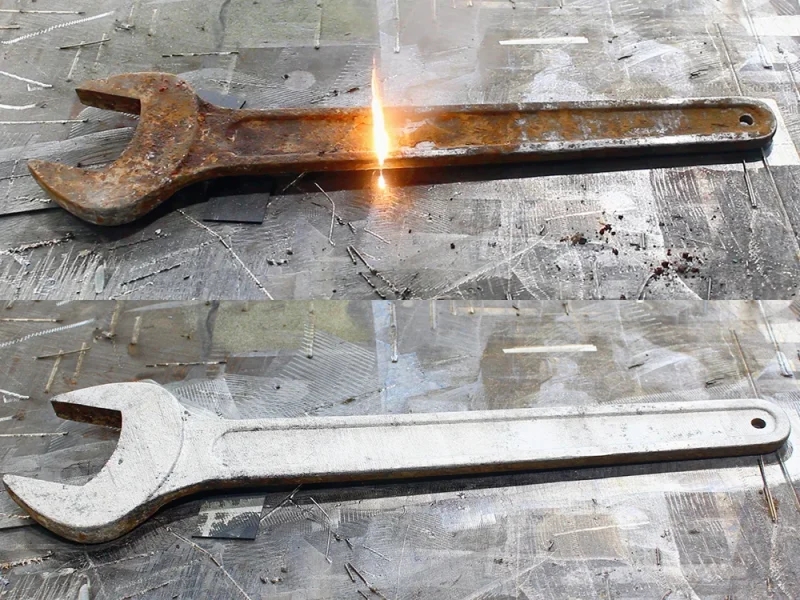
In modern manufacturing, cleaning is no longer a secondary process—it is a critical node in productivity, quality control, and compliance. As industries shift toward automation and sustainability, continuous wave (CW) laser cleaning machines have emerged as a high-efficiency alternative to traditional methods.
But like any industrial technology, CW laser cleaning is not universally superior. Its value lies in where it excels—and where it doesn’t.
Understanding CW Laser Cleaning (Beyond the Basics)
A CW (continuous wave) laser cleaning machine operates by emitting a steady, uninterrupted beam of energy that heats and removes contaminants such as rust, paint, oil, and oxides from surfaces.
Unlike pulsed systems that deliver energy in bursts, CW lasers provide constant thermal input, making them particularly effective for large-area and heavy-duty cleaning tasks.
This is not precision-first technology.
It is throughput-first engineering.
Why CW Laser Cleaning Is Gaining Industrial Momentum
The global cleaning industry is undergoing a structural shift:
- Environmental regulations are tightening
- Labor costs are rising
- Production downtime is increasingly expensive
CW laser systems align with these pressures by offering a fast, scalable, and relatively simple cleaning solution.
1. High-Speed Material Removal
CW lasers deliver continuous energy, enabling rapid removal of thick contaminants like rust or coatings.
This makes them ideal for:
- Steel structures
- Heavy machinery
- Shipbuilding and infrastructure maintenance
In large-scale operations, speed is not a feature—it is the difference between profit and loss.
2. Lower Equipment Cost Compared to Precision Systems
Compared to pulsed laser systems, CW machines typically have:
- Simpler architecture
- Lower initial purchase cost
- Easier maintenance requirements
This positions them as an entry point into laser cleaning adoption, especially for cost-sensitive industries.
3. Operational Simplicity
CW systems are often easier to operate due to:
- Fewer adjustable parameters
- Stable output characteristics
- Reduced need for high-level technical calibration
This reduces training time and enables faster deployment across production lines.
4. Strong Performance in Industrial Environments
CW laser cleaning is particularly suited for robust materials and non-sensitive surfaces, where minor thermal effects are acceptable.
In these contexts, precision is secondary to coverage and efficiency.
The Trade-Offs: Where CW Systems Reveal Their Limits
The same characteristics that make CW lasers powerful also define their limitations.
1. Thermal Accumulation and Surface Impact
Because energy is delivered continuously, heat builds up on the substrate. This can lead to:
- Micro-surface damage
- Oxidation or discoloration
- Material deformation in sensitive components
Continuous energy means continuous risk.
Precision is sacrificed for speed.
2. Limited Precision Control
Unlike pulsed lasers, CW systems lack fine control over energy delivery. This results in:
- Reduced selectivity
- Difficulty handling delicate or thin materials
- Less suitability for high-end applications (electronics, aerospace components)
3. Not Ideal for All Contaminants
CW lasers perform best on moderate to heavy surface contaminants, but struggle with:
- Thick grease or layered oil deposits
- Complex biological fouling
- Deeply embedded contaminants in porous structures
In such cases, multiple passes or alternative methods may be required.
4. Energy Consumption and Infrastructure Demands
CW systems typically require:
- High power input (often several kilowatts)
- Stable cooling systems (often water-based)
- Controlled operating environments
This limits their flexibility, especially in mobile or outdoor scenarios.
5. Maintenance and Operational Constraints
Continuous systems introduce practical challenges:
- Frequent replacement of optical components (e.g., protective lenses)
- Sensitivity to temperature conditions (optimal range typically 10–35°C)
- Need for specialized antifreeze in low-temperature environments
These are not deal-breakers—but they add hidden operational complexity.
6. Safety and Environmental Restrictions
Despite being cleaner than chemical methods, CW laser cleaning still carries risks:
- High-energy beams require strict safety protocols
- Potential spark generation limits use in flammable environments
This restricts deployment in industries such as petrochemicals or explosive environments.
The Strategic Position of CW Laser Cleaning
To understand CW laser cleaning, it must be positioned correctly:
| Dimension | CW Laser Cleaning |
|---|---|
| Speed | High |
| Precision | Moderate to Low |
| Cost | Moderate |
| Best Use Case | Large-scale, heavy-duty cleaning |
| Risk | Thermal impact |
It is not a universal solution. It is a specialized tool optimized for scale.
The Bigger Insight: Efficiency vs. Control
The real decision is not between CW and other technologies. It is between two philosophies:
- Efficiency-first (CW lasers)
- Precision-first (pulsed lasers)
CW laser cleaning wins when:
- Surface tolerance is high
- Volume is large
- Time is critical
It loses when:
- Surface integrity is paramount
- Materials are sensitive
- Fine detail matters
Final Perspective
CW laser cleaning machines are often misunderstood as a “budget version” of advanced laser systems. That is incorrect.
They are better described as:
A high-throughput industrial solution designed for scale, not perfection
In a world where manufacturing is increasingly data-driven and efficiency-optimized, CW laser cleaning does not replace other methods—it redefines where speed becomes more valuable than precision.
The companies that succeed will not ask,
“Is CW laser cleaning better?”
They will ask,
“Where does it create the most leverage?”
Post time: Apr-15-2026
