
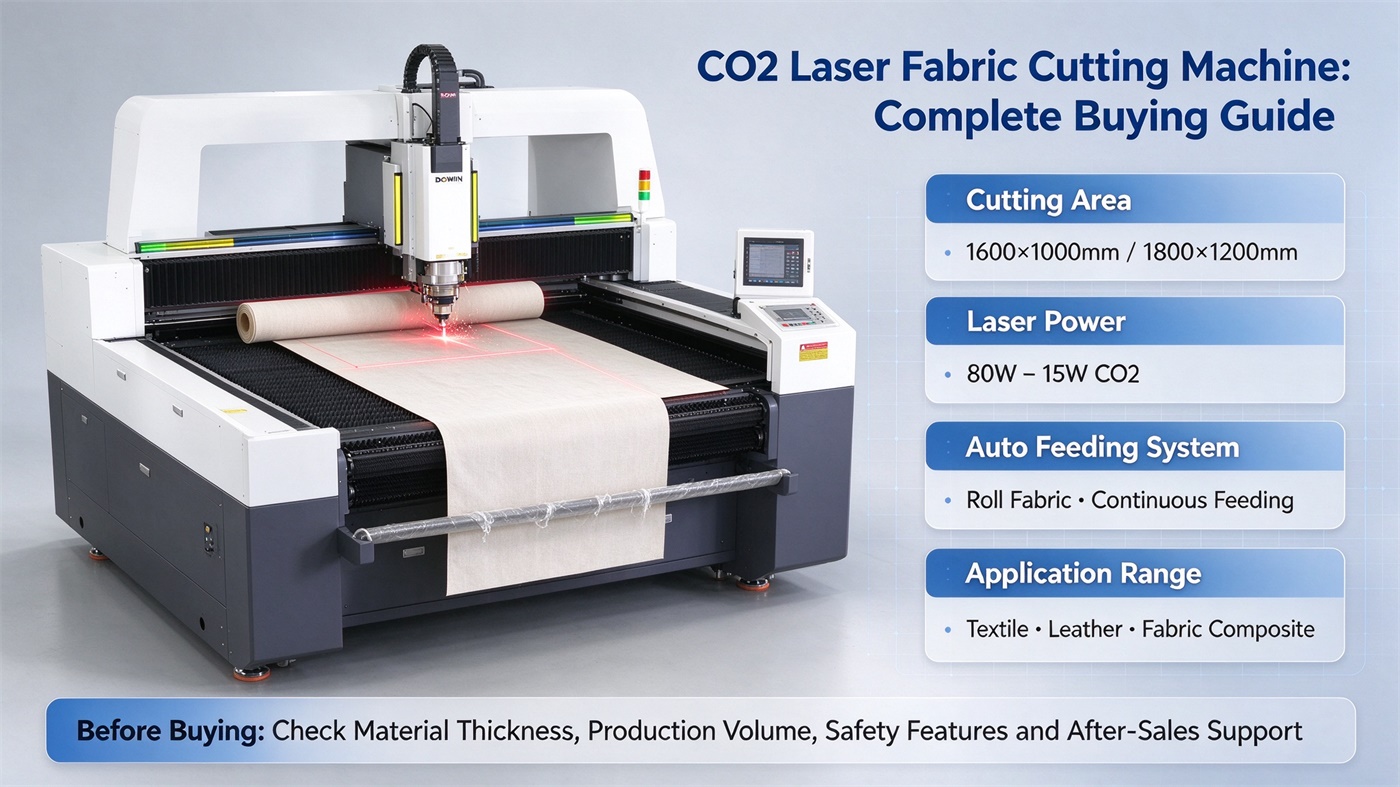
A CO2 laser fabric cutting machine is widely used in textile manufacturing, garment production, home textile processing, and custom fabric cutting. Compared with manual cutting and some mechanical cutting methods, CO2 laser cutting offers automated processing, flexible pattern cutting, and clean, contact-free operation.
However, not every CO2 laser cutting machine is suitable for every fabric. Material composition, fabric thickness, cutting speed, working area, and production volume all affect the machine you should choose.
This buying guide explains how CO2 laser fabric cutting machines work, which fabrics they can process, what specifications matter most, and how to select the right equipment for your business.
1. What Is a CO2 Laser Fabric Cutting Machine?
A CO2 laser fabric cutting machine uses a carbon dioxide laser source to generate an infrared laser beam, typically with a wavelength of approximately 10.6 μm. The beam is focused onto the fabric, heating and vaporizing or thermally separating the material along a programmed cutting path.
Most systems use CNC control software to follow digital designs created in CAD or graphic design programs. This makes it possible to cut intricate shapes, repeated patterns, and customized designs without manufacturing a dedicated cutting die.
Depending on the machine configuration, fabric cutting can be performed on a flat working table, a conveyor system, or a roll-to-roll production line.
For manufacturers processing flexible materials, a CO2 laser fabric cutting machine can support both small-batch customization and automated production.
2. Which Fabrics Can a CO2 Laser Cutting Machine Cut?
Material compatibility is one of the first things to evaluate before purchasing a fabric laser cutter. CO2 lasers work well with many non-metallic materials, but the cutting results vary according to the fiber composition, weave, coating, and thickness.
Synthetic fabrics
Polyester, nylon, and some synthetic blends can be cut with suitable laser parameters. Because these materials are thermoplastic, the heat can seal the edges during cutting, helping reduce fraying. However, excessive heat may cause melting, discoloration, or edge distortion.
Natural fabrics
Cotton, linen, and some other natural textiles can be laser cut, but their edges may darken or char depending on the material and processing conditions. Testing is important when appearance is critical.
Felt and nonwoven fabrics
Certain polyester felts and nonwoven materials are suitable for CO2 laser cutting. Applications include decorative products, textile accessories, crafts, and industrial components.
Technical textiles
Some coated fabrics, technical textiles, and flexible industrial materials can also be processed. Their suitability depends on the coating and chemical composition.
PVC-containing materials should generally not be laser cut because laser processing can release hazardous and corrosive gases. Other coated or chemically treated fabrics should be checked against the manufacturer’s safety guidance before processing.
Before purchasing a machine, ask the supplier to test your actual fabric samples and evaluate edge quality, cutting speed, smoke generation, and dimensional accuracy.
3. What Laser Power Do You Need for Fabric Cutting?
Laser power affects cutting capability, processing speed, and the range of materials a machine can handle. However, higher power does not automatically mean better cutting quality.
| Laser power | Typical applications |
|---|---|
| 40W–60W | Lightweight fabrics, crafts, thin textile materials, and detailed designs |
| 80W–100W | General fabric cutting, garment components, felt, and medium-duty production |
| 130W–150W | Higher-throughput cutting and some thicker or multilayer textile applications |
| 180W and above | Selected demanding applications requiring higher processing capacity |
These ranges are general starting points rather than guaranteed production specifications. Actual performance depends on the laser source, optical configuration, fabric properties, cutting head, motion system, and required edge quality.
For example, a 100W CO2 laser may be suitable for many textile cutting tasks, but a high-speed production line may require a different combination of power, motion control, and automation.
When comparing machines, request sample cuts at your target production speed rather than relying solely on the rated laser power.
4. Flatbed vs. Conveyor CO2 Laser Fabric Cutting Machines
The working table and material-feeding system determine how efficiently the machine handles your production workflow.
Flatbed laser cutting machine
A flatbed machine processes material placed on a stationary working area. It is suitable for individual fabric panels, small batches, samples, customized products, and designs that require frequent changes.
Its main advantage is flexibility. Operators can load different materials and switch between cutting jobs without setting up a continuous production line.
Conveyor laser cutting machine
A conveyor system moves fabric through the cutting area, allowing longer material sections to be processed continuously or in successive sections. This configuration is useful for businesses working with fabric rolls and repetitive production orders.
A conveyor machine may improve productivity by reducing manual material handling, but the result depends on feeding accuracy, fabric tension, alignment, and software coordination.
For large-volume textile production, an automatic feeding system can be more valuable than simply upgrading to a higher-power laser source.
5. Five Important Specifications to Check Before Buying
Working Area
The working area should match the width and size of the fabric pieces you need to cut. A larger table can accommodate bigger patterns and reduce repositioning, but it also increases the machine’s footprint and may affect the initial investment.
For roll materials, confirm both the usable cutting width and the feeding method.
Cutting Speed and Acceleration
Manufacturers often advertise maximum cutting speeds, but these figures do not necessarily represent real production output. Complex curves, small details, frequent direction changes, and material positioning can reduce effective throughput.
Ask for a demonstration using a representative design and compare the actual time required to complete the job.
Motion System
The motion system affects positioning accuracy, repeatability, and stability. Depending on the machine design, important components may include motors, linear guides, transmission systems, and motion controllers.
For repeated textile patterns, stable movement and consistent positioning are essential for maintaining uniform cutting results.
Exhaust and Smoke Filtration
Laser cutting fabric generates smoke and airborne particles. An appropriate exhaust system is essential for removing fumes from the working area.
Depending on the materials processed and local regulations, additional filtration may be required. Confirm that the extraction system has sufficient capacity for the machine and your intended production environment.
Software Compatibility
Check whether the control software supports your existing design workflow and file formats. Efficient import, nesting, path optimization, and repeat-job functions can reduce material waste and preparation time.
For businesses processing many custom orders, software usability can significantly affect daily productivity.
6. How Much Does a CO2 Laser Fabric Cutting Machine Cost?
The price depends on laser power, working area, automation level, motion components, software, and after-sales support.
Entry-level flatbed machines generally require a lower investment than large-format conveyor systems with automatic feeding. Higher-output production machines may cost more because of their motion systems, larger working areas, and integrated automation.
When comparing quotations, look beyond the machine price. Consider the laser source, cutting head, exhaust equipment, installation, training, spare parts, warranty, and expected maintenance expenses.
It is also important to calculate material utilization. A machine that cuts slightly faster but wastes more fabric may not be the most economical choice.
A practical comparison should include the following costs:
-
Initial machine investment
-
Electricity and extraction costs
-
Labor and material handling
-
Lens and other replacement parts
-
Routine maintenance
-
Fabric waste and rejected pieces
-
Downtime and technical support
The best-value machine is the one that meets your required output and quality standards at a sustainable total operating cost.
7. CO2 Laser Cutting vs. Mechanical Fabric Cutting
Both technologies have a place in textile manufacturing. The right choice depends on the material, production volume, design complexity, and required edge quality.
| Factor | CO2 laser cutting | Mechanical cutting |
|---|---|---|
| Intricate patterns | Excellent for complex digital designs | Depends on the tool and cutting method |
| Tooling requirements | No dedicated cutting die for each pattern | Some methods require dies or specialized tooling |
| Edge finish | Can seal some synthetic fabric edges; may char others | Usually avoids thermal discoloration |
| Contact with fabric | Non-contact cutting | Blade or tool contacts the material |
| Automation | Supports CNC and conveyor integration | Also supports highly automated production |
| Material suitability | Depends on thermal response and chemical composition | Depends on blade, tool, and material characteristics |
A CO2 laser is particularly useful for intricate designs and frequent pattern changes. Mechanical cutting may be preferable for some thick, heat-sensitive, or thermally unsuitable materials.
For multilayer fabric cutting, evaluate whether the laser’s thermal effects and cutting depth meet your requirements. A mechanical cutter may offer better results for certain stacked materials.
8. How to Choose the Right CO2 Laser Fabric Cutting Machine
Before contacting a supplier, define your actual production requirements.
First, identify the fabrics you process most frequently, including fiber composition, thickness, coatings, and whether the material arrives as sheets or rolls.
Next, determine your required working width, daily production volume, cutting tolerance, and acceptable edge appearance. These requirements will help narrow down the necessary laser power and machine configuration.
Then, decide whether you need a flatbed system, a conveyor machine, or automatic roll feeding. If your production involves many repeated patterns, also consider nesting software and material alignment features.
Finally, request sample testing. A reliable supplier should be able to demonstrate cutting performance using your materials and explain the recommended parameters, exhaust requirements, maintenance schedule, and limitations.
For manufacturers processing DTF transfer film, textile labels, felt, and other suitable flexible materials, it is also worth comparing whether a dedicated film cutter or a specialized textile cutting system would better match the application. Different materials and cutting requirements may call for different technologies.
9. Why Consider Dowin CO2 Laser Cutting Equipment?
Dowin provides laser processing equipment for industrial and commercial applications. When evaluating a CO2 laser cutting solution for fabric or other flexible materials, buyers should compare the available working area, laser configuration, motion system, software, and feeding options against their actual production requirements.
For businesses that also process DTF transfer film, TPU film, or other flexible materials, selecting the correct cutting configuration is particularly important. Fabric cutting and film cutting may share some equipment requirements, but they should not automatically be treated as the same application.
Before choosing a machine, provide the supplier with your material samples, maximum cutting width, typical design files, and target production volume. This makes it easier to identify a suitable configuration and obtain a meaningful quotation.
Conclusion
A CO2 laser fabric cutting machine can improve design flexibility, automate intricate cutting tasks, and support a wide range of textile applications. However, the best machine depends on more than laser power or advertised cutting speed.
Material compatibility, working area, motion stability, feeding automation, smoke extraction, and total operating cost all influence the final result.
For small workshops, a flatbed machine may provide sufficient flexibility. For manufacturers processing fabric rolls and repetitive orders, a conveyor system with automatic feeding may offer a more suitable production workflow.
The most reliable buying decision starts with testing your actual materials and comparing real cutting performance against your production requirements.
FAQs
Can a CO2 laser cutting machine cut all types of fabric?
No. Many natural and synthetic fabrics can be processed, but the results vary according to material composition, coatings, thickness, and heat sensitivity. PVC-containing materials should generally not be laser cut because hazardous and corrosive gases may be released.
What is the best CO2 laser power for fabric cutting?
For many general fabric-cutting applications, 80W–100W is a useful starting point for evaluation. The best power depends on the material, cutting speed, working area, and required edge quality.
Does laser cutting prevent fabric from fraying?
Laser cutting can seal the edges of some thermoplastic synthetic fabrics, helping reduce fraying. Natural fibers and other materials may char or leave edges that require additional finishing.
Is a conveyor laser fabric cutting machine better than a flatbed machine?
A conveyor machine is generally more suitable for continuous processing of fabric rolls, while a flatbed machine is often more practical for samples, individual panels, and smaller customized jobs. The right option depends on production volume and workflow.
How can I reduce fabric waste when laser cutting?
Use efficient nesting software, optimize cutting paths, maintain accurate material alignment, and test suitable cutting parameters. For roll-fed production, consistent feeding and tension control can also improve material utilization.
What should I ask a supplier before purchasing a CO2 laser fabric cutter?
Ask about compatible materials, usable cutting width, actual cutting speed, motion-system specifications, exhaust requirements, software compatibility, warranty, spare parts, and sample-testing services. Request a demonstration using your own fabric before making a final decision.
Post time: Oct-10-2026
