
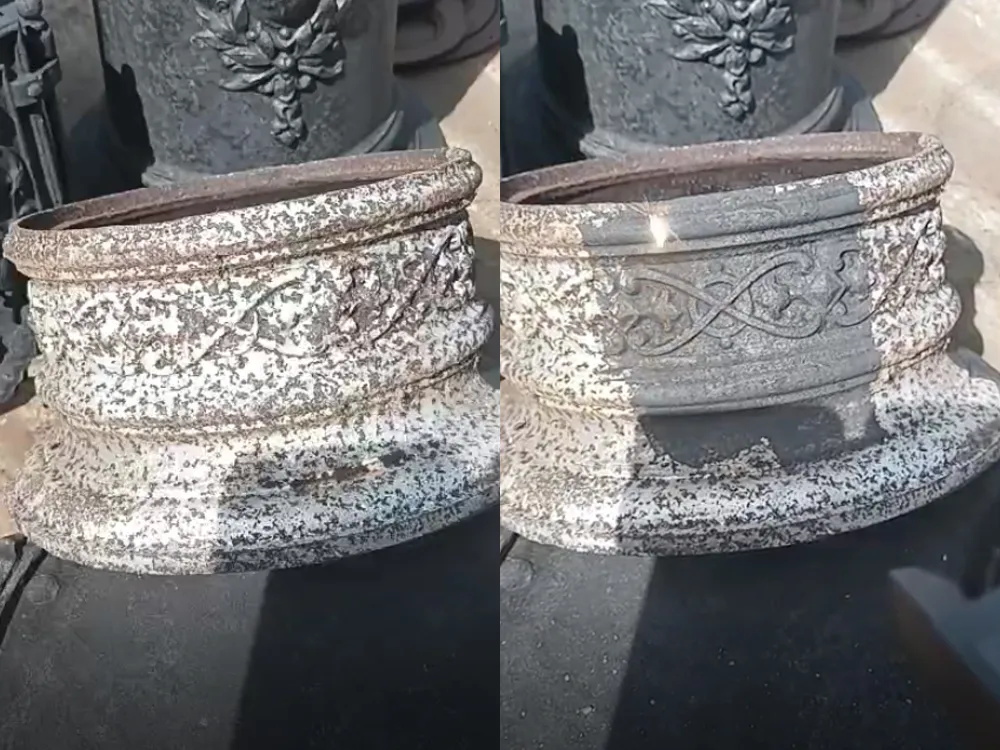
Restoring old buildings is not a cleaning job—it is a negotiation with history.
Every layer of soot, oxidation, or biological growth is not just “dirt,” but part of a complex interaction between material, environment, and time. The challenge is clear: remove what should not be there—without erasing what must remain.
This is exactly where laser cleaning has reshaped the rules.
Why Traditional Cleaning Fails Historic Architecture
Conventional restoration methods—sandblasting, chemical stripping, manual abrasion—operate on a blunt principle: remove everything on the surface.
That logic is incompatible with heritage preservation.
- Abrasive methods destroy micro-details and textures
- Chemicals introduce residues and environmental risks
- Manual cleaning leads to inconsistency and operator bias
More critically, these methods cannot distinguish between contamination and original material. They clean—but they also erase.
Laser cleaning, by contrast, introduces selectivity.
How Laser Cleaning Actually Works on Old Buildings
Laser cleaning relies on a principle called selective absorption.
Dark contaminants—such as pollution crusts, soot, or biological growth—absorb laser energy more efficiently than lighter underlying materials like limestone or marble. This creates a self-limiting effect:
- Contaminants vaporize
- The substrate remains largely unaffected
This is why laser cleaning has been widely adopted in cultural heritage conservation for over two decades.
Unlike mechanical methods, it is non-contact, non-abrasive, and highly controllable.
The Real Decision: It’s Not About “Which Machine,” It’s About “Which Strategy”
Most buyers approach this question incorrectly. They ask:
“Should I choose 100W, 500W, or 1000W?”
That’s the wrong starting point.
The correct question is:
“What am I cleaning—and what must I preserve?”
Because in heritage restoration, material sensitivity outweighs raw power.
Key Factors That Actually Determine the Right Laser Cleaner
1. Material Type: Stone Is Not One Material
Old buildings are composed of diverse substrates:
- Limestone → highly responsive, ideal for laser cleaning
- Marble → sensitive to thermal effects
- Sandstone → structurally fragile and porous
Each reacts differently to laser energy. Improper settings can cause:
- Discoloration
- Microcracking
- Grain loss or surface roughening
Insight:
There is no “universal setting.” Material dictates everything.
2. Type of Contamination: Surface vs Embedded
Laser cleaning excels at surface-bound contaminants, including:
- Black crusts from pollution
- Soot and carbon deposits
- Biological growth (algae, lichen)
These are ideal because they absorb laser energy more efficiently than the substrate.
However, deeply embedded contaminants present a limitation:
- Increasing power to remove them risks damaging the base material
Conclusion:
Laser cleaning is precise—but not infinitely deep.
3. Power Range: Matching Energy to Risk
Power selection is a balancing act:
- Low power (100W–300W):
- Best for delicate carvings, wood, or sensitive finishes
- Slower but safer
- Mid-range (500W–1000W):
- Ideal for most façade cleaning
- Balanced efficiency and control
- High power (1000W+):
- Suitable for thick deposits and large surfaces
- Requires skilled parameter control
Higher power does not mean better results—it increases both speed and risk.
4. Pulse Control: The Hidden Variable Most People Ignore
Power gets attention. Pulse control determines outcomes.
Modern systems allow adjustment of:
- Pulse duration
- Frequency
- Energy density (fluence)
These parameters directly affect:
- Heat accumulation
- Cleaning depth
- Surface preservation
Advancements in pulse modulation have significantly reduced issues like yellowing or thermal damage in sensitive materials.
Reality:
Two machines with the same wattage can produce completely different results.
5. Operator Skill: The Deciding Factor Nobody Wants to Admit
Laser cleaning is often marketed as “easy.” It is not.
Outcomes depend heavily on:
- Parameter tuning
- Scanning speed
- Distance and focus control
Poor operation can lead to:
- Uneven cleaning
- Surface damage
- Irreversible loss of historical detail
Hard truth:
The operator is part of the system.
Where Laser Cleaning Truly Excels in Old Building Restoration
Laser technology is particularly effective for:
- Historic stone façades with pollution crusts
- Sculptures and intricate carvings
- Fire- or smoke-damaged surfaces
- Removal of graffiti without substrate damage
It enables layer-by-layer removal, preserving original craftsmanship and surface integrity.
This level of control is impossible with traditional methods.
The Environmental and Regulatory Advantage
Restoration is no longer just technical—it is regulatory.
Laser cleaning offers:
- No chemical waste
- Minimal secondary pollution
- Lower compliance costs
As environmental regulations tighten globally, this advantage is becoming decisive—not optional.
A More Honest Perspective: Laser Cleaning Is Powerful—but Not Perfect
Despite its advantages, laser cleaning has limitations:
- Not ideal for deeply embedded contaminants
- Requires testing before full-scale application
- High upfront investment
- Strong dependence on expertise
It is not a universal solution—but it is the most controllable one available today.
Conclusion: Restoration Is About Restraint, Not Force
Choosing the right laser cleaner for old buildings is not about maximizing power—it is about minimizing unintended impact.
The future of restoration belongs to technologies that can:
- Differentiate between contamination and history
- Operate with micron-level precision
- Scale without sacrificing authenticity
Laser cleaning meets these criteria—but only when applied with the right strategy.
Final insight:
In heritage restoration, the best cleaning method is the one that leaves the least evidence it was ever used.
Post time: Apr-20-2026
