
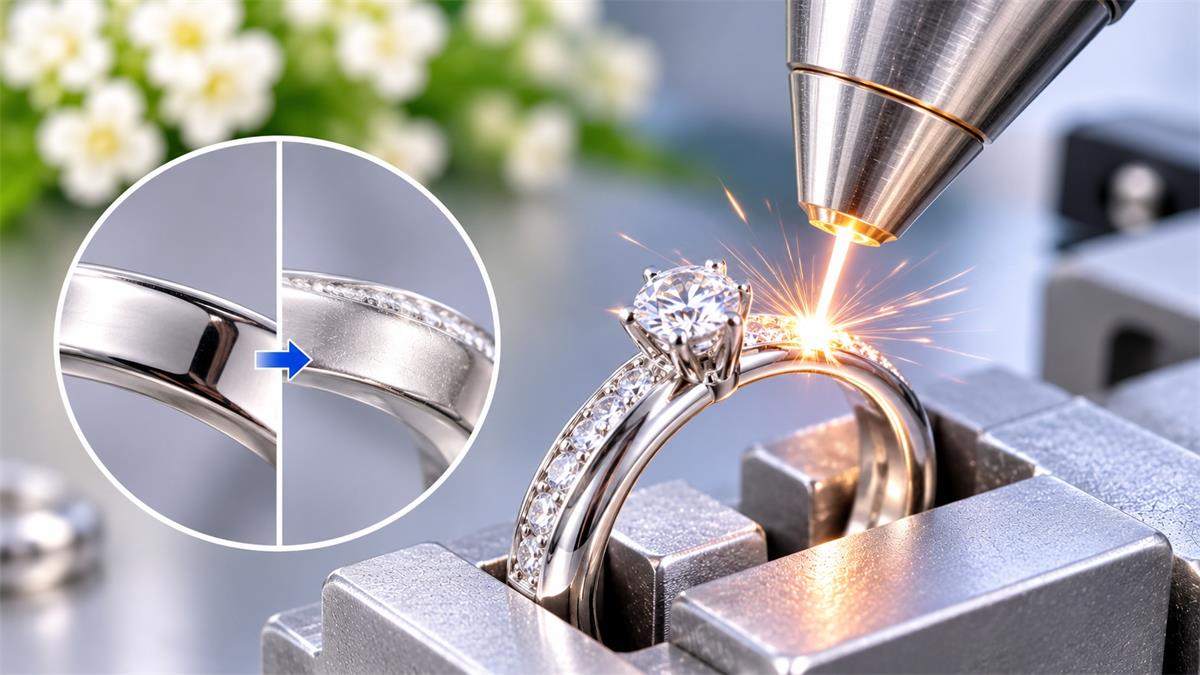
Yes, white gold can be laser welded, but maintaining its original color requires careful control of the welding process. Unlike yellow gold, white gold contains additional metals such as palladium, nickel, silver, and copper, depending on the alloy formulation. These metals influence how the material responds to laser energy and how the repaired area looks after welding.
For jewelry repair workshops, one of the biggest concerns is avoiding visible discoloration around the welding area. A jewelry laser welding machine can help achieve precise repairs with localized heat input, but the correct parameters, filler material, and surface finishing are equally important.
1. Why Does White Gold Sometimes Change Color During Welding?
White gold is not pure white metal. It is a gold alloy mixed with other metals to create a naturally pale or white appearance.
There are two common types of white gold:
- Nickel-based white gold: Uses nickel as an alloying element to create a white appearance. It can be relatively hard and is commonly used in jewelry manufacturing.
- Palladium-based white gold: Uses palladium to produce a white alloy. It is often selected for higher-end jewelry and nickel-sensitive applications.
Many white gold jewelry pieces are also coated with rhodium to create a brighter, more reflective white finish.
During laser welding, excessive heat can cause oxidation, surface discoloration, or changes in the appearance of the alloy. If the jewelry has rhodium plating, the coating around the welding area may also be damaged or removed.
This is why a welded area may look slightly different from the surrounding surface, even when the actual metal connection is strong.
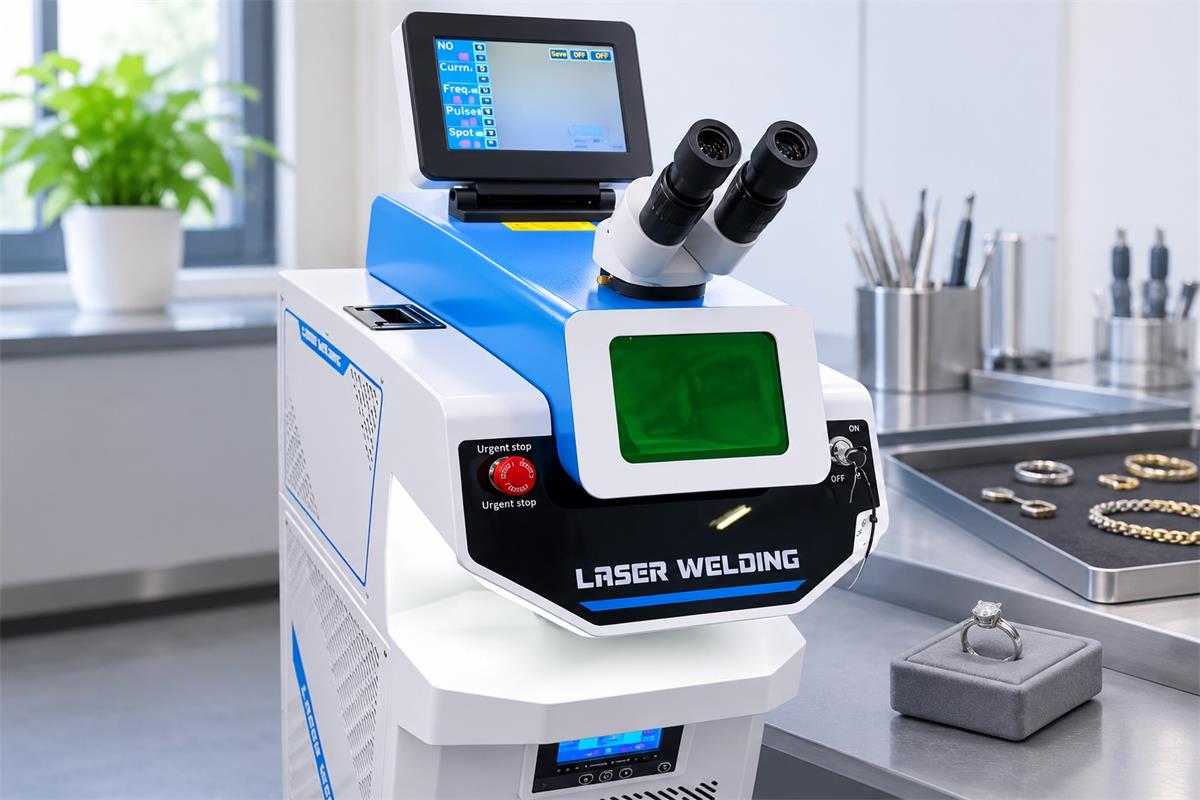
2. Can Laser Welding Prevent White Gold Discoloration?
Laser welding can significantly reduce unnecessary heat exposure compared with processes that heat a larger section of the jewelry. However, it cannot guarantee that white gold will experience no color changes.
Several factors influence the final appearance:
- Laser energy: Excessive energy can create a larger molten area and increase the risk of surface damage.
- Pulse duration: Short, controlled pulses can help limit the time the surrounding material is exposed to heat.
- Spot diameter: A smaller spot allows more localized energy application.
- Alloy composition: Nickel-based and palladium-based white gold may respond differently.
- Surface coating: Existing rhodium plating can be affected by the welding process.
- Filler material: An incompatible filler alloy may create visible differences in color after polishing.
The objective is to achieve sufficient fusion at the joint while minimizing unnecessary heat input to the surrounding material.
3. Does Rhodium Plating Affect White Gold Laser Welding?
Yes. Rhodium plating is one of the most important considerations when repairing white gold jewelry.
Many white gold rings, necklaces, and bracelets have a thin rhodium coating that gives them a bright, polished white appearance. However, this coating is not the same material as the underlying white gold alloy.
When laser welding is performed on a rhodium-plated surface, the coating in the immediate welding area may be damaged or removed by the heat.
For this reason, jewelry repair professionals should consider the following steps:
- Identify whether the jewelry has rhodium plating.
- Inspect the exact welding position and surrounding surface.
- Prepare the repair area appropriately, removing plating locally when necessary.
- Perform the laser welding using suitable parameters.
- Polish and refinish the repaired area.
- Apply rhodium plating again if necessary to restore a consistent appearance.
It is important to understand that laser welding alone does not restore damaged rhodium plating. If the original piece has a plated finish, additional surface treatment may be required.
4. How to Choose the Right Laser Parameters for White Gold
White gold requires careful parameter adjustment because different alloy formulations can have different melting and thermal characteristics.
For pulsed YAG laser welding, operators should pay attention to the following settings:
| Parameter | Why It Matters |
|---|---|
| Pulse energy | Controls the energy delivered to the welding point. |
| Pulse duration | Influences heat exposure and molten pool formation. |
| Pulse frequency | Controls the number of pulses delivered per second. |
| Spot diameter | Determines the size of the welding area. |
| Shielding gas | Helps reduce oxidation and atmospheric contamination. |
There is no universal parameter setting for all white gold jewelry. A thin white gold chain requires a different approach from a thick ring or a large bracelet connection.
A good starting method is to test the exact alloy on a scrap sample with similar thickness. Begin with conservative settings, inspect the fusion quality, and gradually adjust the parameters until a reliable weld is achieved.
5. Which White Gold Jewelry Can Be Laser Welded?
Pulsed YAG laser welding is suitable for many white gold jewelry repair applications.
White Gold Rings
White gold rings may develop cracks, broken joints, or damaged sections after repeated use. Laser welding can repair localized damage while limiting unnecessary heat exposure to the rest of the ring.
White Gold Chains
Thin chain links are difficult to repair using conventional heating methods because nearby links can also be affected. A focused laser spot allows operators to work on individual connections with greater precision.
White Gold Earrings
Laser welding can be used to repair broken earring posts, connections, and small decorative components. This is particularly useful when working on delicate jewelry designs.
White Gold Settings
Some localized repairs around gemstone settings can be performed using laser welding. However, nearby gemstones require careful protection because heat and thermal stress can damage certain stones.
6. Can You Weld White Gold Without Damaging Diamonds?
Laser welding can reduce heat exposure to nearby areas, but it does not make gemstone damage impossible.
Diamonds are generally more heat-resistant than many colored gemstones, but they can still be affected by thermal shock, existing inclusions, or sudden temperature changes. Other stones, such as emeralds, opals, and some treated gemstones, may be considerably more sensitive to heat.
Before repairing white gold jewelry containing diamonds or gemstones:
- Identify the gemstone and its condition.
- Evaluate the distance between the welding point and the stone.
- Consider removing vulnerable stones when practical.
- Use suitable protective methods and controlled welding parameters.
- Test the repair procedure on a similar sample when possible.
For valuable jewelry, the operator should evaluate the complete setting and not rely solely on the localized nature of laser welding.
7. Is a 150W or 200W Jewelry Laser Welder Better for White Gold?
Both 150W and 200W pulsed YAG jewelry laser welding machines can be considered for white gold repair. The better choice depends on the thickness of the material, repair applications, and required welding energy.
150W Jewelry Laser Welder
A 150W desktop jewelry laser welder is suitable for many precision repair applications, including thin white gold chains, earrings, rings, and small decorative components.
For jewelry repair shops focusing mainly on delicate gold jewelry, this configuration can be a practical choice.
200W Jewelry Laser Welder
A 200W machine provides greater available power and more flexibility for applications involving thicker jewelry components or higher pulse energy requirements.
For workshops handling different jewelry materials and a wider range of repair jobs, a 200W configuration may be worth considering.
Explore the Dowin 200W 180 Joules YAG Pulsed Jewelry Laser Welder for more information about this configuration.
When comparing machines, do not focus only on rated wattage. Adjustable pulse energy, pulse duration, spot diameter, microscope visibility, and actual welding results are all important.
8. Laser Welding vs Traditional Soldering for White Gold
Both laser welding and traditional soldering are used in white gold jewelry repair. However, they have different advantages.
| Comparison | Laser Welding | Traditional Soldering |
|---|---|---|
| Heat application | Localized | Generally heats a larger area |
| Precision | High for small repair areas | Depends on operator skill |
| Nearby components | Reduced heat exposure with proper settings | May require more extensive protection |
| Small repairs | Well suited to precision spot repairs | Can be more challenging on delicate parts |
| Surface finishing | May require polishing and replating | May require solder cleanup and refinishing |
Laser welding is particularly useful for precision repairs where controlling the heat-affected area is important. Traditional soldering remains suitable for many conventional jewelry fabrication and joining operations.
9. How to Get a Better White Gold Welding Result
For consistent white gold welding results, jewelry workshops should follow a repeatable testing process.
- Identify the alloy: Determine whether the material is nickel-based or palladium-based white gold.
- Check the surface: Identify rhodium plating and any existing coatings.
- Clean the material: Remove oil, polishing compounds, and surface contamination.
- Prepare compatible filler material: Match the filler alloy as closely as practical to the original jewelry.
- Test the parameters: Use scrap material with similar composition and thickness.
- Inspect the weld: Check penetration, cracks, porosity, and discoloration.
- Finish the surface: Polish and restore the rhodium coating when required.
For workshops repairing different types of gold jewelry every day, having a machine with flexible parameter adjustment makes it easier to handle different materials and repair requirements.
10. FAQ: Laser Welding White Gold
Can a jewelry laser welder weld 18K white gold?
Yes. A pulsed YAG jewelry laser welder can weld 18K white gold. The operator should adjust the parameters according to the alloy composition, material thickness, and joint design.
Will white gold turn yellow after laser welding?
Not necessarily. However, excessive heat, oxidation, or damage to the rhodium coating can cause visible color differences. Proper parameter control and appropriate surface finishing help maintain a consistent appearance.
Does white gold need rhodium plating after laser welding?
Not every repair requires replating. However, if the original jewelry has a rhodium-plated surface and the coating is damaged around the repair area, polishing and re-rhodium plating may be necessary.
Can I use the same filler wire for yellow gold and white gold?
It is generally not recommended. White gold and yellow gold have different alloy compositions and colors. Using compatible filler material helps achieve better metallurgical and visual results.
Can laser welding repair white gold rings with diamonds?
Yes, in suitable cases. However, the gemstone setting, distance from the welding point, and stone characteristics must be evaluated before welding. Some repairs may require removing the stones first.
Is a 150W laser welder powerful enough for white gold?
A 150W pulsed YAG jewelry laser welder can handle many white gold repair applications, particularly small and delicate components. The actual suitability depends on material thickness and welding requirements.
Conclusion
White gold can be laser welded without necessarily causing noticeable color changes, but the final appearance depends on alloy composition, welding parameters, filler material, and surface treatment.
A pulsed YAG jewelry laser welder provides precise energy control and helps minimize unnecessary heat exposure during jewelry repair. However, rhodium plating may still need to be restored after welding to achieve a uniform white finish.
If your workshop repairs 14K or 18K white gold rings, chains, earrings, and other fine jewelry, explore Dowin jewelry laser welding machines. Contact Dowin with your jewelry samples and repair requirements to discuss a suitable configuration and request a welding test.
Post time: Nov-16-2026
