
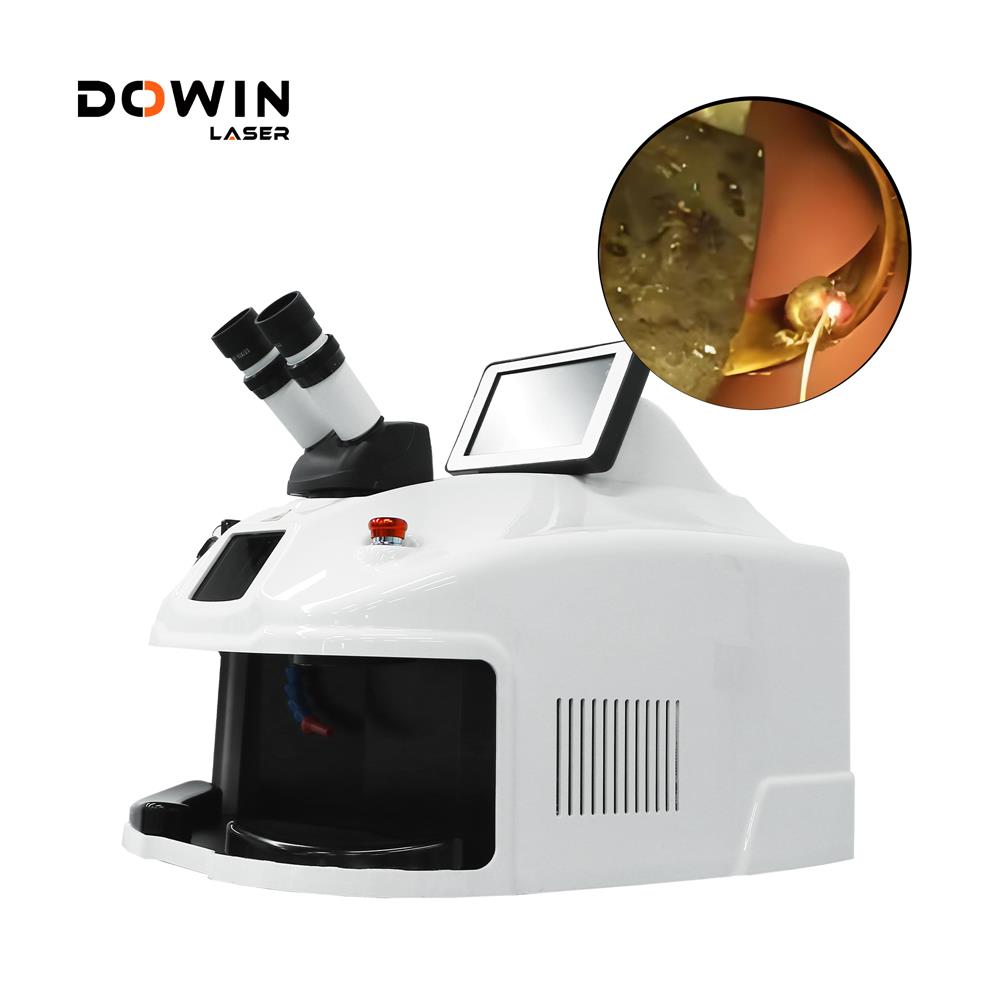
Yes, jewelry can often be laser welded with gemstones still in place, but the answer depends on the type of stone, its treatment, its position, and the exact repair being performed.
This is one of the biggest advantages of a jewelry laser welding machine over traditional torch soldering. A laser can deliver energy to a very small area, reducing the amount of heat transferred to the surrounding jewelry. This makes certain repairs possible without removing gemstones first.
However, laser welding does not mean every gemstone is automatically safe. Professional jewelers should evaluate each piece before welding.
Why Laser Welding Can Work Around Gemstones
Traditional torch soldering heats a relatively large area of metal. Heat can travel through the setting and reach nearby stones, potentially causing damage to heat-sensitive gemstones or treatments.
A laser welder works differently.
The laser beam is focused onto a small area of the metal, allowing the operator to control:
-
Laser power
-
Pulse duration
-
Pulse frequency
-
Spot size
-
Welding position
-
Filler wire
-
Heat input
This localized heat input can significantly reduce the thermal exposure of surrounding areas.
As a result, jewelry laser welding is particularly useful for precision repairs around diamond settings, prongs, ring shanks, and delicate jewelry components.
Which Jewelry Repairs Can Be Laser Welded with Stones in Place?
Several common jewelry repairs may be suitable for laser welding without removing the stone.
1. Prong Repair
Worn or damaged prongs are a common reason for jewelry repair.
Instead of heating the entire setting with a torch, a laser can be used to add small amounts of compatible metal to the damaged prong. The jeweler can rebuild the worn section while keeping the laser’s heat concentrated around the repair area.
This is particularly useful for engagement rings and other gemstone-set jewelry.
2. Ring Shank Repair
Cracks or worn areas in a ring shank can sometimes be repaired using laser welding while the gemstone remains mounted.
The operator can direct the laser toward the damaged section and control the amount of heat entering the surrounding metal.
For valuable jewelry, this can reduce unnecessary disassembly and handling.
3. Crack and Porosity Repair
Small cracks, pits, and porosity defects can be filled using laser welding.
The operator can deposit compatible filler material precisely where it is required rather than heating a large section of the jewelry.
4. Chain and Link Repair
Fine chains and small links can benefit from the precision of laser welding.
When a chain contains decorative stones or nearby settings, the localized nature of laser welding can make certain repairs more practical than conventional torch work.
Are Diamonds Safe During Laser Welding?
Diamonds are generally more tolerant of heat than many other gemstones, but “diamond” does not automatically mean “risk-free.”
The condition of the stone, inclusions, treatments, mounting position, and laser parameters all matter.
For example, a jeweler should consider:
-
Whether the diamond has significant inclusions
-
Whether it has been treated
-
How close the laser weld is to the stone
-
How securely the diamond is mounted
-
How much heat can accumulate in the setting
-
Whether repeated laser pulses are required
A professional operator should always inspect the specific stone and repair before deciding whether it can remain in place.
What About Emeralds, Opals, and Other Heat-Sensitive Stones?
This is where extra caution is necessary.
Some gemstones are significantly more sensitive to heat or thermal shock than others. Examples can include opal, emerald, turquoise, pearls, and certain treated or composite stones.
In these cases, removing the stone may still be the safest approach.
The important principle is:
Laser welding reduces heat exposure; it does not eliminate heat.
A laser welding machine can make heat much more controllable, but the operator still needs to understand gemstone properties and select appropriate welding parameters.
Laser Welding vs Torch Soldering for Gemstone Jewelry
| Feature | Laser Welding | Torch Soldering |
|---|---|---|
| Heat concentration | Very localized | Broad |
| Heat-affected area | Small | Larger |
| Precision | Very high | Moderate |
| Work near stones | Suitable for many applications | More difficult |
| Prong rebuilding | Excellent | Possible |
| Fine jewelry repair | Excellent | Good |
| Risk from thermal exposure | Lower when properly controlled | Higher |
| Stone removal | May not be necessary for some repairs | More frequently required |
| Operator requirements | Laser-specific training | Traditional soldering skills |
The key advantage of laser welding is controlled heat input, not simply the fact that it uses a laser.
How Do Jewelers Protect Stones During Laser Welding?
Professional laser welding involves more than pointing the laser at the damaged area.
Before welding, the jeweler should:
1. Inspect the Gemstone
Check the stone for inclusions, fractures, treatments, and other potential weaknesses.
2. Examine the Setting
The position of the stone relative to the weld is critical. A repair immediately beside a gemstone requires more caution than a repair several millimeters away.
3. Use Appropriate Laser Parameters
Excessive power or prolonged exposure can create unnecessary heat. Pulse energy and duration should be adjusted according to the metal and repair.
4. Control the Weld Area
The operator should keep the laser focused precisely on the intended repair zone.
5. Use Suitable Filler Material
When material needs to be added, the filler should be compatible with the jewelry alloy and the intended finish.
6. Monitor Heat Accumulation
Even when individual laser pulses are small, repeated pulses can gradually increase the temperature of the surrounding metal.
Can You Laser Weld a Ring Without Removing the Diamond?
In many suitable cases, yes.
This is one of the most attractive applications of a jewelry laser welding machine.
For example, if a ring has a small crack in the shank several millimeters away from the diamond setting, laser welding may allow the jeweler to repair the crack while leaving the diamond mounted.
A worn prong can also potentially be rebuilt using controlled laser deposition.
However, the decision should always be made based on the specific stone and repair location, rather than assuming that every gemstone-set ring can be laser welded safely.
Why Jewelry Repair Shops Use Laser Welding
The ability to perform certain repairs without removing gemstones can provide several practical benefits.
Less Disassembly
If a stone does not need to be removed, the repair process can be simpler.
Lower Handling Risk
Every time a gemstone is removed and reset, additional handling is involved.
Greater Precision
The laser allows the operator to work on small areas that may be difficult to access with a torch.
Reduced Finishing
Precise weld placement can reduce the amount of grinding and polishing required after repair.
More Repair Options
Laser welding can expand the types of delicate repairs a jewelry workshop can confidently undertake.
Is Laser Welding Safe for All Gemstones?
No.
This is an important distinction for professional jewelry businesses.
A jewelry laser welding machine is a precision heat source, not a cold welding process. The surrounding area still receives some thermal energy, and certain gemstones can be damaged by heat or thermal shock.
Jewelry professionals should therefore classify stones according to their properties and treatment history before deciding whether to weld with the stone in place.
When there is significant uncertainty, removing the gemstone or using another repair method may be the safer choice.
Frequently Asked Questions
Can you laser weld a ring with the stone still mounted?
Yes, certain ring repairs can be laser welded while the gemstone remains mounted. The feasibility depends on the gemstone, setting, repair location, and laser parameters.
Can you laser weld gold jewelry with diamonds in place?
In suitable cases, yes. The highly localized heat input of laser welding can make some diamond-set gold repairs possible without removing the diamond.
Can laser welding damage gemstones?
Yes. Incorrect laser parameters, excessive heat, thermal shock, existing fractures, or sensitive gemstone treatments can cause damage. Proper inspection and parameter selection are essential.
Is laser welding better than soldering for jewelry with stones?
For many precision repairs near suitable gemstones, laser welding offers better heat control than torch soldering. However, it is not automatically the best method for every gemstone or repair.
Do you always need to remove gemstones before laser welding?
No. One of the advantages of jewelry laser welding is that certain repairs can be performed with stones in place. The decision should be made on a case-by-case basis.
Conclusion
Can you laser weld jewelry with stones in place? Yes—but only when the gemstone and repair are suitable for the process.
The main advantage of a jewelry laser welder is its ability to deliver highly localized energy. Compared with traditional torch soldering, this can significantly reduce unnecessary heat exposure and make delicate repairs more controllable.
For prong rebuilding, ring repair, crack repair, fine chain repair, and precision restoration, laser welding can provide an effective solution while preserving the existing gemstone setting in suitable cases.
For jewelry repair shops handling valuable gemstone-set pieces, investing in a professional jewelry laser welding machine can provide capabilities that are difficult to achieve with conventional torch soldering alone.
Post time: Aug-17-2026
