
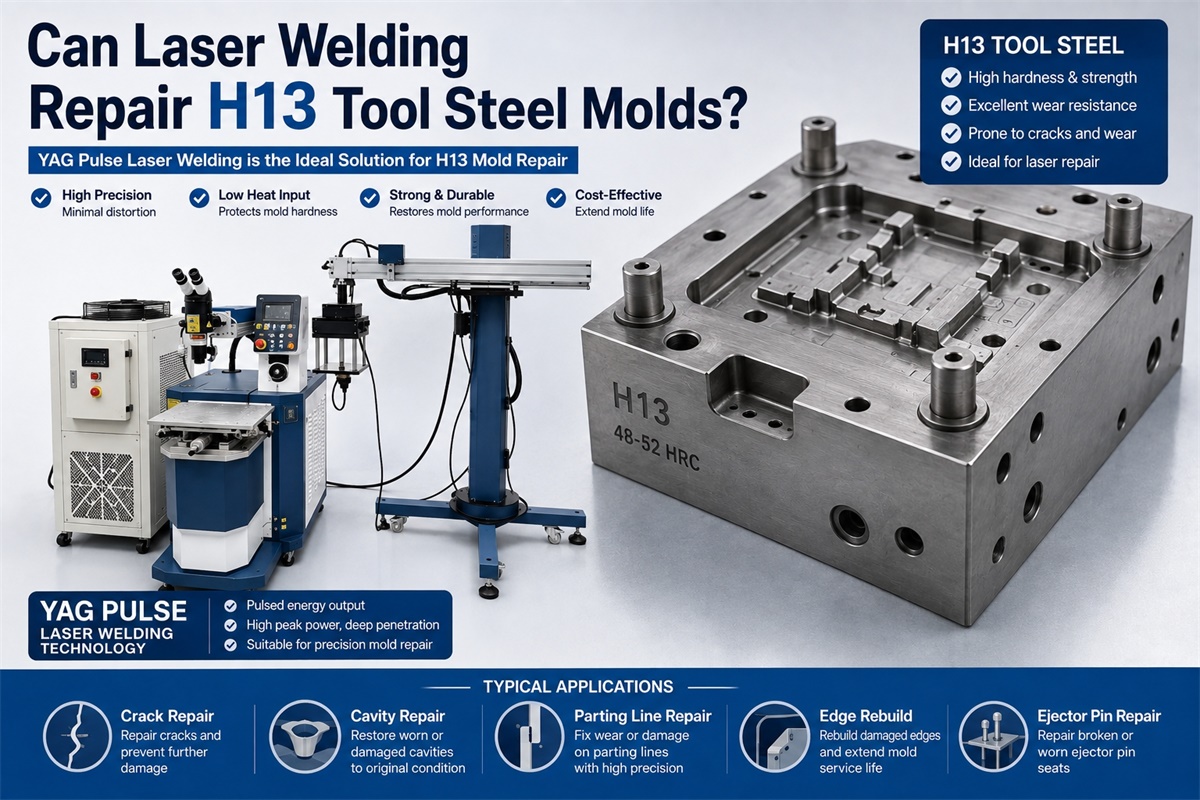
Yes, laser welding can repair H13 tool steel molds, including localized cracks, worn edges, chipped corners, scratches, and dimensional defects.
H13 is a hot-work tool steel known for high hardness, toughness, thermal-fatigue resistance, and resistance to repeated heating and cooling. It is widely used in molds and dies where conventional welding can create excessive heat and distortion.
Laser welding is particularly attractive for H13 mold repair because it can deposit a small amount of filler material precisely onto the damaged area while limiting heat input to the surrounding mold.
Research has specifically investigated laser repair of AISI H13 mold steel and found that welding parameters, filler material, and repair geometry have an important influence on the mechanical performance of the repaired area.
Go to learn more: Laser Mold Repair
Why Is H13 Suitable for Laser Mold Repair?
H13 is commonly used in demanding tooling applications because it combines hardness, toughness, wear resistance, and thermal-fatigue resistance.
However, these same properties make precision repair important.
A conventional welding process can introduce a relatively large amount of heat into the mold. This may lead to:
-
Mold distortion
-
Changes in hardness
-
Residual stress
-
Cracking
-
Difficult post-welding machining
-
Damage to polished surfaces
Laser welding concentrates the energy into a much smaller area. This allows the technician to rebuild only the damaged section instead of heating a large portion of the mold.
Studies of laser-repaired H13 molds have reported the benefits of localized deposition and limited changes around the repaired region.
What H13 Mold Defects Can Laser Welding Repair?
A laser mold welding machine can be used for various localized H13 repairs.
Cracks
Small surface cracks can be removed or prepared and then filled with compatible filler material.
For deeper cracks, simply welding over the visible surface is not sufficient. The complete defect needs to be properly identified and prepared before welding.
Worn Edges
Parting lines, shut-off areas, and other high-contact features can gradually wear during mold operation.
Laser welding can rebuild the missing material so that the original geometry can be restored through machining or polishing.
Chipped Corners
H13 molds can develop chipped edges or corners through impact, improper handling, or repeated production cycles.
Laser welding allows the missing metal to be rebuilt layer by layer with precise control.
Scratches and Small Dents
Localized surface defects can be filled with a small amount of compatible filler material before grinding and polishing.
This is particularly useful for precision mold surfaces where removing a large amount of surrounding material would affect the mold dimensions.
Why Is Laser Welding Better for Precision H13 Repairs?
The main advantage is localized heat input.
The laser beam can be focused onto a small area, allowing filler material to be deposited precisely where required. This reduces unnecessary heating of the surrounding H13 steel.
For precision mold repair, this can help reduce:
-
Thermal distortion
-
Excessive heat-affected areas
-
Unnecessary material removal
-
Post-welding grinding
-
Damage to adjacent mold features
Laser mold repair is therefore particularly useful around fine cavities, sharp edges, parting lines, and polished surfaces.
Does H13 Need Preheating Before Laser Welding?
This depends on the condition of the H13 mold, its hardness, geometry, repair size, and the specific welding procedure.
H13 is an air-hardening tool steel, so uncontrolled cooling can create hard and brittle microstructures and increase the risk of cracking. Welding guidance for H13 therefore emphasizes controlling preheat, cooling, filler material, and post-weld treatment.
Laser welding can substantially reduce heat input compared with conventional welding, but reduced heat input does not mean that H13 can always be welded without thermal control.
For a hardened H13 mold, the welding procedure should be developed according to the actual material condition rather than using a universal temperature or laser setting.
What Laser Parameters Are Important for H13?
There is no single laser parameter that works for every H13 mold.
Important variables include:
-
Laser power or pulse energy
-
Pulse duration
-
Pulse frequency
-
Spot diameter
-
Welding speed
-
Filler-wire diameter
-
Wire feeding speed
-
Welding layer thickness
-
Shielding gas
-
Mold hardness
-
Repair depth
For small precision defects, a pulsed laser welding machine provides fine control over energy delivered to each weld spot.
For larger repair areas or higher-productivity applications, a fiber laser system may also be appropriate depending on the repair geometry.
The best parameters should be established through a sample test using the actual H13 mold or an equivalent material.
What Filler Wire Should Be Used?
The filler wire should be selected according to the H13 substrate and the required properties of the repaired area.
Important considerations include:
-
Chemical compatibility
-
Hardness
-
Toughness
-
Wear resistance
-
Machinability
-
Polishing behavior
-
Thermal-fatigue performance
The goal is not simply to produce a strong weld. The repaired region must also be capable of being machined and finished to the required mold dimensions.
Research on laser-repaired H13 has shown that filler material and welding conditions can significantly affect fatigue performance and the properties of the repaired region.
Can Hardened H13 Be Laser Welded?
Yes, but hardened H13 requires greater process control than annealed material.
The existing hardness and tempering condition influence how the steel responds to welding. Excessive or poorly controlled heat can change the local microstructure and hardness.
Research and industrial studies have examined laser repair of pre-hardened H13, including the use of laser cladding and subsequent heat treatment to control the hardness difference between the deposited material and the original H13 substrate.
Therefore, when repairing a hardened H13 injection mold or die-casting mold, the welding procedure should be matched to the original heat-treatment condition.
Laser Welding Process for H13 Mold Repair
A typical H13 laser repair process follows these steps:
1. Inspect the Damage
Determine the crack, wear, chip, or dimensional defect and identify whether the damage extends below the visible surface.
2. Remove the Defective Material
Depending on the defect, machining, grinding, or other preparation may be required before welding.
3. Clean the Repair Area
Remove oil, grease, oxidation, coolant, and other contamination.
4. Select Compatible Filler Material
Choose filler wire based on the H13 substrate and required final properties.
5. Set Laser Parameters
Adjust pulse energy or laser power, pulse duration, frequency, spot size, and welding speed according to the repair.
6. Build Up the Damaged Area
Deposit filler material in controlled layers rather than applying excessive material in one operation.
7. Machine the Repair
After welding, the excess material can be removed through machining, grinding, EDM, or other suitable finishing processes.
8. Polish and Inspect
For injection mold cavities and cosmetic surfaces, final polishing may be required to restore the original surface quality.
Laser Welding vs TIG Welding for H13
Both laser welding and TIG can be used for tool-steel repair, but they have different characteristics.
| Feature | Laser Welding | TIG Welding |
|---|---|---|
| Heat input | Highly localized | Generally higher |
| Precision | Very high | Good |
| HAZ | Small | Larger |
| Fine mold features | Excellent | More difficult |
| Small defects | Excellent | Good |
| Distortion control | Better | More challenging |
| Filler deposition | Highly controlled | Manual |
| Precision cavity repair | Very suitable | Application dependent |
The advantage of laser welding is not simply that it produces a stronger weld. Its major benefit for precision H13 repair is the ability to control where and how much heat and filler material are applied.
Can Laser-Welded H13 Be Polished?
Yes. Properly selected filler material and welding parameters can produce a repair that can subsequently be machined, ground, and polished.
This is particularly important for injection molds where the repaired area may be located on a visible cavity surface.
The final repair should therefore be evaluated not only immediately after welding, but also after:
Welding → machining → grinding → polishing → mold trial
A good laser welding process should restore the functional geometry and surface finish required by the mold.
What Is the Best Laser Welding Machine for H13?
For precision H13 mold repair, a suitable machine should provide:
-
Stable laser output
-
Fine pulse or power control
-
Small adjustable spot size
-
Microscope or high-magnification optical system
-
Accurate positioning
-
Suitable filler-wire support
-
Stable shielding gas
-
Parameter adjustment for different H13 conditions
A pulsed Nd:YAG laser mold welding machine can be particularly suitable for small and highly precise H13 repairs because of its controllable pulse energy.
For larger repair areas and higher productivity, fiber laser systems may also be considered.
The correct machine should ultimately be selected according to the H13 hardness, defect size, repair depth, mold geometry, and required surface finish.
Frequently Asked Questions
Can laser welding repair H13 injection molds?
Yes. Laser welding can repair localized H13 mold defects such as cracks, worn edges, chipped corners, scratches, and dimensional errors.
Can laser welding repair hardened H13?
Yes, but the welding procedure must account for the existing hardness and heat-treatment condition. Proper thermal control and filler selection are important for reducing cracking and undesirable hardness changes.
Does H13 crack during laser welding?
H13 can crack if the welding process is poorly controlled. Its hardenability makes cooling rate, thermal stress, surface preparation, and filler selection important factors.
Is laser welding suitable for H13 die-casting dies?
Yes. H13 is widely used in hot-work tooling, and laser-based repair processes have been studied for H13 dies and molds.
Is laser welding better than TIG for H13 mold repair?
For small, precision-critical repairs, laser welding generally offers better control of heat input and filler deposition. TIG can still be appropriate for larger or less precision-sensitive repairs.
Final Takeaway
Laser welding can effectively repair H13 tool steel molds, but the quality of the repair depends heavily on process control.
The key is not simply choosing a powerful laser. A successful H13 repair requires the right combination of laser parameters, filler material, thermal control, surface preparation, welding technique, and post-welding finishing.
For precision injection molds and dies, laser welding is especially valuable because it can rebuild localized damage while minimizing unnecessary heat and preserving nearby mold features. Research on H13 specifically supports the use of laser-based repair while highlighting the importance of optimizing welding conditions and filler materials.
For commercial mold repair applications, the best practice is to test the actual H13 material and repair defect before selecting the final machine configuration.
Post time: Sep-04-2026
