
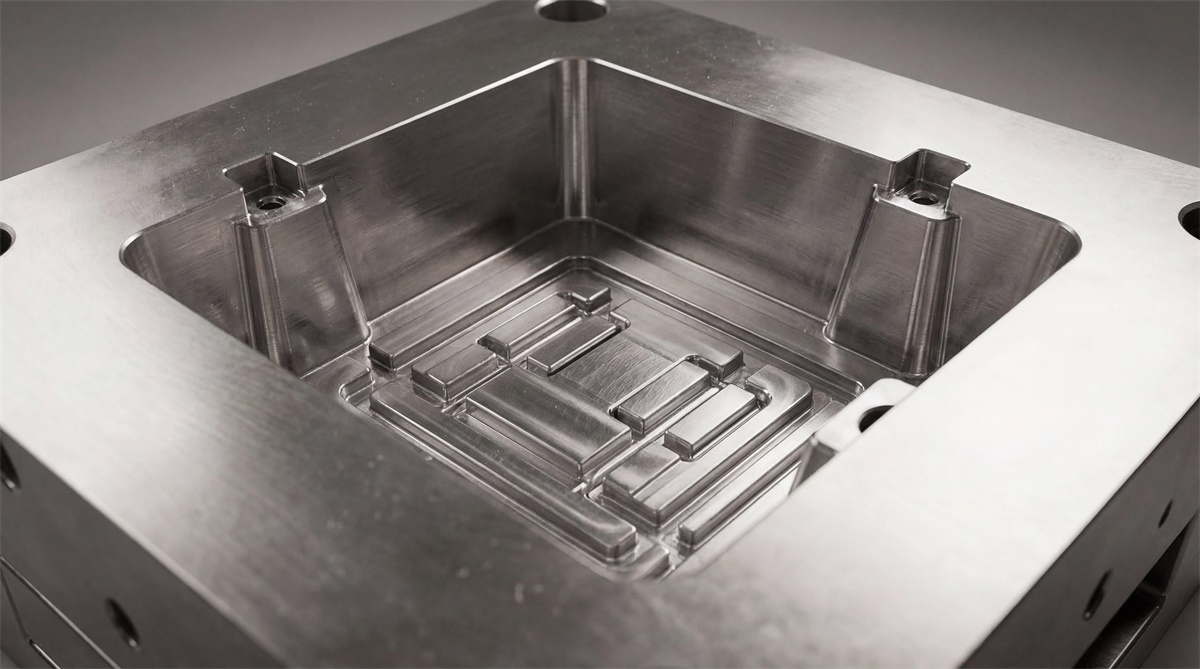
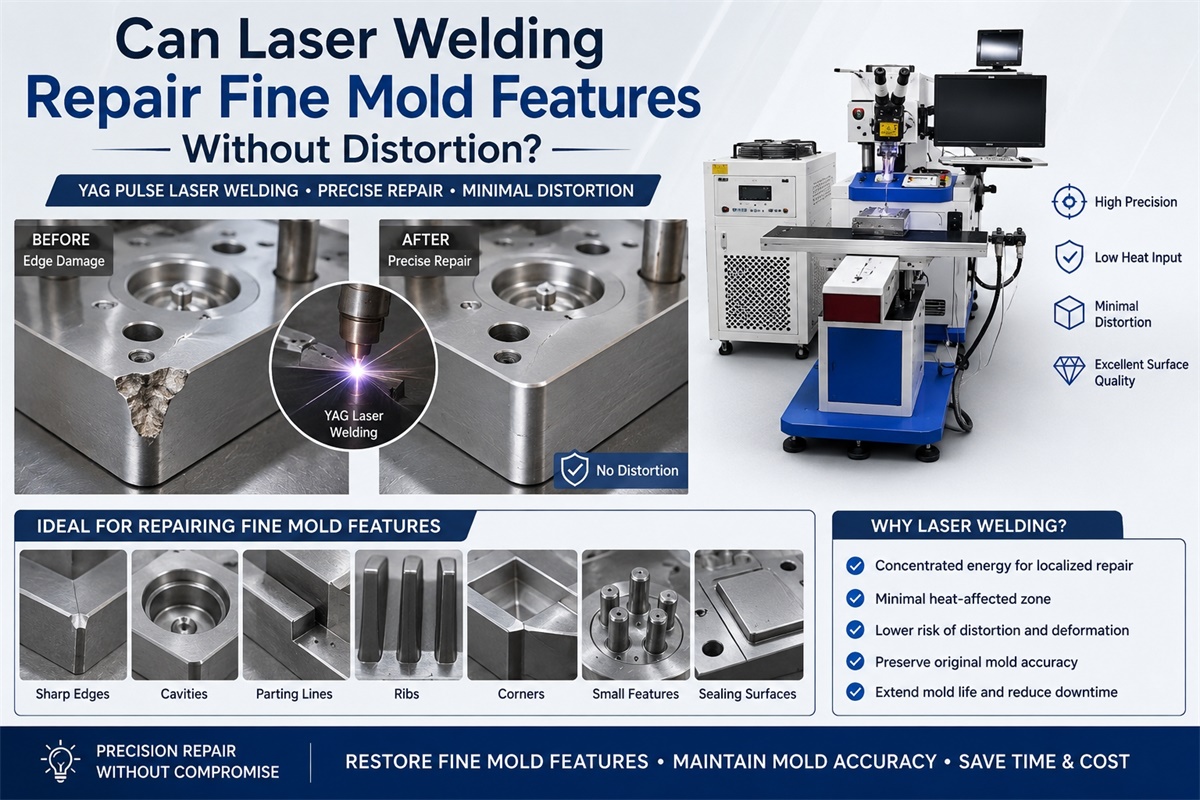
Fine mold features such as sharp edges, parting lines, ribs, cavities, corners, and sealing surfaces are difficult to repair with conventional welding. Excessive heat can cause distortion, discoloration, cracking, or dimensional changes that affect the final molded part.
Laser welding is one of the most precise methods for repairing fine mold features because it concentrates energy into a very small area and limits heat input. When the process is properly controlled, a laser welder can rebuild damaged areas while keeping the surrounding mold geometry largely unchanged.
Why Fine Mold Features Are Difficult to Repair
Injection molds often contain features with tight dimensional tolerances. A small amount of excess material or deformation can affect:
- Part dimensions
- Surface finish
- Parting-line accuracy
- Ejection performance
- Sealing surfaces
- Cavity geometry
- Product appearance
Traditional welding processes such as TIG can introduce a relatively large amount of heat into the workpiece. This increases the risk of thermal distortion, especially when repairing thin edges or small damaged areas.
Laser welding approaches the problem differently by delivering concentrated laser energy directly to the repair location.
How Laser Welding Minimizes Mold Distortion
The main advantage is localized heat input.
A laser pulse can be focused onto a very small spot, allowing the operator to melt the filler material and a small amount of the base metal without heating a large surrounding area.
This helps reduce:
1. Heat-Affected Area
Because the laser energy is concentrated, the heat-affected zone can be significantly smaller than with conventional welding methods.
Less surrounding heat means less thermal expansion and contraction.
2. Thermal Deformation
Fine mold components can be sensitive to even small dimensional changes. Controlled laser pulses help minimize the amount of material exposed to high temperatures.
3. Excessive Material Removal
Laser mold repair can deposit material precisely where it is required instead of removing and rebuilding a large section of the mold.
4. Damage to Nearby Features
When a damaged edge is located close to a cavity, hole, rib, or precision surface, localized laser welding makes it easier to restrict the repair to the damaged area.
Can Laser Welding Repair Sharp Edges?
Yes. Sharp mold edges are among the applications where precision laser welding can be particularly useful.
For example, if a mold edge has been chipped during production, a laser welder can deposit compatible filler material onto the damaged section. After welding, the repaired area can be machined, polished, or EDM-finished back to the required geometry.
The key is controlling:
- Laser power
- Pulse duration
- Pulse frequency
- Spot diameter
- Welding speed
- Filler wire diameter
- Filler material
- Welding position
The correct combination prevents excessive melting and reduces the possibility of distortion.
What About Fine Cavities and Small Features?
Laser welding can also be used around small cavities and other detailed mold structures.
For precision mold repair, the objective is usually not simply to add as much weld material as possible. Instead, the technician deposits small amounts of material layer by layer.
This approach makes it possible to rebuild areas such as:
- Cavity edges
- Core edges
- Thin walls
- Ribs
- Corners
- Parting lines
- Small holes
- Wear areas
- Eroded surfaces
- Cracks and chipped sections
After welding, the repaired region can be finished to restore the original dimensions and surface quality.
YAG Laser Welding for Precision Mold Repair
For dedicated mold repair applications, pulsed YAG laser welding machines have traditionally been widely used because their pulse-based energy delivery allows precise control of heat input.
A YAG mold welding machine can be configured for detailed repair work where the operator needs to control individual laser pulses and filler deposition.
This makes YAG laser welding particularly suitable for repairing precision tool steels and mold components where excessive heat is undesirable.
Common mold materials that may be repaired with appropriate parameters include:
- H13
- P20
- NAK80
- S136
- 718
- Other tool steels
The actual weldability and required parameters depend on the specific steel grade, heat treatment, filler material, and condition of the mold.
Laser Welding vs. TIG for Fine Mold Repair
| Feature | Laser Mold Welding | TIG Welding |
|---|---|---|
| Heat input | Highly localized | Higher surrounding heat |
| Heat-affected zone | Small | Generally larger |
| Fine feature repair | Excellent | More difficult |
| Distortion risk | Low when properly controlled | Higher |
| Small-area deposition | Highly precise | Less localized |
| Mold edge repair | Suitable | Possible but more challenging |
| Operator skill | Requires laser welding expertise | Requires skilled TIG welding |
| Post-processing | Usually required | Usually required |
The advantage of laser welding is not that distortion is completely impossible. Rather, the process gives the technician much better control over heat input and weld placement.
Does Laser Welding Guarantee Zero Distortion?
No welding process should be described as completely distortion-free.
The final result depends on several factors, including:
- Mold size and geometry
- Material composition
- Existing heat treatment
- Thickness of the repair area
- Welding parameters
- Filler material
- Number of welding passes
- Preheating and cooling conditions
- Technician experience
- Post-welding machining
For extremely tight-tolerance mold repairs, dimensional inspection should still be performed after welding and finishing.
How to Achieve the Best Results
For fine mold features, a typical repair workflow is:
1. Inspect the damage
Determine the depth, width, and location of the damaged area.
2. Clean the repair area
Remove oil, oxidation, contaminants, and damaged material.
3. Select compatible filler material
The filler should be matched to the mold steel and required final properties.
4. Set low, controlled heat input
Choose suitable pulse parameters and spot size.
5. Deposit material layer by layer
Build up only the damaged area rather than heating the surrounding mold unnecessarily.
6. Machine the repaired area
Grinding, milling, polishing, or EDM can restore the original geometry.
7. Inspect dimensions and surface quality
Verify that the repaired feature meets the required mold specifications.
When Is Laser Mold Welding the Best Choice?
Laser welding is particularly attractive when the mold has high-value precision features that cannot tolerate significant thermal deformation.
Typical applications include:
- Injection mold repair
- Die casting mold repair
- Precision tooling
- Plastic mold cavity repair
- Parting-line repair
- Mold edge rebuilding
- EDM damage repair
- Wear and corrosion repair
- Small crack repair
For a mold that is expensive to manufacture or difficult to replace, repairing the damaged section can be considerably more practical than producing an entirely new component.
Conclusion
Yes, laser welding can repair fine mold features with very low distortion when the process is correctly controlled. Its concentrated energy, precise material deposition, and controllable heat input make it well suited to repairing sharp edges, cavities, parting lines, ribs, and other detailed mold structures.
For precision mold repair, a pulsed YAG laser welding machine is especially useful when controlled heat input and accurate filler deposition are priorities. However, achieving distortion-free results depends on proper parameter selection, compatible filler material, welding technique, and post-weld finishing.
For manufacturers and mold repair shops dealing with chipped edges, worn cavities, cracks, or dimensional damage, laser welding provides a practical way to restore fine mold features while minimizing the risk of thermal deformation and unnecessary material removal.
Post time: Sep-04-2026
