
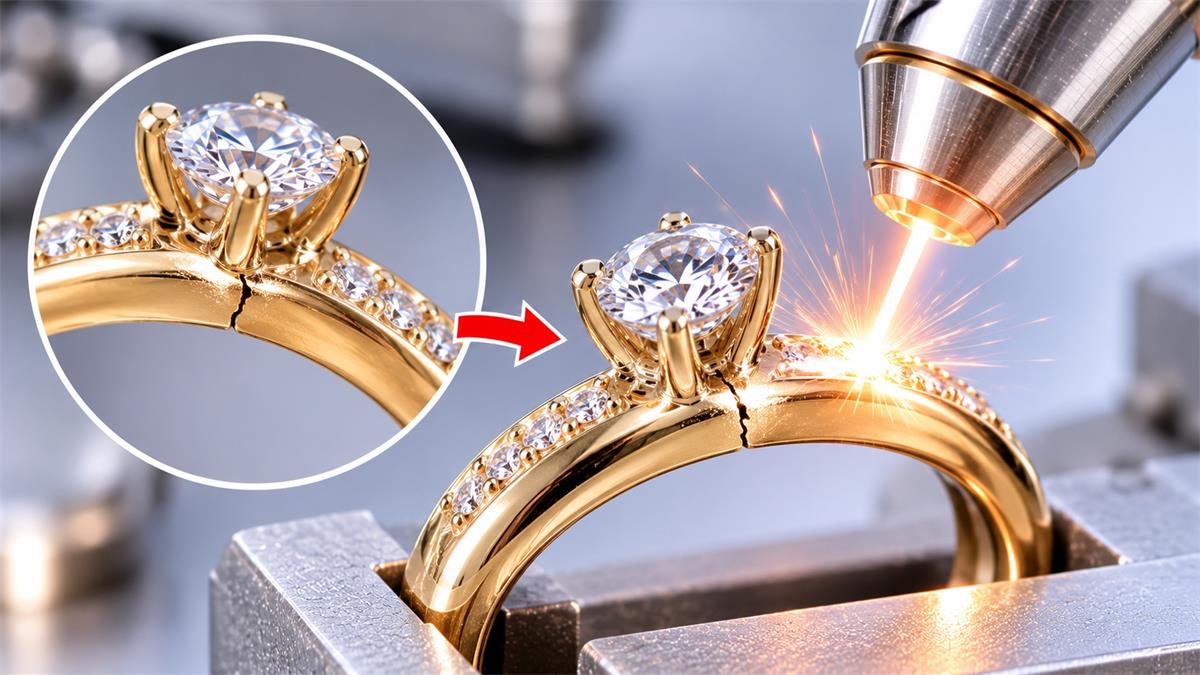
Porosity is one of the most common problems encountered in gold jewelry casting. Small holes, pinholes, and internal cavities can appear on rings, pendants, bracelets, and other cast gold components. These defects affect the appearance of finished jewelry and can also reduce its structural strength. For jewelry manufacturers, laser welding offers an effective way to repair many localized porosity defects without reheating the entire casting.
A pulsed YAG jewelry laser welding machine allows operators to apply concentrated energy to small defective areas. By adding compatible gold filler material when necessary, technicians can fill surface pores, restore missing material, and improve the appearance of cast jewelry. However, not every casting defect can be repaired successfully. Understanding the type and depth of porosity is essential before starting.
1. What Causes Porosity in Gold Castings?
Gold casting porosity refers to small holes or cavities that develop inside or on the surface of cast jewelry. These defects can occur during melting, pouring, solidification, and cooling.
Several factors can contribute to casting porosity:
- Gas porosity: Gas trapped in molten metal can form small rounded cavities during solidification.
- Shrinkage porosity: Metal contracts as it cools. Insufficient feeding of molten metal can leave cavities inside the casting.
- Contaminated metal: Impurities, oxidation, or unsuitable melting conditions can contribute to casting defects.
- Improper casting temperature: Incorrect temperature control can affect metal flow and solidification.
- Inadequate mold conditions: Problems with mold preparation, venting, or investment material can contribute to defects.
Not all pores have the same structure. Some are tiny surface pinholes, while others are connected to larger internal cavities. Identifying the defect correctly helps determine whether laser welding is an appropriate repair method.
2. Can Laser Welding Repair Porosity in Gold Castings?
Yes. Laser welding can repair many localized porosity defects in gold castings, particularly small surface holes, pinholes, and isolated cavities that can be accessed by the laser.
The basic process involves directing laser pulses at the defective area to melt the surrounding metal. Compatible gold filler wire can then be introduced to fill the cavity and restore the missing material.
Compared with conventional torch-based repair, laser welding offers several advantages:
- Localized heat input: Energy is concentrated around the defective area rather than heating the entire jewelry component.
- Precise material restoration: Operators can add filler material to small holes and cavities.
- Reduced heat exposure: Nearby decorative details and other components can experience less unnecessary heating.
- Small repair area: The process is suitable for correcting localized surface defects.
- Less finishing work in suitable applications: Controlled welding can reduce the amount of material that needs to be removed during polishing.
However, laser welding does not automatically eliminate every internal casting defect. Deep, widespread, or interconnected porosity may require more extensive reconstruction or recasting.
3. What Types of Gold Casting Porosity Can Be Repaired?
Before choosing laser welding, jewelry manufacturers should distinguish between different types of casting defects.
Surface Pinholes
Surface pinholes are small holes visible on the outside of a gold casting. They are common problems during jewelry finishing because polishing can reveal defects that were not obvious on the original casting surface.
Laser welding is particularly useful for repairing suitable surface pinholes. A technician can apply controlled pulses and add small amounts of compatible filler material to close the defects.
Small Surface Cavities
Some castings contain larger cavities that appear after filing, grinding, or polishing. These defects may require more filler material than ordinary pinholes.
Laser welding can be used to rebuild the missing metal gradually, provided the cavity is accessible and the surrounding casting remains structurally sound.
Localized Shrinkage Porosity
Shrinkage porosity can create irregular cavities within cast gold components. If the defect reaches the surface and is relatively localized, laser welding may help restore the affected area.
However, a large internal shrinkage cavity may extend beyond the visible opening. Simply covering the surface without addressing the underlying defect can produce an unreliable repair.
Porosity in Ring Shoulders and Decorative Areas
Rings often contain detailed shoulders, raised patterns, and decorative elements. Small casting holes in these areas can affect the appearance of the finished jewelry.
Laser welding allows technicians to repair selected defects while limiting unnecessary heating of nearby decorative features.
Deep or Widespread Internal Porosity
Not every casting defect is suitable for laser repair. If a component contains extensive internal porosity, numerous interconnected cavities, or severely weakened metal, localized welding may not restore its original strength.
For these cases, recasting or replacing the defective component may be a more reliable solution.
4. Step-by-Step: How to Repair Porosity in Gold Castings with a Laser Welder
For jewelry manufacturers and repair workshops, the following workflow provides a practical starting point for repairing localized gold casting defects.
Step 1: Inspect the Casting
Examine the defective area under a microscope. Identify the size, shape, and distribution of the pores.
Determine whether the defect is limited to the surface or may extend into the casting. For suspected deep or extensive internal porosity, additional inspection or suitable non-destructive testing may be necessary.
Step 2: Clean the Defective Area
Remove polishing compounds, oil, dirt, oxidation, and other contamination from the repair area.
The metal must be clean and dry before welding. Contamination can interfere with the welding process and contribute to poor fusion or additional defects.
Step 3: Prepare the Surface
For some defects, light grinding or filing may be necessary to expose sound metal and remove loose or contaminated material.
For deeper cavities, the technician should evaluate the opening carefully before adding filler. The objective is to create a clean repair area without unnecessarily removing good material.
Step 4: Select Compatible Gold Filler Wire
If the defect requires additional metal, choose filler material compatible with the original gold alloy.
For example, repairing 14K yellow gold with an unsuitable filler alloy can create differences in color, hardness, and finishing characteristics.
The filler material should be selected according to:
- Gold purity, such as 14K or 18K.
- Gold color, including yellow, white, and rose gold.
- Alloy composition.
- Required mechanical properties.
- Expected surface finish after polishing.
Step 5: Apply Controlled Laser Pulses
Position the defective area under the microscope. Apply controlled laser pulses to melt the surrounding metal and introduce compatible filler material where necessary.
For small pinholes, only a small amount of filler may be required. Larger cavities may need gradual material addition to avoid excessive melting or surface deformation.
Avoid applying too much energy to one location. The goal is to achieve proper fusion between the filler and the original casting, not simply to cover the hole with molten metal.
Step 6: Inspect the Repaired Area
After welding, examine the repair under magnification. Check for incomplete fusion, remaining pores, cracks, excessive filler, and surface irregularities.
For important structural components, visual inspection alone may not be sufficient to confirm that internal defects have been eliminated.
Step 7: Polish and Finish the Jewelry
Once the repair has been inspected, perform appropriate grinding and polishing to restore the original appearance.
Careful finishing is especially important for high-polish gold rings, pendants, and other jewelry with visible surfaces.
5. What Laser Parameters Are Important for Gold Porosity Repair?
Repairing casting porosity requires a different approach from simply joining two separate metal components. The operator needs to control how much metal melts and how the filler material combines with the original casting.
For a pulsed YAG jewelry laser welding machine, the following parameters are particularly important:
| Parameter | Importance |
|---|---|
| Pulse energy | Controls the energy delivered to the defective area and influences penetration. |
| Pulse duration | Affects heat delivery and the size of the molten pool. |
| Pulse frequency | Controls the number of laser pulses delivered per second. |
| Spot diameter | Determines the size of the area affected by each pulse. |
| Filler wire diameter | Influences how much additional metal can be introduced into the cavity. |
| Shielding gas | Helps protect the molten metal from atmospheric contamination. |
There is no universal parameter setting for all gold casting defects. A small pinhole in a 14K ring requires a different approach from a larger cavity in an 18K gold pendant.
Operators should test the settings on comparable gold samples before repairing valuable jewelry. The correct combination should provide sufficient fusion while avoiding excessive melting, deformation, and additional porosity.
6. Can Laser Welding Repair Porosity in 14K and 18K Gold?
Yes. Both 14K and 18K gold castings can be repaired using laser welding, provided the alloy composition and defect characteristics are suitable.
Laser Welding 14K Gold Castings
14K gold contains approximately 58.5% pure gold, with the remaining portion consisting of other alloying metals.
Different 14K alloys can have different melting characteristics depending on their composition. Yellow, white, and rose gold may therefore require different welding conditions.
When repairing 14K gold casting porosity, compatible filler material is important for maintaining consistent color and finishing characteristics.
Laser Welding 18K Gold Castings
18K gold contains approximately 75% pure gold. It is commonly used for premium jewelry products, including rings, necklaces, bracelets, and luxury pendants.
Laser welding can repair suitable localized porosity defects in 18K gold. However, alloy composition still matters. Different 18K colors and formulations can respond differently during welding.
For both purities, technicians should avoid assuming that identical settings will produce the same results.
7. Laser Welding vs Traditional Soldering for Gold Casting Porosity
Traditional soldering can be used for certain gold jewelry repairs, but it is not always the most convenient solution for small casting defects.
Laser welding offers several practical advantages when repairing localized porosity.
| Comparison | Laser Welding | Traditional Soldering |
|---|---|---|
| Heat application | Localized heat input | Generally heats a larger area |
| Small pinholes | Suitable for precise filling | Can be more difficult to control on very small defects |
| Filler material | Can introduce compatible gold wire | Uses suitable solder material |
| Nearby details | Less unnecessary heat exposure with proper settings | May require additional heat protection |
| Finishing | May reduce additional finishing work | May require more solder cleanup |
Laser welding is particularly useful when repairing small defects on finished or partially finished jewelry. Traditional soldering remains an option for suitable repair jobs, but the larger heated area can be a disadvantage when working around delicate details or mounted gemstones.
8. Is a 150W Jewelry Laser Welder Suitable for Gold Casting Repair?
A 150W desktop pulsed YAG jewelry laser welder can be suitable for many localized gold casting repair applications, including small pinholes, surface cavities, and other precision jewelry repairs.
For jewelry manufacturers, several features are worth considering:
- Adjustable pulse parameters: Help accommodate different gold alloys and defect sizes.
- Microscope observation: Allows operators to locate small pores and control filler placement.
- Precise spot welding: Makes it easier to repair localized casting defects.
- Filler wire compatibility: Supports adding material to cavities that require reconstruction.
- Versatile applications: Can also be used for repairing gold rings, pendants, chains, and other jewelry components.
However, the machine’s rated power alone does not determine its ability to repair casting porosity. Minimum controllable pulse energy, pulse duration, spot size, and the depth of the defect are equally important.
For workshops handling larger metal components or a wider range of repair applications, a 200W configuration may also be considered.
Explore the Dowin 200W 180 Joules YAG Pulsed Jewelry Laser Welder for more information about this machine configuration.
9. How to Reduce Casting Porosity Before Laser Repair
Although laser welding can repair many casting defects, preventing porosity during manufacturing is always preferable to repairing defective products afterward.
Jewelry manufacturers can pay attention to several production factors:
- Maintain appropriate melting and pouring temperatures.
- Use suitable melting and degassing procedures for the alloy.
- Keep metal and casting equipment clean.
- Optimize mold design, venting, and feeding conditions.
- Follow appropriate casting and cooling procedures.
- Inspect cast components before polishing and finishing.
Laser welding should be considered a repair solution rather than a replacement for proper casting process control.
10. FAQ: Laser Welding Porosity in Gold Castings
Can a jewelry laser welder fill small holes in gold?
Yes. A jewelry laser welder can fill many small holes and surface pinholes in gold castings. Compatible gold filler wire can be added when additional material is required.
Can laser welding repair internal porosity in gold castings?
It depends on the location and extent of the defect. If an internal cavity is accessible from the surface and can be properly exposed, laser welding may be possible. Deep or widespread internal porosity is generally more difficult to repair.
Can you laser weld porosity in 14K and 18K gold?
Yes. Both 14K and 18K gold can be laser welded. However, the alloy composition, color, and defect size should be considered when selecting welding parameters and filler material.
Does laser welding change the color of gold?
Laser welding can produce localized surface discoloration or differences in appearance depending on the alloy, shielding, and welding conditions. Compatible filler material and appropriate polishing help achieve a consistent finish.
Do I need gold filler wire to repair casting porosity?
Not always. Very small defects may sometimes be repaired by remelting the surrounding metal. Larger cavities generally require compatible filler material to restore the missing volume.
Can laser welding repair porosity in gold rings after casting?
Yes. Laser welding is commonly suitable for localized defects found during jewelry finishing, including pinholes and small surface cavities on rings, pendants, and other cast components.
Is a 150W laser welder enough for gold casting repairs?
A 150W pulsed YAG jewelry laser welder can handle many small and medium precision jewelry repair applications. Actual suitability depends on the defect size, metal thickness, pulse energy range, and welding requirements.
Will polishing remove the appearance of repaired porosity?
Proper laser filling followed by controlled polishing can produce a smooth surface. However, polishing alone cannot correct an incompletely filled cavity or hidden internal defects.
Conclusion
Laser welding is an effective repair option for many localized porosity defects in gold castings. It can help jewelry manufacturers correct surface pinholes, small cavities, and other casting imperfections without heating the entire component.
A pulsed YAG jewelry laser welding machine provides localized energy control and supports the use of compatible gold filler wire to restore missing material. Nevertheless, deep or widespread internal porosity may require more extensive repair or recasting.
If your jewelry factory frequently encounters pinholes and casting defects in 14K or 18K gold products, explore Dowin Jewelry Laser Welding Machines. Contact Dowin with your gold samples and repair requirements to discuss a suitable machine configuration and request a welding test.
“`
Post time: Nov-18-2026
