
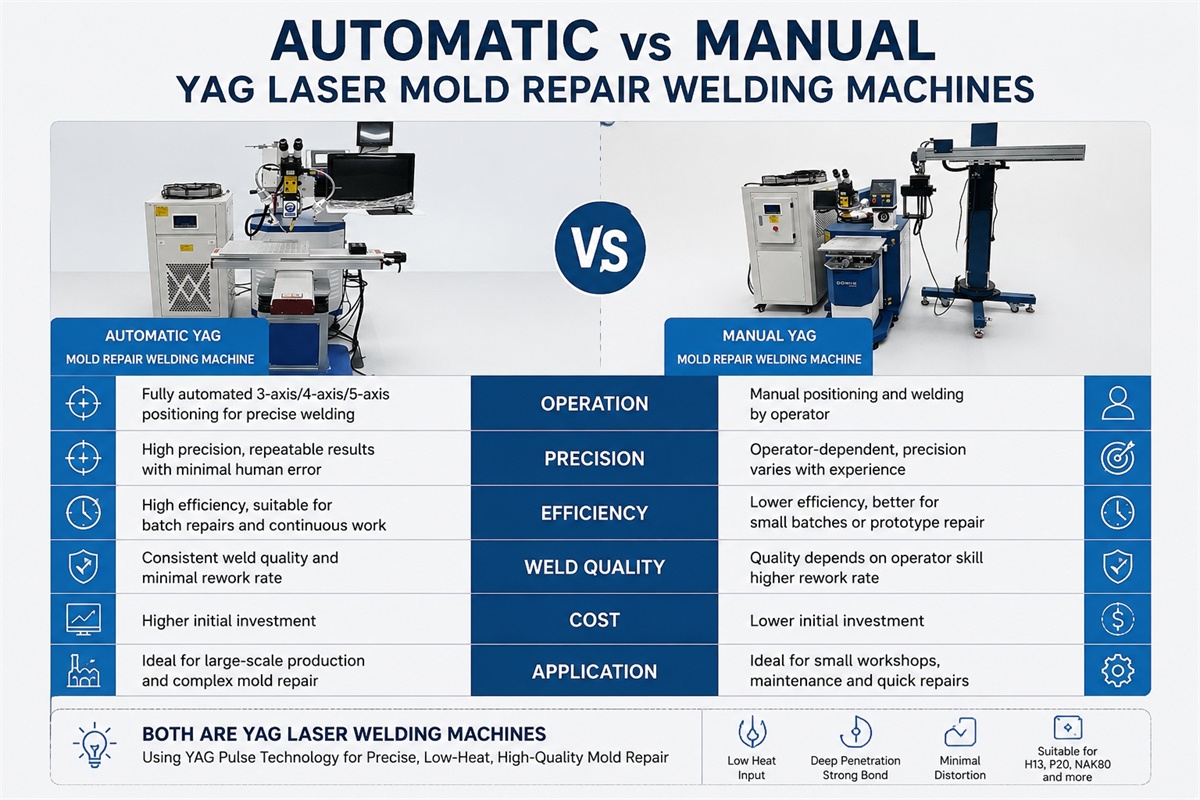
Choosing between an automatic and manual laser mold repair welding machine depends largely on the type of molds you repair, production volume, required consistency, and the complexity of the damaged areas.
Both systems can repair cracks, worn edges, broken corners, scratches, and dimensional defects. However, their working methods are quite different.
Select the type you need:Laser Mold Repair Welding
For mold repair shops handling many repetitive jobs, automatic laser welding can improve consistency and productivity. For flexible repair work involving different mold sizes and irregular defects, a manual laser welder may be more practical.
What Is Manual Laser Mold Repair Welding?
A manual laser mold welding machine relies mainly on the operator to position the laser and control the welding process.
The operator observes the repair area through a microscope or optical system and manually controls the welding position, laser parameters, and filler wire.
Manual systems are particularly useful for:
-
Small and irregular mold repairs
-
Different mold sizes
-
Prototype and maintenance work
-
One-off repair jobs
-
Complex or difficult-to-access areas
-
Workshops with relatively low repair volumes
The biggest advantage is flexibility. An experienced operator can adjust the welding position and parameters according to the actual condition of the mold.
What Is Automatic Laser Mold Repair Welding?
An automatic laser mold repair welding machine uses a motorized positioning system to move the workpiece or laser along programmed axes.
Depending on the machine configuration, it can provide automatic or semi-automatic movement along multiple axes.
A typical automatic system may include:
-
Laser welding source
-
X/Y/Z motion platform
-
CNC or motion controller
-
Automatic or assisted wire feeding
-
Optical viewing system
-
Programmable welding paths
-
Parameter memory
Once the welding parameters and movement path are established, the machine can repeat the same process with significantly less manual positioning.
Automatic vs Manual: Key Differences
| Feature | Manual Laser Welding | Automatic Laser Welding |
|---|---|---|
| Operation | Operator controlled | Programmed/motorized |
| Flexibility | Excellent | Good |
| Repeatability | Depends on operator | Excellent |
| Productivity | Suitable for low-medium volume | Better for repetitive work |
| Complex repairs | Excellent | Good, depending on programming |
| Operator skill | Higher | Lower after setup |
| Consistency | Operator dependent | Highly consistent |
| Setup | Faster for simple jobs | More setup initially |
| Batch production | Less efficient | More efficient |
| Initial investment | Usually lower | Usually higher |
The difference is not simply manual vs automatic. It is primarily a difference in how much of the positioning and welding process is controlled by the operator versus the machine.
Precision and Repeatability
For mold repair, repeatability is extremely important.
With a manual machine, two repairs performed by different operators may have slightly different weld patterns, deposition amounts, or heat input.
An automatic system can follow the same programmed movement and welding parameters repeatedly.
This makes automatic laser welding particularly attractive for:
-
Repeated mold repairs
-
Standardized repair procedures
-
Production environments
-
Multiple operators
-
High-volume repair departments
However, manual welding can still achieve excellent precision when operated by an experienced technician.
Productivity: Which Is Faster?
The answer depends on the job.
For a single complicated repair, manual laser welding may actually be faster because the operator can immediately adjust the welding path without programming.
For repeated or larger repair jobs, automatic welding can provide better productivity because the machine performs the positioning automatically.
For example:
One-off complex repair → Manual may be more efficient
Repeated repair pattern → Automatic may be more efficient
This distinction is important when calculating the real return on investment.
Automatic Wire Feeding vs Manual Wire Feeding
Filler wire control is another important difference.
Manual mold welding typically requires the operator to coordinate the laser position and filler wire manually.
Automatic systems can incorporate an automatic wire feeder, allowing the wire to be supplied at a controlled speed.
This can improve:
-
Deposition consistency
-
Welding stability
-
Operator efficiency
-
Repeatability
-
Continuous welding performance
Automatic wire feeding is particularly useful when repairing longer worn areas or performing repeated buildup work.
Which Is Better for Small Mold Repairs?
For highly localized repairs such as:
-
Fine cracks
-
Small pits
-
Sharp corners
-
Thin edges
-
Small dimensional corrections
a manual laser mold welder can be very effective because the operator can make immediate adjustments.
If the same type of small repair needs to be performed repeatedly, an automatic platform can become more advantageous.
Therefore, repair complexity and repetition are often more important than repair size alone.
Which Is Better for Large Mold Repair?
Large molds do not necessarily require an automatic machine.
The deciding factors are usually:
-
Repair area
-
Number of repairs
-
Repetition
-
Required consistency
-
Operator workload
-
Required production speed
If a large repair is performed only occasionally, manual welding may be sufficient.
If a repair shop handles many molds with similar repair requirements, automatic movement and wire feeding can significantly reduce operator workload.
Operator Skill Requirements
Manual laser welding generally requires more hands-on skill.
The operator needs to understand:
-
Laser parameters
-
Welding position
-
Filler wire selection
-
Heat control
-
Weld pool behavior
-
Mold material characteristics
-
Layer-by-layer deposition
Automatic machines reduce some of the repetitive work, but they do not eliminate the need for technical knowledge.
The operator still needs to select suitable welding parameters, prepare the mold, set the welding path, and inspect the final repair.
In other words, automation reduces repetitive operation; it does not replace process knowledge.
Cost Considerations
A manual laser mold welding machine generally has a simpler configuration and can have a lower initial investment.
An automatic machine usually costs more because it may include:
-
Motorized axes
-
CNC control
-
Automatic wire feeding
-
Programmable movement
-
More sophisticated control systems
However, the purchase price should not be the only consideration.
For a high-volume mold repair business, reduced labor time and improved repeatability can make an automatic machine more economical over the long term.
Which Machine Should You Choose?
Choose a Manual Laser Mold Welder If:
-
You mainly perform one-off repairs
-
Mold types vary significantly
-
Repair locations are irregular
-
Flexibility is more important than automation
-
You already have experienced welding technicians
-
Your repair volume is relatively low
Choose an Automatic Laser Mold Welding Machine If:
-
You repair molds in batches
-
Similar repairs are performed repeatedly
-
Consistent welding results are important
-
You want to reduce repetitive operator work
-
Automatic wire feeding is required
-
Productivity is a major priority
-
You plan to standardize your repair process
Can Automatic and Manual Systems Be Combined?
Yes. A practical solution for many mold repair workshops is a machine that combines precise optical observation with a motorized multi-axis platform.
The operator can position the mold, select welding parameters, and adjust the process while the machine handles controlled movement.
This provides a balance between the flexibility of manual welding and the repeatability of automation.
For companies moving from manual mold repair toward higher production efficiency, this type of configuration can be particularly useful.
Frequently Asked Questions
Is automatic laser welding better than manual laser welding?
Not necessarily. Automatic welding is better for repeatability and repetitive production, while manual welding offers greater flexibility for irregular and one-off mold repairs.
Is automatic laser welding easier to operate?
It can reduce repetitive manual positioning, but operators still need to understand laser parameters, mold materials, filler wire, and repair procedures.
Can automatic laser welding repair precision molds?
Yes. With appropriate laser parameters, positioning accuracy, and optical control, automatic systems can be used for precision mold repair.
Is manual laser welding cheaper?
Manual systems generally have a simpler configuration, so the initial investment can be lower. The actual cost advantage depends on labor requirements and repair volume.
Is automatic wire feeding necessary for mold repair?
Not for every application. It becomes more valuable when repairing larger areas, performing repeated buildup, or seeking consistent filler deposition.
Final Verdict
The choice between automatic and manual laser mold repair welding machines should be based on your actual repair workflow.
Manual laser welding is ideal when flexibility, operator control, and one-off repairs are the priority.
Automatic laser welding is more suitable when repeatability, productivity, automatic movement, and consistent filler deposition are important.
For a small mold repair workshop with diverse repair jobs, manual welding can be the more practical choice. For a high-volume repair operation or manufacturer that repeatedly repairs similar molds, an automatic laser mold welding machine can provide greater efficiency and consistency.
The best approach is to test your actual mold samples before purchasing and compare not only weld quality, but also repair time, operator workload, repeatability, and post-welding machining results.
Post time: Sep-03-2026
