
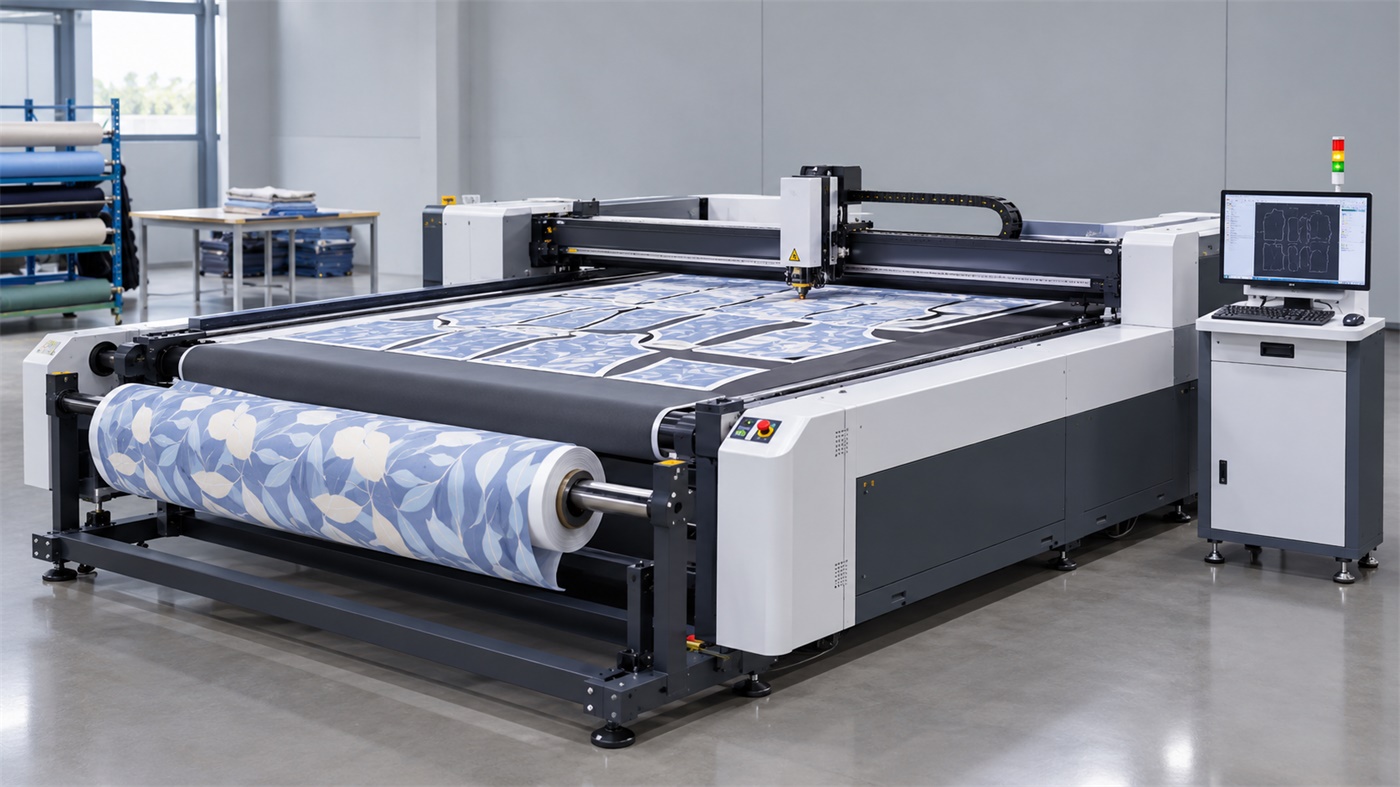
An automatic fabric cutting machine is an essential investment for textile manufacturers looking to increase production capacity, improve cutting consistency, and reduce manual handling. As garment orders become more diverse and delivery schedules become tighter, relying entirely on manual cutting can make it difficult to maintain both efficiency and product quality.
For factories processing large quantities of fabric, automated cutting systems offer a more consistent way to handle repetitive cutting tasks. Depending on the material and production requirements, manufacturers can choose between laser cutting machines, CNC knife cutters, and other automated textile cutting solutions.
This guide explains how automatic fabric cutting machines support mass production, which features matter most when purchasing equipment, and how to select the right system for your factory.
1. Why Use an Automatic Fabric Cutting Machine for Mass Production?
Manual fabric cutting requires operators to position materials, follow patterns, and maintain cutting accuracy throughout production. As order volumes increase, these tasks can consume considerable labor and create inconsistencies between batches.
An automatic fabric cutting machine uses programmed cutting paths and a controlled motion system to process fabric more consistently. When combined with automatic feeding, it can reduce repeated material handling and help maintain a continuous production workflow.
The main advantages include improved cutting consistency, reduced dependence on manual positioning, easier processing of complex patterns, and better integration with digital design files.
For manufacturers producing sportswear, garments, textile accessories, labels, and other fabric products, automation can also simplify the transition between different designs.
However, actual productivity depends on the fabric type, cutting method, machine configuration, material layout, and operator workflow. Choosing a machine based on the complete production process is more effective than comparing cutting speeds alone.
2. Laser Cutting vs. Traditional Fabric Cutting
Different cutting technologies suit different production requirements. Understanding their differences is the first step toward choosing the right automatic fabric cutting machine.
| Feature | Automatic Laser Cutting | CNC Knife Cutting | Manual Cutting |
|---|---|---|---|
| Cutting method | Focused laser beam | Mechanical blade | Hand-operated tool |
| Digital pattern processing | Yes | Yes | Depends on the workflow |
| Complex contours | Excellent | Good to excellent, depending on the tool | Depends on operator skill |
| Physical blade wear | No cutting blade | Yes | Depends on the tool |
| Edge sealing | Possible with suitable synthetic fabrics | No thermal sealing | No thermal sealing |
| Automatic roll feeding | Available on suitable models | Available on suitable models | Usually manual |
| Best application | Detailed cutting of compatible textiles | Heat-sensitive and multilayer materials, depending on the machine | Small batches and simple tasks |
Laser cutting is particularly useful when a factory needs detailed contours, repeatable digital cutting paths, and the ability to change patterns without manufacturing physical dies.
CNC knife cutting may be preferable for materials that cannot tolerate laser heat or for applications requiring multilayer cutting. Manual cutting can remain practical for small production volumes or simple jobs.
For textile manufacturers seeking automated processing of compatible fabrics, a fabric auto-feeding laser cutting machine is worth evaluating as part of a modern production workflow.
3. How Automatic Feeding Improves Fabric Cutting Efficiency
Automatic feeding is one of the most important features to consider when purchasing a fabric cutting machine for mass production.
Instead of requiring operators to place every section of fabric manually, an automatic feeding system advances material from a roll onto the cutting area. The machine can then process successive sections according to the programmed cutting pattern.
This setup is particularly useful for factories working with continuous rolls of textile material. It reduces repetitive loading tasks and can help maintain a more consistent production rhythm.
When evaluating an automatic feeding system, consider the maximum fabric width, feeding stability, conveyor design, tension control, and compatibility with your material. Lightweight, stretchy, or slippery fabrics may require additional attention to prevent shifting, stretching, or wrinkles.
Automatic feeding does not eliminate every manual task. Operators may still need to inspect the material, prepare cutting files, monitor production, and collect finished pieces. Nevertheless, a well-configured system can reduce unnecessary handling and improve workflow efficiency.
4. Why Choose a Vision Laser Cutting Machine for Printed Fabric?
Printed textiles create a particular challenge for automated cutting. The printed pattern may not align perfectly with the original digital design because of variations during printing, fabric movement, or material deformation.
A vision laser cutting machine uses a camera and specialized software to identify printed outlines or other recognizable features. The cutting system then follows the detected contours rather than relying exclusively on a fixed cutting path.
This capability is useful for sublimation-printed sportswear, garment panels, embroidered patches, textile labels, and other products where the cutting path must match an existing design.
Dowin offers vision-equipped models within its automatic fabric laser cutting machine catalog, including configurations designed for printed and embroidered textile applications.
When selecting a vision system, check whether it can recognize your actual artwork, handle the fabric’s positioning variations, and maintain the required cutting accuracy at your target production speed.
5. What Fabrics Can an Automatic Laser Cutting Machine Process?
CO2 laser cutting machines are commonly used for non-metallic materials, including many textile and flexible-material applications. However, compatibility depends on fiber composition, thickness, coatings, and the required edge quality.
Polyester fabric: Commonly used in apparel, sportswear, flags, and promotional textiles. Laser cutting can produce clean contours and may seal the edges through localized melting.
Nylon fabric: Suitable for certain laser cutting applications, although melting, discoloration, and edge deformation must be controlled.
Felt and fleece: Used for decorative products, textile accessories, toys, and industrial components. Appropriate power and speed settings are necessary to prevent excessive charring.
Cotton and linen: Can be laser cut, but these natural fibers may scorch rather than melt-seal. Testing is necessary when appearance and edge quality are important.
Embroidered and printed textiles: Vision-assisted laser cutting can help follow complex outlines and align cuts with existing designs, provided the material and application are compatible with laser processing.
Before introducing a material into production, test samples using the intended cutting parameters. Coatings and blended fibers may behave differently from the base textile. PVC-containing materials and unidentified coatings should not be laser processed without confirming material safety because hazardous or corrosive fumes may be released.
6. Key Features to Look for in an Industrial Fabric Cutting Machine
Not every automatic fabric cutting machine is designed for the same production environment. The following features deserve particular attention when comparing industrial models.
Automatic Feeding and Conveyor System
For roll-based production, a stable feeding mechanism helps deliver fabric continuously to the cutting area. Confirm the maximum roll width, conveyor dimensions, and compatibility with your fabric’s thickness and elasticity.
Single or Multiple Laser Heads
Depending on the machine design, multiple heads can process separate patterns simultaneously and improve throughput. However, their effectiveness depends on the layout, spacing between designs, and whether the heads can work independently.
Vision Recognition
For printed and embroidered fabrics, a vision system can help identify contours and align cutting paths with the actual material. This is particularly valuable when artwork does not always remain in exactly the same position.
Working Area
The effective cutting area should accommodate your fabric width, pattern dimensions, and production layout. A larger work area can reduce repositioning, but it should be matched to your available factory space and actual output requirements.
Software and Motion Control
Compatible design software, stable motion control, and straightforward file preparation can reduce setup time. Before purchasing, verify that the machine supports your preferred design workflow and required file formats.
Exhaust and Safety Systems
Laser cutting produces smoke and airborne byproducts that must be properly extracted. An appropriate exhaust system, suitable filtration where required, and interlocked safety features are important considerations for industrial operation.
7. How to Calculate the Production Capacity You Need
A common purchasing mistake is choosing an automatic fabric cutting machine based only on its maximum advertised speed.
A more useful approach is to estimate how many finished pieces your factory needs to produce per shift.
For example, suppose your factory needs to cut 4,000 components during an eight-hour shift. The required average output is:
4,000 ÷ 8 = 500 pieces per hour.
This is the average output target, not the machine’s required maximum speed. You must also allow time for setup, material loading, pattern changes, inspection, and collection of finished parts.
The next step is to test how many acceptable pieces the machine can produce per hour using your actual fabric and cutting patterns. Complex contours and small features may take longer than simple shapes, while multiple-head processing or optimized nesting may improve output.
A practical machine evaluation should therefore include cutting time, material utilization, downtime, labor requirements, and the percentage of pieces that meet quality standards.
8. How Automatic Fabric Cutting Reduces Material Waste
Fabric is often one of the largest variable costs in textile manufacturing. Poor pattern arrangement, inconsistent manual cutting, and repeated setup adjustments can increase material waste.
Digital cutting software can arrange patterns within the available fabric width to improve material utilization. This process is commonly called nesting.
For repetitive production, optimized nesting can help reduce unused spaces between components. Automatic feeding can also support more consistent handling of roll materials, although the final result depends on fabric stability and machine setup.
Laser cutting offers additional flexibility when handling complex outlines because the cutting path can be adjusted digitally. For suitable synthetic textiles, localized edge sealing may also reduce fraying-related quality problems.
However, laser cutting does not automatically guarantee lower material waste. The quality of the nesting layout, kerf width, fabric defects, pattern spacing, and production workflow all influence the final yield.
Factories should compare material consumption per accepted finished piece rather than assuming that automation alone will eliminate waste.
9. Which Dowin Fabric Laser Cutting Machine Should You Consider?
Different production requirements call for different machine configurations. Dowin’s fabric auto-feeding laser cutting machine range includes several models for fabric, textile, and related non-metal cutting applications.
For manufacturers processing printed or embroidered fabrics, a vision-equipped machine can help recognize outlines and follow the required cutting paths. This is useful when the design position varies between sections of material.
For roll-based textile production, a conveyor-belt automatic feeding system can help reduce manual fabric positioning and support continuous processing. Dowin’s DW-1610AF model, for example, is listed with a 1600 × 1000 mm working area and accommodation for roll materials up to 1600 mm wide.
For higher-throughput applications, some models in the catalog offer multiple laser heads. The right configuration depends on whether the heads can process your patterns efficiently and whether your material and layout allow simultaneous cutting.
Rather than selecting a machine based on model specifications alone, provide your supplier with the fabric type, material width, design files, required daily output, and edge-quality expectations. Sample cutting can help establish whether the proposed configuration meets your production targets.
10. Common Mistakes When Buying an Automatic Fabric Cutting Machine
Choosing only by laser power. Higher power does not necessarily mean better results. Cutting speed, focus, motion accuracy, material properties, and edge quality must be considered together.
Ignoring fabric movement. Stretchy or lightweight fabrics can shift or deform during feeding. A suitable feeding system and material-handling process are essential.
Overlooking vision requirements. A standard laser cutter may follow programmed paths accurately but cannot necessarily compensate for variations in printed artwork. Printed fabric applications may require a suitable vision system.
Underestimating maintenance and extraction. Industrial laser cutting requires routine maintenance and appropriate smoke extraction. These costs should be included in the operating budget.
Skipping sample tests. A machine that performs well on one fabric may produce different results on another. Always test the actual material and representative cutting patterns before committing to production.
Conclusion
An automatic fabric cutting machine can help textile manufacturers improve cutting consistency, reduce repetitive manual work, and support larger production volumes. For compatible textiles, an automatic feeding CO2 laser cutting machine provides digital cutting flexibility, while vision recognition can help align cuts with printed or embroidered designs.
The best solution depends on your material, production target, cutting complexity, and required level of automation. For heat-sensitive materials or applications involving multiple fabric layers, a CNC knife cutter may be more appropriate.
If your factory needs automated roll feeding, accurate textile cutting, or vision-assisted contour cutting, explore the Dowin fabric auto-feeding laser cutting machine catalog to compare available configurations.
Frequently Asked Questions
1. What is the best automatic fabric cutting machine for mass production?
The best machine depends on the material and production process. Automatic feeding laser cutters are useful for compatible textiles and complex digital patterns, while CNC knife cutting systems can be more suitable for heat-sensitive materials or multilayer cutting.
2. Can an automatic fabric cutting machine cut printed fabric?
Yes. A vision-equipped laser cutting machine can recognize printed contours and adjust the cutting path to match the artwork. Actual accuracy depends on the vision system, fabric stability, and printing quality.
3. Does automatic fabric cutting reduce labor costs?
It can reduce repetitive manual feeding, positioning, and cutting tasks. Actual labor savings depend on the machine’s automation level, production volume, and the amount of supervision and material handling still required.
4. Can a laser cutting machine process fabric rolls continuously?
Models equipped with a compatible automatic feeding and conveyor system can process roll materials continuously or in successive sections. Maximum roll width and feeding capability vary by machine configuration.
5. Is laser cutting suitable for cotton fabric?
Cotton can be laser cut, but it may scorch or char instead of forming a sealed edge. Sample testing is necessary to determine suitable settings and whether the resulting edge quality meets production requirements.
6. How do I choose between a single-head and a dual-head fabric laser cutter?
A single-head machine may be sufficient for smaller output requirements or complex patterns that need one cutting path at a time. A dual-head machine can increase throughput when both heads can process suitable patterns efficiently. Compare actual sample-cutting results and production capacity before deciding.
Post time: Oct-12-2026
