
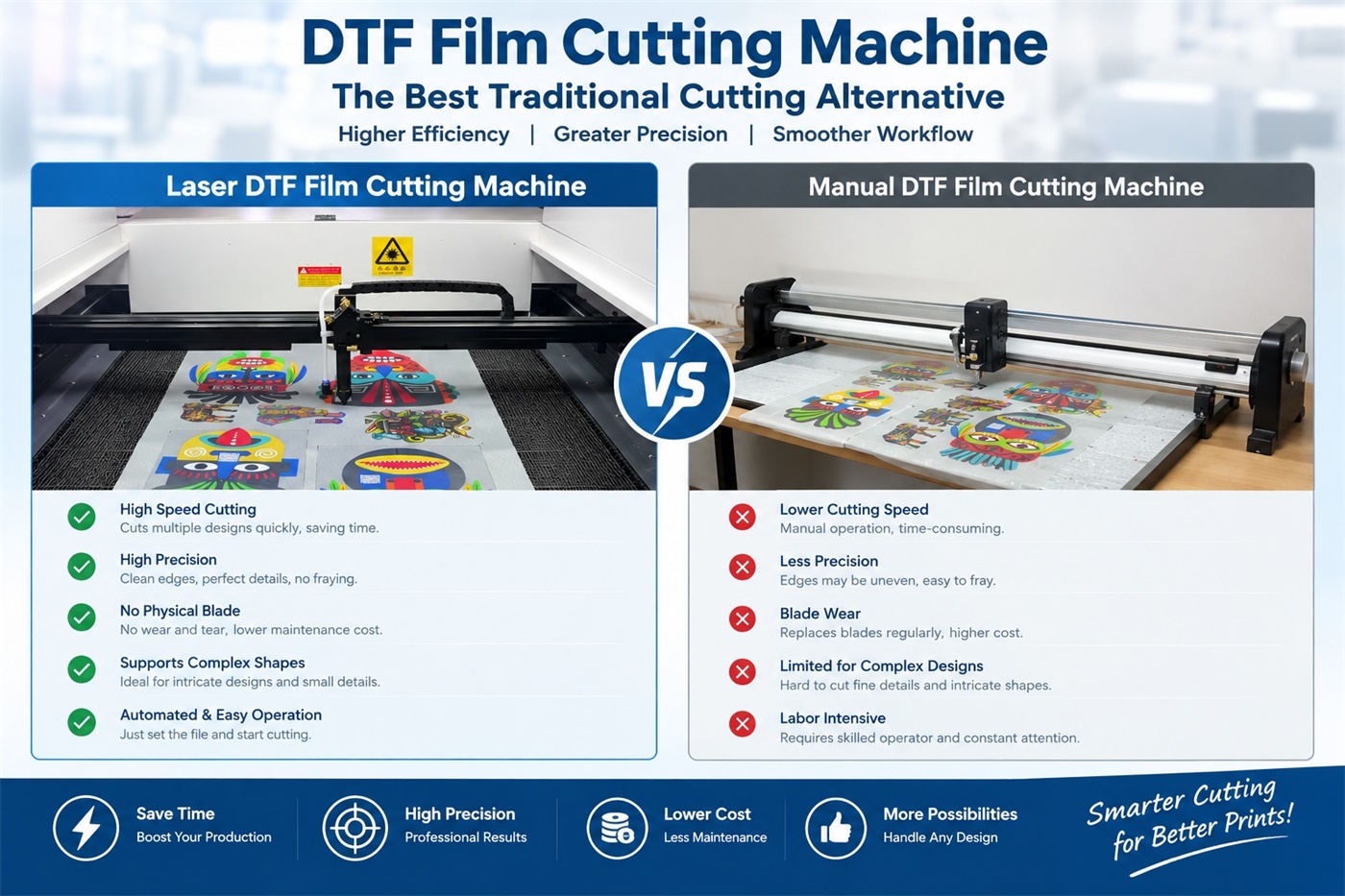
For small DTF printing jobs, manual film cutting may be enough. But as order volume increases, manually positioning and cutting transfer film can take more time and create inconsistencies.
This is where an automatic DTF laser cutter becomes a practical alternative. Compared with manual DTF film cutting, an automated laser system can improve cutting efficiency, accuracy, and production consistency.
Automatic vs Manual DTF Film Cutting
The main difference is how the cutting process is performed.
A manual DTF film cutting machine relies more heavily on the operator to position, feed, and cut the film. It can be suitable for occasional orders or businesses with limited production requirements.
An automatic DTF laser cutter uses digital cutting files and an automated working system to process the film with much less manual intervention.
For a growing DTF transfer business, this difference becomes increasingly important.
1. Production Efficiency
Manual cutting requires operators to repeatedly position the film and monitor the cutting process. When hundreds or thousands of transfers need to be processed, labor can quickly become a production bottleneck.
An automatic laser cutter can continuously process cutting jobs according to preset parameters, reducing repetitive manual work.
For high-volume DTF production, automation can significantly improve workflow efficiency.
2. Cutting Precision
DTF transfers often contain small letters, curves, logos, and irregular shapes. Manual cutting can become less consistent when operators need to process large quantities.
Laser cutting follows digital cutting paths, allowing the same design to be reproduced with consistent positioning and cutting accuracy.
This makes an automatic DTF laser cutter particularly useful for detailed designs and repeat orders.
3. Labor Requirements
Manual cutting requires an operator to spend considerable time handling the film.
With an automatic laser system, the operator can focus more on loading materials, monitoring production, and managing other stages of the DTF workflow.
The goal is not simply to replace a worker with a machine. It is to reduce repetitive cutting work and make the entire production process more efficient.
4. Better for Large DTF Orders
Manual cutting can work well when order quantities are small.
However, when your business produces DTF transfers continuously, automation becomes much more valuable.
A typical production workflow can be:
DTF Printing → Powder Application → Curing → Automatic Laser Cutting → Finished DTF Transfer
This allows the laser cutter to become part of an existing DTF production line.
Automatic DTF Laser Cutter vs Manual Cutting
| Feature | Automatic DTF Laser Cutter | Manual DTF Cutting |
|---|---|---|
| Automation | High | Low |
| Cutting consistency | High | Operator dependent |
| Complex designs | Suitable | More difficult |
| Repetitive work | Reduced | High |
| Large-volume production | Excellent | Less efficient |
| Labor requirement | Lower | Higher |
| Production scalability | Excellent | Limited |
Which DTF Cutting Machine Should You Choose?
A manual cutting solution can be suitable for small DTF printing businesses, occasional orders, and low-volume customization.
An automatic DTF laser cutter is a better choice when you are producing large quantities of DTF transfers, supplying other apparel businesses, or planning to expand production capacity.
For DTF transfer manufacturers and high-volume printing companies, the biggest advantage is not simply cutting speed. It is the combination of automation, repeatability, precision, and reduced manual handling.
At Dowin, we manufacture laser cutting equipment for DTF film applications. We can test your actual DTF film and designs to help determine the appropriate laser configuration for your production requirements.
FAQ
Is an automatic DTF laser cutter better than a manual cutting machine?
For high-volume production, an automatic laser cutter generally provides better efficiency, consistency, and automation. Manual cutting can still be economical for small production volumes.
Can an automatic laser cutter cut detailed DTF designs?
Yes. Laser cutting is well suited to small text, curves, logos, and irregular patterns when the machine is properly configured.
Does an automatic DTF laser cutter reduce labor?
Yes. Automation reduces repetitive manual positioning and cutting work, allowing operators to spend more time managing the overall production process.
Is a manual DTF cutter suitable for beginners?
Yes. If production volume is low and orders are mainly simple designs, manual cutting can be a relatively straightforward starting solution.
Who should buy an automatic DTF laser cutter?
It is especially suitable for DTF transfer manufacturers, DTF printing companies, apparel customization businesses, garment manufacturers, and DTF printer distributors that need higher production capacity.
Conclusion
The choice between an automatic DTF laser cutter and a manual DTF film cutting machine mainly depends on production volume and future growth.
For occasional or small-batch orders, manual cutting may be sufficient. For continuous production, complex designs, and growing DTF transfer orders, automatic laser cutting provides a more scalable solution.
If you are considering upgrading from manual DTF film cutting, send us your film samples and cutting files. We can test them and recommend a suitable automatic laser cutting solution.
Post time: Sep-08-2026
