
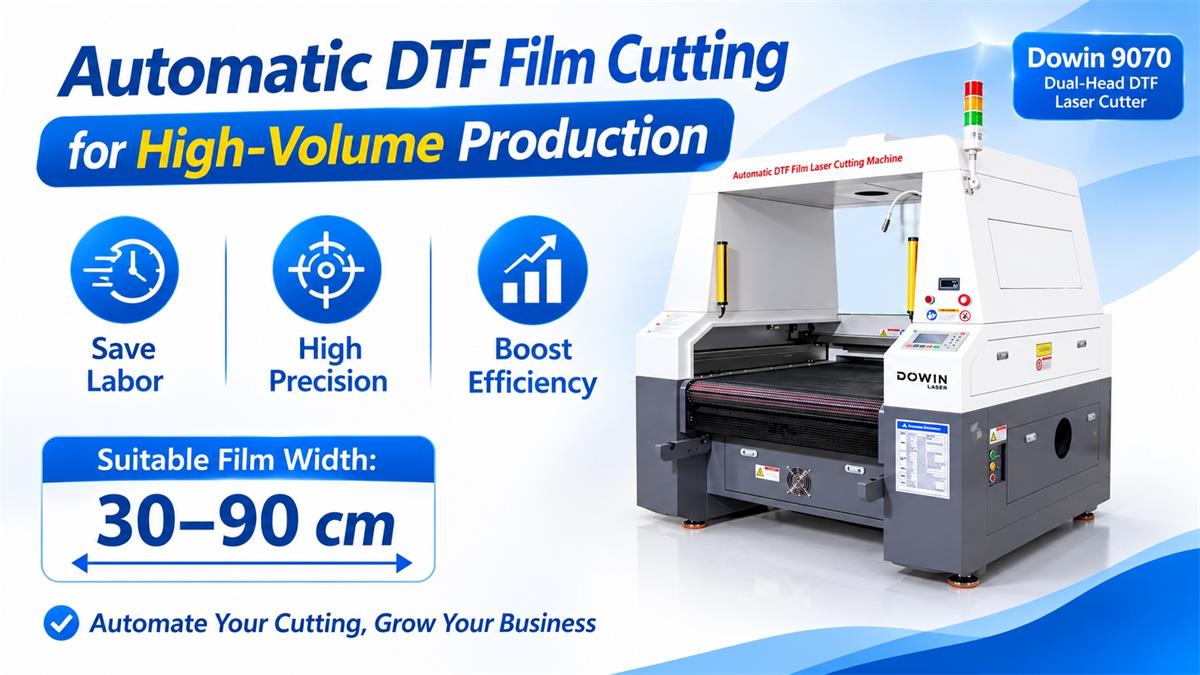
When a DTF printing factory starts processing thousands of transfer designs every day, manual cutting is no longer an efficient production method. Large orders require consistent cutting quality, stable material feeding, and the ability to process different designs without slowing down the entire production line. An industrial automatic DTF film cutting machine like the Dowin 9070 combines automatic material handling, camera positioning, and CO2 laser cutting to help manufacturers handle larger production volumes with less repetitive labor. For businesses supplying wholesale DTF transfers, garment factories, and customized apparel manufacturers, choosing the right cutting system can make a significant difference in production efficiency.
1. Why High-Volume DTF Production Needs Automatic Cutting
DTF printing technology has made it easier for businesses to produce customized garment transfers in different sizes, colors, and patterns. However, increasing printing capacity creates another challenge: how to process the printed film efficiently after printing.
Many factories still use manual scissors, cutting tables, or basic mechanical cutters to separate printed transfers.
These methods may work for small orders, but they become increasingly difficult to manage when production volumes increase.
Common problems include:
- Labor-intensive operations: Workers spend hours manually positioning and separating printed film.
- Production bottlenecks: Cutting cannot keep up with multiple DTF printers operating simultaneously.
- Inconsistent results: Manual cutting quality depends heavily on operator experience.
- Longer delivery times: Large orders require additional time for finishing and sorting.
- Higher operating costs: Factories may need additional workers to handle increasing order quantities.
For high-volume manufacturers, the objective should be to automate repetitive cutting operations rather than continuously increasing the number of employees.
2. How Automatic DTF Film Cutting Works
An industrial automatic DTF cutting machine integrates several operations into one production process.
Step 1: Automatic Material Feeding
Printed PET film is loaded into the feeding system. Depending on the machine configuration, the system can handle roll materials or prepared sheets.
Automatic feeding reduces the need for operators to repeatedly position individual sections of film.
Step 2: Camera Recognition and Positioning
After the material enters the working area, the camera system identifies registration marks, printed edges, or other supported positioning references.
The software uses this information to determine the actual positions of the printed graphics.
This is particularly important when processing customized designs because the cutting paths need to match the printed artwork rather than simply follow fixed dimensions.
Step 3: Automatic Laser Cutting
The CO2 laser follows the programmed cutting paths and separates the printed designs according to the selected parameters.
Unlike mechanical blade cutting, laser cutting is a non-contact process. It does not require a blade to press against the film, making it suitable for many compatible flexible-film applications.
Step 4: Material Collection and Unloading
With a compatible automatic unloading configuration, finished materials can be transferred to the next production stage with less manual intervention.
The operator mainly monitors the process, checks cutting quality, and prepares subsequent production jobs.
3. What Makes Automatic Cutting Suitable for Large Orders?
High-volume DTF production requires more than simply increasing laser power or cutting speed. The entire material-handling process must be efficient.
Continuous Material Processing
Roll-to-roll feeding is particularly useful for factories that regularly process long rolls of printed PET film.
Instead of manually loading individual sheets, the feeding system moves the material through the machine according to its configured workflow.
This reduces interruptions between production cycles and helps maintain a more consistent workflow.
Automatic Recognition of Different Designs
Wholesale DTF manufacturers rarely produce only one design. A single production batch may contain different logos, lettering, clothing graphics, and irregular patterns.
Camera-based positioning allows the machine to recognize supported registration references and match cutting paths to the printed material.
This flexibility is valuable when production involves multiple designs rather than simple rectangular separation.
Less Dependence on Manual Operations
In traditional production, employees repeatedly measure, position, cut, and collect printed film.
Automation reduces these repetitive tasks and allows workers to concentrate on machine supervision, material preparation, quality inspection, and packaging.
For factories with multiple printers, this can help balance printing and finishing capacity.
4. Why Cutting Accuracy Matters in High-Volume DTF Production
When processing a small number of transfers, operators may have enough time to inspect and correct individual cutting problems.
In large-scale production, even a small positioning deviation can affect many finished products.
Consider several common situations:
- Printed graphics have irregular outlines.
- Multiple designs are arranged closely together.
- Different artwork sizes appear on the same film roll.
- Printed positions vary slightly during material feeding.
- Small logos require accurate contour cutting.
A vision positioning system helps identify the actual printed positions and adjust the cutting paths accordingly.
For manufacturers producing customized DTF transfers, this is more useful than relying entirely on fixed cutting coordinates.
However, cutting accuracy also depends on camera calibration, film stability, artwork preparation, and suitable laser parameters. Buyers should request sample testing with their own printed designs.
5. Dual-Head Laser Cutting for Higher Production Capacity
For factories processing large quantities of DTF film, the number of cutting heads can also influence production efficiency.
A dual-head CO2 laser configuration allows two suitable cutting paths to be processed simultaneously.
Potential advantages include:
- Parallel cutting: Two laser heads can process separate suitable areas at the same time.
- Reduced processing time: Suitable layouts can be completed more efficiently than sequential single-head cutting.
- Better production utilization: The cutting station can handle larger batches within the available working hours.
- Flexible production layouts: Multiple designs can be arranged according to the machine’s cutting configuration.
It is important to understand that dual-head cutting does not automatically double production speed. The actual output depends on artwork arrangement, cutting complexity, machine movement, and the coordination of both heads.
When comparing machines, ask suppliers to demonstrate real production results using the same film and cutting files.
6. Automatic DTF Cutting vs. Manual Cutting for Industrial Factories
| Comparison | Manual Cutting | Automatic Laser Cutting |
|---|---|---|
| Material feeding | Manual handling | Automatic feeding available |
| Cutting method | Scissors or mechanical tools | Programmed CO2 laser |
| Positioning | Manual alignment | Camera-assisted recognition |
| Complex designs | Time-consuming | Flexible digital cutting paths |
| Labor requirements | More repetitive work | Reduced repetitive operations |
| Large production batches | More difficult to manage | Better suited to automated workflows |
| Production consistency | Operator-dependent | Program-controlled |
For small customized orders, manual cutting may still be economical. However, when a factory regularly handles large quantities of printed film, automatic cutting becomes a more attractive long-term investment.
7. How to Calculate the Production Capacity You Need
Before purchasing an industrial DTF film cutter, you should understand how much cutting capacity your factory actually requires.
Start by collecting three important figures:
- Daily printed film output.
- Average cutting time per meter or per batch.
- Available production hours per shift.
For example, suppose your factory produces 300 meters of printed DTF film per day.
If your current manual cutting process cannot finish all 300 meters within the working shift, you need to identify whether the bottleneck comes from material loading, cutting speed, alignment, or finished-product handling.
After automation, calculate the complete machine cycle rather than considering laser cutting speed alone.
Daily Cutting Capacity = Actual Processing Speed × Effective Operating Hours
Effective operating hours should account for material loading, software preparation, job changes, inspection, and maintenance.
A machine with a high advertised cutting speed may still deliver disappointing daily output if material handling and setup take too long.
8. What Should You Check Before Buying an Industrial DTF Film Cutter?
Material Compatibility
Confirm that the machine is suitable for your actual PET transfer film and any TPU materials you plan to process. Different coatings and film structures can react differently to laser energy.
Maximum Material Width
Check the maximum supported film width and effective cutting area. These specifications must match your existing DTF printer output.
Automatic Feeding and Unloading
If your factory processes continuous rolls, prioritize a feeding system designed for roll-based production. Confirm whether automatic unloading is included in the selected configuration.
Camera Positioning
Ask whether the system recognizes registration marks, graphic contours, or both. Test different printed designs to evaluate actual recognition performance.
Cutting Quality
Request sample cutting tests to inspect edge quality, film deformation, cutting consistency, and the suitability of the finished transfers for subsequent heat-pressing operations.
Production Demonstration
Do not evaluate equipment based only on videos showing an empty machine moving at high speed. Ask for a complete demonstration using actual printed film, including feeding, recognition, cutting, and unloading.
9. Dowin 9070 Automatic DTF Film Laser Cutting Machine
For DTF manufacturers looking to upgrade their finishing process, Dowin offers the 9070 automatic DTF film laser cutting machine.
The machine is designed for automatic cutting of printed DTF transfer film, with camera registration, CO2 laser processing, and automatic material handling options.
Key features include:
- Automatic camera registration: Recognizes supported registration marks and printed contours.
- Automatic feeding: Supports automated material handling for continuous production configurations.
- CO2 laser cutting: Processes compatible thin PET and TPU films without mechanical blade contact.
- Contour cutting: Supports customized graphics, logos, lettering, and irregular shapes.
- Automatic unloading: Available for configurations designed for continuous material processing.
- Flexible production: Suitable for DTF transfer film and other compatible flexible-film applications.
For factories processing large quantities of printed transfers, the main advantage is combining material handling, visual positioning, and programmed cutting in one automated workflow.
Different 9070 configurations are available, so buyers should confirm the working width, laser-head arrangement, feeding structure, and unloading options according to their production requirements.
View the Dowin 9070 Automatic DTF Film Laser Cutting Machine for product details and configuration information.
10. Which Businesses Should Invest in Automatic DTF Cutting?
Automatic cutting is particularly valuable for businesses with the following production characteristics.
Wholesale DTF Transfer Manufacturers
Wholesale suppliers regularly process large batches of different transfer designs. Automatic contour cutting can help reduce manual finishing work and improve production organization.
Large Garment Printing Factories
Factories operating several DTF printers need sufficient downstream cutting capacity. Automated equipment helps prevent cutting operations from becoming a bottleneck.
Customized Apparel Manufacturers
Businesses producing sportswear, uniforms, workwear, and customized clothing often handle different logos, letters, and decorative graphics. Camera-assisted contour cutting provides greater flexibility for these orders.
Growing DTF Printing Businesses
Companies preparing to expand production should evaluate automation before labor requirements become difficult to manage. Investing at the right time can make future production expansion easier.
Frequently Asked Questions
1. Is automatic DTF film cutting suitable for large-scale production?
Yes. Automatic feeding, camera positioning, and programmed laser cutting can help factories process large quantities of printed transfer film with less repetitive manual work.
2. Can an automatic DTF cutter process continuous film rolls?
Yes, suitable roll-to-roll configurations can process continuous PET film rolls. Confirm the maximum roll width, feeding system, and unloading arrangement before purchasing.
3. Does a dual-head DTF laser cutter increase production speed?
It can increase productivity by processing suitable cutting paths simultaneously. Actual performance depends on artwork layout, machine configuration, and cutting parameters.
4. Can a DTF laser cutter process irregular graphic shapes?
Yes. With compatible cutting software and camera positioning, a laser system can follow programmed contour paths for customized logos, letters, and irregular graphics.
5. How does automatic cutting reduce labor costs?
It reduces repetitive material positioning, manual cutting, and handling operations. The actual labor savings depend on production volume, machine automation level, and operator involvement.
6. Can one machine process both PET and TPU film?
Some configurations support both materials. However, compatibility and cutting parameters must be verified through actual material testing.
7. Is a laser cutter better than a traditional DTF vinyl cutter?
They use different cutting methods. A laser cutter provides non-contact processing and flexible digital cutting paths, while a blade-based cutter uses mechanical cutting. The best choice depends on material compatibility, cutting requirements, and production volume.
Conclusion
High-volume DTF production requires more than fast printing. Cutting, material handling, and finishing must also keep pace with the output of modern DTF printers.
Manual cutting may be sufficient for small businesses, but it can become a serious bottleneck when order quantities increase. Automatic DTF film cutting helps manufacturers reduce repetitive labor, improve cutting consistency, and organize larger production batches more efficiently.
For wholesale transfer manufacturers and industrial DTF printing factories, the Dowin 9070 is worth evaluating as an automatic PET and TPU film cutting solution.
Before selecting a machine, provide your supplier with your actual film samples, printer width, daily production volume, and cutting files. A real production test is the most reliable way to determine whether the machine can meet your factory’s requirements.
Post time: Nov-12-2026
