
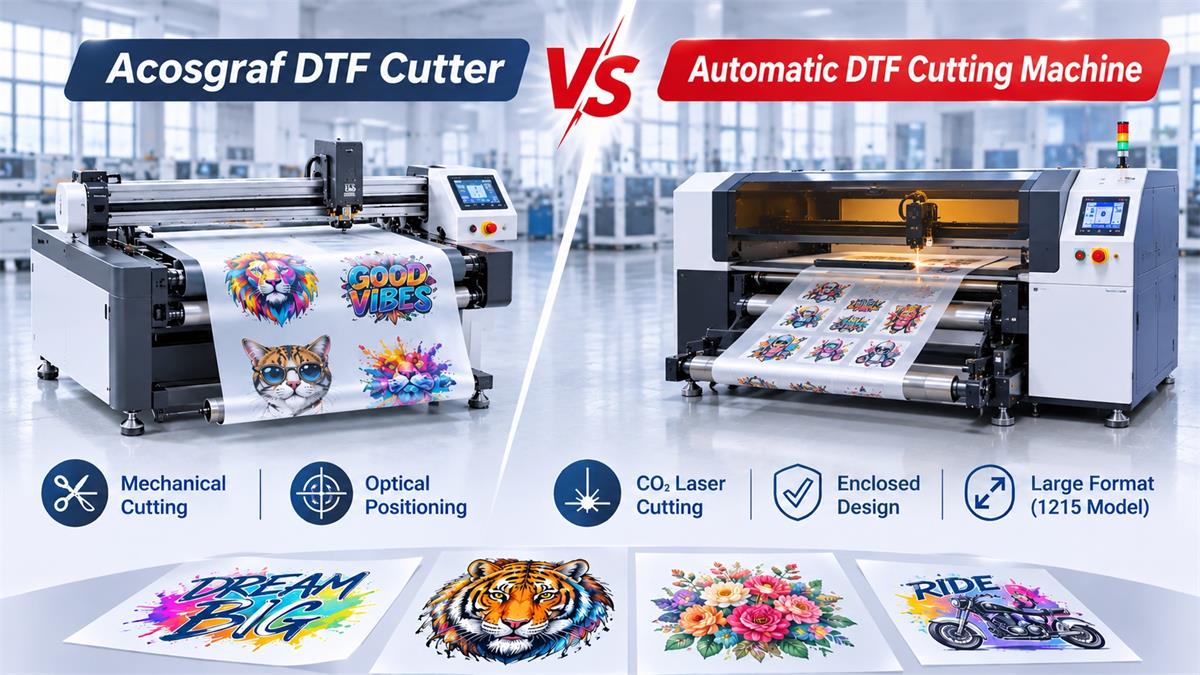
As DTF printing businesses expand, cutting printed transfer film efficiently becomes an important part of production. The Acosgraf DTF Cutter is one example of an automated cutting solution designed to reduce manual work in DTF production. However, buyers comparing DTF cutting equipment should also consider laser-based systems, especially when processing PET film, TPU film, custom logos, and complex graphics.
Dowin offers several automatic DTF laser cutting solutions, including the 9070 DTF Laser Cutter, the 9070 Enclosed DTF Cutter, and the larger 1215 Automatic DTF Cutting Machine. These machines provide different configurations for businesses looking to improve cutting efficiency and expand production capacity.
1. What Is the Acosgraf DTF Cutter?
The Acosgraf DTF Cutter is an automated cutting machine designed to streamline the finishing stage of DTF transfer production. Its main purpose is to reduce the time and labor required to separate printed transfers after printing and curing.
Based on the available product information, its main features include:
- Automated cutting for DTF transfer production.
- X-axis cutting configuration in the SPSI product listing.
- Optical registration mark recognition.
- Integration into an existing DTF production workflow.
- Support for roll-based DTF film processing.
- Reduced manual handling and repetitive cutting work.
Some Acosgraf configurations are also described by distributors as supporting X and Y-axis cutting. Buyers should confirm the exact model configuration, cutting axes, and working width with the supplier before ordering.
The main advantage of this type of equipment is workflow automation. It is particularly relevant to DTF printing businesses that already have established printing and curing processes and want to reduce manual cutting operations.
2. What Is an Automatic DTF Laser Cutting Machine?
An automatic DTF laser cutting machine uses a focused CO2 laser beam to cut printed transfer film according to digital cutting paths. Depending on the machine configuration, it can work with roll materials or individual sheets and use a camera or vision system to identify printed graphics and cutting positions.
Unlike a conventional blade cutter, laser cutting is a non-contact process. There is no mechanical cutting blade pressing against the film, and the cutting path can be adjusted digitally for different designs.
For professional DTF production, this approach offers several potential advantages:
- Digital cutting paths for customized shapes and detailed graphics.
- Non-contact processing without mechanical blade pressure.
- Vision-based positioning for printed contour cutting, depending on configuration.
- Automatic feeding options for continuous production.
- Flexible processing of compatible PET and TPU films.
However, laser cutting is a thermal process. Different PET and TPU films may react differently to laser energy. Buyers should test their actual materials to check edge quality, melting, deformation, and possible effects on printed layers before choosing a laser system.
3. Acosgraf DTF Cutter vs. Dowin Automatic DTF Laser Cutter
The key difference is not simply the brand name. It is the cutting technology, machine configuration, and production requirements.
| Comparison | Acosgraf DTF Cutter | Dowin Automatic DTF Laser Cutter |
|---|---|---|
| Cutting technology | Mechanical X-axis cutting system, according to the listed configuration | CO2 laser cutting |
| Positioning | Optical registration mark recognition on documented configurations | Camera and vision-based positioning, depending on model |
| Cutting method | Mechanical blade-based cutting | Non-contact laser cutting |
| Material applications | Printed DTF transfer film | Compatible DTF PET film, TPU film, UV stickers, labels and other applications depending on model |
| Feeding options | Roll or in-line workflow, depending on configuration | Automatic feeding and roll or sheet processing, depending on model |
| Enclosure options | Confirm with supplier | Fully enclosed 9070 configuration available |
| Large-format production | Confirm maximum working width | 1215 model with 1200 × 1500 mm working area |
| Best selection criteria | Existing DTF finishing workflow and required cutting configuration | Material compatibility, cutting area, laser configuration and production volume |
These machines should not be compared using cutting speed alone. A mechanical cutter and a CO2 laser cutter process material differently. The actual production result depends on film thickness, artwork complexity, cutting path, feeding stability, and machine configuration.
4. Which Dowin DTF Cutting Machine Should You Consider?
Dowin offers different DTF laser cutting configurations rather than a single machine for every production requirement.
Dowin 9070 Enclosed DTF Cutter for PET and TPU Film
The 9070 Enclosed DTF Cutter is designed for businesses that prefer a fully enclosed laser working area.
Its main advantages include:
- Fully enclosed safety cover to isolate the laser working area.
- LED lighting and camera visibility inside the working area.
- DTF transfer film and compatible TPU film cutting.
- Applications including UV stickers, crystal labels, wash labels, and garment labels.
- A more enclosed and professional working environment.
This configuration is worth considering for workshops where laser safety, working-area enclosure, and a cleaner machine layout are important purchasing factors.
Dowin 9070 Laser Cutter for DTF and TPU Film
The 9070 DTF Laser Cutter is designed for automatic contour cutting of printed DTF film.
Its product configuration highlights:
- Camera registration and contour recognition.
- Automatic loading and unloading options.
- Processing of compatible printed PET film rolls and sheets.
- Digital cutting paths for customized graphics and irregular shapes.
- CO2 laser cutting without mechanical blade contact.
It is a practical option for DTF printing companies that want to move beyond manual trimming and introduce laser-based cutting into their existing production workflow.
Dowin 1215 Automatic DTF and TPU Film Cutting Machine
For businesses with larger production requirements, the Dowin 1215 DTF and TPU Film Cutting Machine provides a larger working format.
Its main specifications and features include:
- 1200 × 1500 mm working area.
- Dual 160W laser head configuration.
- Automatic feeding system.
- Industrial CCD camera positioning technology.
- Servo motor, reducer, rack-and-pinion transmission, and linear guide rail system.
- Non-contact laser cutting for compatible flexible materials.
The 1215 is suitable for larger DTF printing factories and transfer manufacturers that need more working space for batch layouts and continuous production. Its larger format also makes it suitable for processing compatible TPU materials, UV stickers, crystal labels, care labels, and embroidered patches.
5. Blade Cutting vs. Laser Cutting: What Should Buyers Consider?
When comparing an Acosgraf-style DTF cutter with a laser DTF cutting machine, understanding the difference between mechanical and thermal cutting is essential.
Mechanical Blade Cutting
Blade-based systems use a physical cutting tool to separate printed film. They can be suitable for conventional DTF contour cutting and production workflows where avoiding thermal effects is a priority.
However, buyers should consider blade wear, cutting-tool maintenance, material thickness, and the machine’s ability to process complex designs consistently.
CO2 Laser Cutting
Laser systems use concentrated heat to process compatible film materials. They do not require a mechanical cutting blade and can follow digital cutting paths for customized designs.
For manufacturers processing different types of film products, laser systems may offer greater application flexibility. However, the material must be suitable for laser processing, and appropriate extraction and ventilation are essential.
Neither method is automatically better for every DTF application. The correct choice depends on the material, cutting quality requirements, production volume, and overall manufacturing workflow.
6. How to Choose the Right Automatic DTF Cutter
Before purchasing a DTF cutting machine, consider the following questions.
1. What Film Width Do You Process?
Check the maximum usable cutting width rather than relying only on the machine’s external dimensions. Your cutter should accommodate the actual film width used by your DTF printer.
2. Do You Need Roll-to-Roll or Sheet Processing?
Some production lines mainly process continuous film rolls, while others handle individual sheets or different material formats. Choose a feeding configuration that matches your existing workflow.
3. Do You Need a Fully Enclosed Machine?
A fully enclosed laser cutter can help isolate the working area and provide a more controlled operating environment. This is particularly relevant when laser safety requirements are an important consideration.
4. What Is Your Daily Production Volume?
A smaller working format may be sufficient for a growing DTF workshop. Larger factories processing multiple orders and different layouts may benefit from a larger working area and dual-head configuration.
5. Have You Tested Your Actual Film?
This is especially important when selecting a laser cutting system. PET and TPU films vary in composition, thickness, coating, and adhesive structure. Request a cutting test using your actual material and artwork before making a final decision.
7. Final Verdict: Acosgraf or Dowin Automatic DTF Cutter?
The Acosgraf DTF Cutter is designed to automate the finishing process for printed DTF transfers, particularly for businesses looking to reduce repetitive manual cutting and integrate a cutter into an existing production line.
Dowin takes a different approach with CO2 laser-based DTF cutting systems. Its 9070 models provide solutions for standard and enclosed configurations, while the 1215 offers a larger working area and dual-head laser configuration for higher-capacity production requirements.
The right choice depends on your production priorities:
- For conventional DTF finishing: Consider the Acosgraf cutting configuration and confirm its compatibility with your existing printing line.
- For enclosed laser processing: Consider the Dowin 9070 Enclosed DTF Cutter.
- For automatic laser contour cutting: Consider the Dowin 9070 DTF Laser Cutter.
- For larger-format production: Consider the Dowin 1215 Dual-Head DTF and TPU Film Cutting Machine.
At Dowin, we manufacture CO2 laser cutting machines for DTF and TPU film applications. Instead of recommending a machine based only on its model number, we encourage buyers to evaluate their film materials, cutting files, working width, and production targets.
If you are comparing an Acosgraf DTF Cutter with an automatic laser cutting solution, you can send us your film samples and artwork. Our team can help evaluate material compatibility and recommend a suitable Dowin configuration for your production requirements.
Frequently Asked Questions
Is the Acosgraf DTF Cutter a laser cutting machine?
The Acosgraf DTF Cutter listed by SPSI is described as an X-axis mechanical cutting system with optical registration mark recognition. It should not be confused with a CO2 laser DTF cutter.
What is the difference between an Acosgraf DTF Cutter and a laser DTF cutter?
The main difference is the cutting method. The Acosgraf system uses mechanical cutting, while a laser DTF cutter uses a focused CO2 laser beam. Each method has different material requirements, maintenance considerations, and cutting characteristics.
Can a Dowin laser cutter cut both PET and TPU film?
Dowin offers DTF and TPU film cutting machines designed for these applications. However, actual cutting results depend on the material composition and thickness. Sample testing is recommended before production.
What is the difference between Dowin 9070 and 1215 DTF cutters?
The 9070 has a 900 × 700 mm working format, while the 1215 provides a larger 1200 × 1500 mm working area with a dual 160W laser head configuration and automatic feeding system.
Is an enclosed DTF laser cutter necessary?
Not every production environment requires the same machine enclosure. However, an enclosed design helps isolate the laser working area and may be preferable where stricter laser safety requirements apply.
Can a laser DTF cutter replace manual cutting?
For compatible materials and properly prepared cutting files, an automatic laser cutter can replace many repetitive manual cutting operations. The actual labor savings depend on production volume, feeding arrangements, and operator involvement.
Post time: Nov-06-2026
