
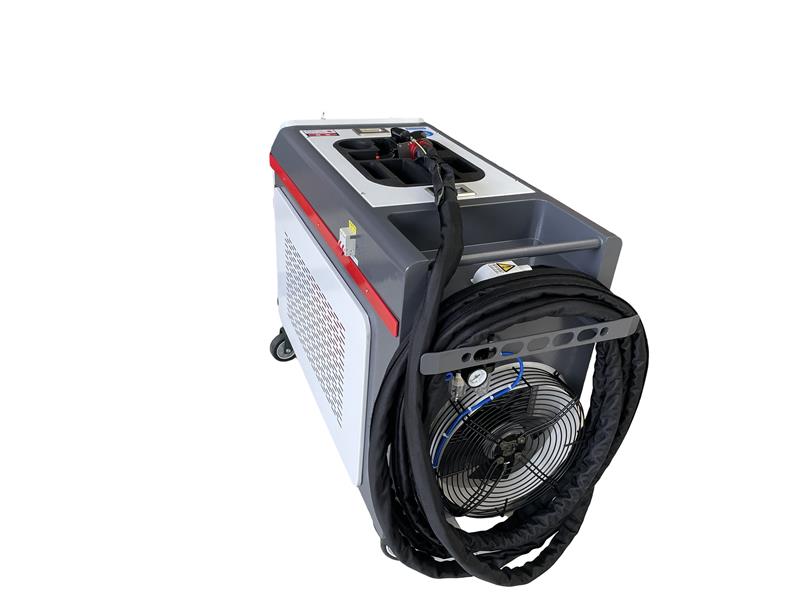
Industrial cleaning used to be simple — but brutal.
Sandblasting stripped surfaces aggressively. Chemical cleaning polluted factories. Grinding damaged materials while creating dust, noise, and endless labor costs. For decades, industries tolerated these problems because there were few alternatives powerful enough to compete.
Then handheld laser cleaning machines entered the market.
Among all power levels, the 500W handheld laser cleaning machine has become one of the most important turning points in modern industrial cleaning. It sits in a unique position: powerful enough for serious industrial applications, yet still portable enough for flexible field operation.
That balance is exactly why the 500W class is exploding in popularity worldwide.
Recent market discussions show that 500W handheld laser cleaners are increasingly favored by maintenance companies, automotive restoration businesses, mold repair workshops, shipyards, and mobile cleaning startups because they combine industrial-grade cleaning power with operational flexibility.
Why the 500W Power Range Became the Industry Sweet Spot
Lower-power laser cleaning machines often struggle with thick rust, heavy coatings, or large-area cleaning. Extremely high-power systems, meanwhile, become expensive, bulky, and difficult to operate in mobile environments.
The 500W handheld laser cleaning machine sits directly in the middle.
It delivers:
- High cleaning efficiency
- Strong rust removal capability
- Faster paint stripping
- Better productivity
- Manageable machine size
- Reasonable power consumption
This combination makes 500W systems attractive for businesses that need real industrial performance without moving into oversized automated cleaning stations.
In many cases, 500W systems are now viewed as the minimum serious commercial-grade configuration for mobile laser cleaning operations. Discussions from professional laser cleaning communities repeatedly show users selecting 500W systems because lower-power machines often cannot maintain acceptable productivity in commercial environments.
How a 500W Handheld Laser Cleaning Machine Works
A handheld laser cleaner uses high-energy laser beams to remove:
- Rust
- Paint
- Oxide layers
- Oil contamination
- Resin residue
- Surface coatings
The laser energy interacts with contaminants through rapid heating and ablation. The unwanted layer absorbs the laser energy faster than the underlying substrate, causing contaminants to vaporize or detach from the surface.
Unlike sandblasting or grinding, the process is non-contact.
That changes everything.
There is:
- No abrasive media
- No physical wear
- Minimal substrate damage
- Lower consumable costs
- Reduced secondary pollution
Modern 500W systems typically use pulsed fiber laser technology because pulsed lasers offer stronger precision and better substrate protection.
Pulsed Laser Technology Is the Real Game Changer
Many people mistakenly think all laser cleaning systems work the same way.
They do not.
The real difference often comes from beam structure and pulse control.
Modern 500W pulse laser cleaners commonly use MOPA pulse technology, allowing operators to independently adjust:
- Pulse width
- Frequency
- Energy output
- Cleaning speed
This flexibility dramatically expands cleaning applications.
For example:
- Narrow pulses can reduce heat impact on delicate materials
- Wider pulses improve heavy rust removal
- Frequency adjustments optimize paint stripping
- Different scan modes improve cleaning consistency
This level of control is why laser cleaning is increasingly replacing traditional industrial methods.
It is not just “cleaning.”
It is programmable surface engineering.
Top-Hat vs Gaussian Beam: An Industry Debate Most Buyers Never Hear About
One of the most important technical discussions in laser cleaning today revolves around beam profiles.
Most buyers never even hear about this before purchasing a machine.
Gaussian Beam
Gaussian beams concentrate energy heavily in the center.
Advantages:
- Strong cleaning power
- Excellent rust removal
- Better oxide cleaning
- Aggressive surface stripping
Disadvantages:
- Higher substrate risk
- Greater heat concentration
- Potential surface damage on delicate materials
Top-Hat Beam
Top-hat beams distribute energy more evenly.
Advantages:
- Softer cleaning effect
- Better substrate protection
- Lower risk of surface deformation
- Ideal for delicate cleaning
Disadvantages:
- Less aggressive on heavy mill scale
- Slower for thick contamination removal
Industry discussions on Reddit repeatedly highlight this distinction. Experienced operators often explain that top-hat lasers excel in delicate cleaning while Gaussian systems remain stronger for aggressive metal contamination removal.
The reality is uncomfortable:
There is no universally “best” beam profile.
The right choice depends entirely on the cleaning application.
Major Applications of 500W Handheld Laser Cleaning Machines
Rust Removal
This is still the largest application globally.
500W handheld systems can efficiently remove:
- Surface rust
- Oxidation
- Corrosion layers
- Metal contamination
Typical industries include:
- Shipbuilding
- Steel fabrication
- Automotive restoration
- Railway maintenance
- Construction equipment repair
Some manufacturers report cleaning efficiencies reaching 4m²/h for heavy rust removal applications.
Paint Removal
Paint stripping is one of the fastest-growing laser cleaning sectors.
Traditional paint removal creates:
- Toxic waste
- Chemical exposure
- Massive labor costs
Laser cleaning offers cleaner operation with better surface control.
500W systems are especially effective for:
- Industrial coatings
- Automotive paint
- Epoxy layers
- Surface preparation
Tire Mold Cleaning
Tire mold cleaning has become one of the most valuable industrial applications for laser cleaning.
Traditional methods such as chemical soaking and abrasive cleaning often shorten mold lifespan. Laser cleaning avoids direct abrasion while reducing downtime.
This matters because tire molds are expensive.
Protecting the mold itself becomes economically critical.
Weld Seam Cleaning
Laser cleaning is increasingly integrated into welding production lines.
It removes:
- Oxide layers
- Oil contamination
- Welding residue
- Surface discoloration
This improves weld quality while reducing manual finishing work.
Portability Is Reshaping the Entire Industry
The biggest transformation is not simply cleaning performance.
It is mobility.
Older industrial laser systems were massive stationary machines. Modern handheld systems allow operators to bring the laser directly to:
- Ship hulls
- Pipelines
- Large machinery
- Outdoor structures
- Automotive frames
This flexibility has created entirely new business models.
Mobile laser cleaning services are now emerging globally because handheld systems make on-site industrial cleaning commercially viable.
That trend barely existed a few years ago.
The Hidden Problem Nobody Talks About: Safety
Laser cleaning videos online often look effortless.
Reality is different.
Laser cleaning generates:
- Vaporized coatings
- Metal particles
- Toxic fumes
- Smoke residue
Reddit discussions repeatedly warn about improper ventilation and poor respiratory protection during paint removal or heavy industrial cleaning.
This is where inexperienced operators make dangerous mistakes.
Professional laser cleaning requires:
- Fume extraction
- Respirators
- Laser safety glasses
- Controlled workspaces
- Proper ventilation
The laser itself is only part of the system.
Safety infrastructure matters just as much.
Why 500W Handheld Laser Cleaning Represents the Future
The deeper reason 500W handheld laser cleaning machines are growing so rapidly is simple:
Manufacturing is changing.
Factories increasingly demand:
- Cleaner production
- Lower consumable costs
- Environmental compliance
- Precision surface treatment
- Automation compatibility
- Flexible maintenance solutions
Traditional methods struggle to meet these requirements simultaneously.
Laser cleaning does.
And the 500W category has become the practical balance point between power, portability, cost, and industrial usability.
That is why this segment is expanding so aggressively worldwide.
The future of industrial cleaning is no longer about brute force.
It is about controllable energy, intelligent processing, and precision surface management.
Post time: May-09-2026
