
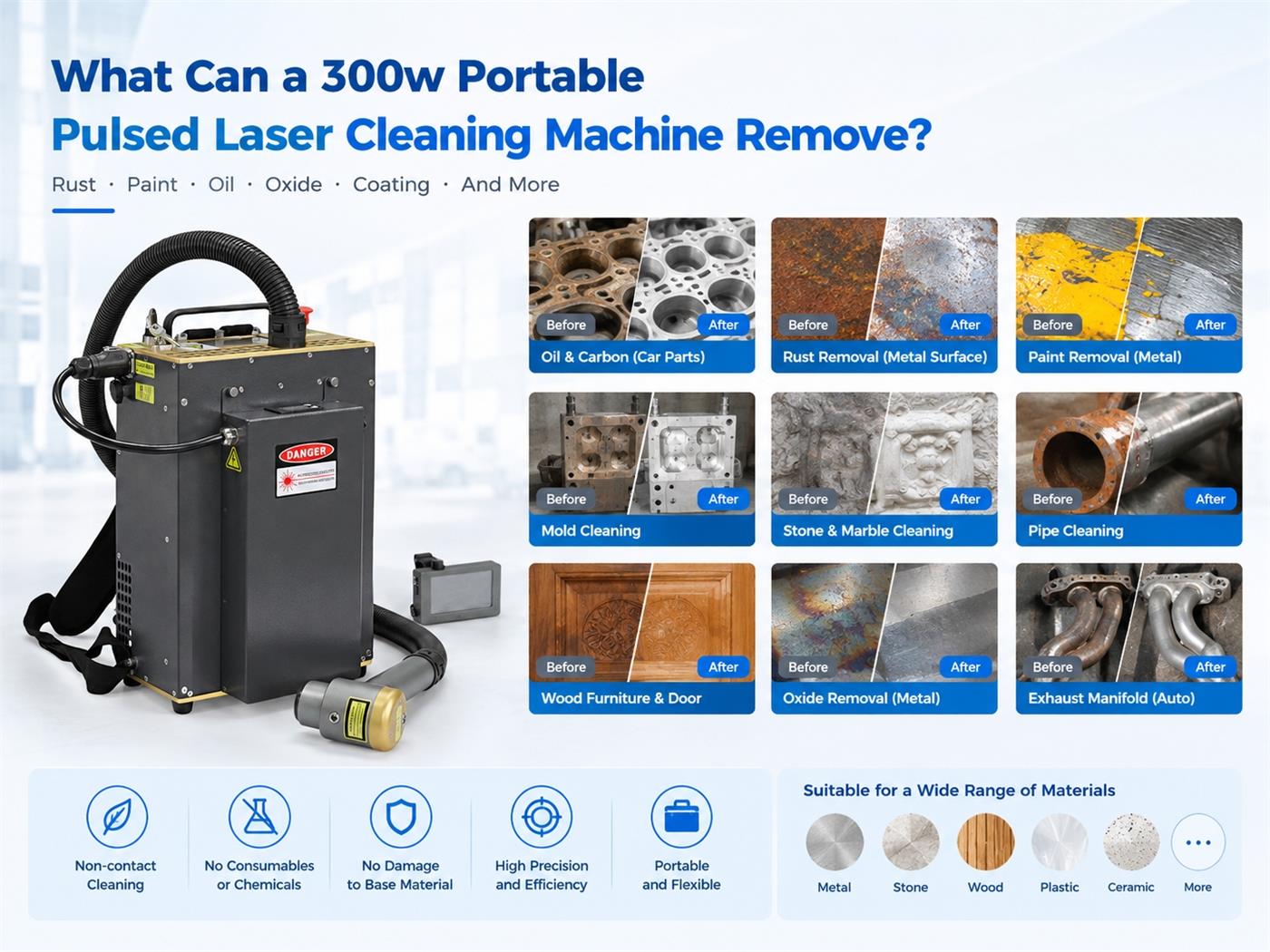
A 300W portable pulsed laser cleaning machine is becoming a practical solution for removing rust, paint, oil, carbon, oxidation, and other surface contaminants from metal components. Compared with traditional grinding, sandblasting, or chemical cleaning, pulsed laser cleaning provides a non-contact and highly controllable way to treat specific areas.
This guide explains how a 300W pulsed laser cleaner works, what it can remove, where it can be used, and what to consider before buying one.
What Is a 300W Portable Pulsed Laser Cleaning Machine?
A 300W pulsed laser cleaning machine uses short, high-energy laser pulses to interact with contaminants on a surface.
When the laser beam reaches the contaminated layer, the absorbed energy can cause the unwanted material to rapidly vaporize, detach, or be removed from the substrate. With properly selected parameters, the operator can target the contamination while minimizing the effect on the base material.
The portable design makes the machine suitable for workshops, maintenance areas, production lines, and on-site cleaning.
What Can a 300W Laser Cleaning Machine Remove?
A 300W pulsed laser cleaner can be used for many common industrial cleaning tasks.
Rust and Oxidation
Rust removal is one of the most popular applications. It can clean rust from:
-
Steel parts
-
Pipes
-
Automotive components
-
Machine parts
-
Tools
-
Metal structures
Paint and Coatings
Laser cleaning can remove certain paint and coating layers from suitable metal substrates, making it useful for surface preparation and localized paint stripping.
Oil and Grease
Industrial components often accumulate oil and grease during production or maintenance. Laser cleaning can remove many types of surface oil contamination without abrasive contact.
Carbon Deposits
Automotive and mechanical components can develop carbon deposits during operation. A pulsed laser can be used for localized carbon and residue removal from suitable metal parts.
Mold Contamination
Injection molds and other tooling can accumulate oil, residue, oxidation, and deposits. The non-contact nature of laser cleaning makes it suitable for detailed mold surfaces.
Why Choose 300W Pulsed Laser Cleaning?
The 300W configuration offers a balance between cleaning efficiency and process control for many applications.
Non-Contact Cleaning
The laser does not physically touch the workpiece, reducing mechanical wear and avoiding abrasive media.
No Chemical Solvents
Laser cleaning does not normally require chemical cleaning agents, which can reduce consumable use and secondary chemical waste.
Precise Cleaning
The laser can be focused on a specific contaminated area, making it useful for localized cleaning and detailed components.
Low Thermal Influence
Pulsed laser energy can be delivered in short bursts. With appropriate parameters, this helps limit unnecessary heat transfer to the substrate.
Portable Operation
A portable 300W system can be moved between different work areas, which is useful for maintenance and repair applications.
Where Can a 300W Pulsed Laser Cleaner Be Used?
The machine can be applied across several industries.
Automotive: engine components, carbon deposits, rust, oil, and paint.
Mold manufacturing: mold surfaces, inserts, cavities, and production residue.
Metal fabrication: rust removal, paint stripping, and pre-weld surface preparation.
Machinery maintenance: cleaning gears, machine components, tools, and mechanical parts.
Industrial restoration: removal of corrosion, coatings, and accumulated contamination.
300W Pulsed Laser vs. Traditional Cleaning
| Feature | 300W Pulsed Laser Cleaning | Traditional Cleaning |
|---|---|---|
| Contact | Non-contact | Often contact-based |
| Chemicals | Normally not required | May be required |
| Abrasive media | Not required | May be required |
| Precision | High | Method dependent |
| Localized cleaning | Excellent | Often less precise |
| Secondary waste | Low | Can be higher |
| Portability | Available | Depends on equipment |
Traditional methods remain useful for many applications, particularly very large surfaces or extremely heavy contamination. Laser cleaning becomes attractive when precision and reduced consumables are important.
How to Get the Best Cleaning Results
Laser cleaning is not simply a matter of increasing power.
Important parameters include:
-
Laser power
-
Pulse energy
-
Pulse duration
-
Frequency
-
Scanning speed
-
Spot size
-
Focus position
-
Number of passes
The correct settings depend on both the contaminant and the substrate.
For example, removing heavy rust from carbon steel may require very different parameters from cleaning oxidation from stainless steel or removing paint from aluminum.
For a new application, testing a small area first is recommended.
Does a 300W Laser Cleaning Machine Damage the Surface?
A properly configured laser cleaning process can minimize substrate alteration, but no laser cleaning system should be considered automatically damage-free.
Excessive energy or incorrect parameters can affect the base material, especially on thin, reflective, painted, or heat-sensitive surfaces.
The goal should always be:
Remove the contamination while maintaining the required substrate condition.
Is 300W Enough for Your Application?
A 300W pulsed laser cleaner can be suitable for many medium-duty industrial cleaning applications, especially localized rust, paint, oil, carbon, and oxidation removal.
However, machine selection should consider:
-
Contaminant thickness
-
Cleaning area
-
Required cleaning speed
-
Substrate material
-
Working environment
-
Portability requirements
For very large surfaces or extremely thick contamination, a higher-power laser cleaning system may be more appropriate.
Final Thoughts
A 300W Portable Pulsed Laser Cleaning Machine provides a flexible solution for rust removal, paint stripping, oil and grease cleaning, carbon removal, mold cleaning, and metal surface preparation.
Its combination of pulsed laser technology, non-contact cleaning, precise control, low consumable use, and portability makes it suitable for many industrial maintenance applications.
The key to successful laser cleaning is not maximum power, but the correct combination of laser parameters, scanning strategy, and substrate protection.
FAQ
What can a 300W pulsed laser cleaning machine remove?
It can remove many common contaminants, including rust, oxidation, paint, oil, grease, carbon deposits, dirt, and certain coatings.
Is 300W enough for rust removal?
Yes. 300W pulsed laser cleaning is suitable for many rust-removal applications, although heavily accumulated rust may require multiple passes or a higher-power system.
Can it remove paint?
Yes. Many paint and coating removal applications can be handled with a 300W pulsed laser, depending on the coating and substrate.
Can a 300W laser cleaner be used for mold cleaning?
Yes. It can clean suitable mold surfaces, including localized oil, oxidation, residue, and other contamination.
Is a portable laser cleaner suitable for outdoor or on-site work?
A portable configuration is specifically useful when the equipment needs to be moved between workstations or maintenance locations. The actual operating environment must still meet the machine’s safety and electrical requirements.
Post time: Sep-16-2026
