
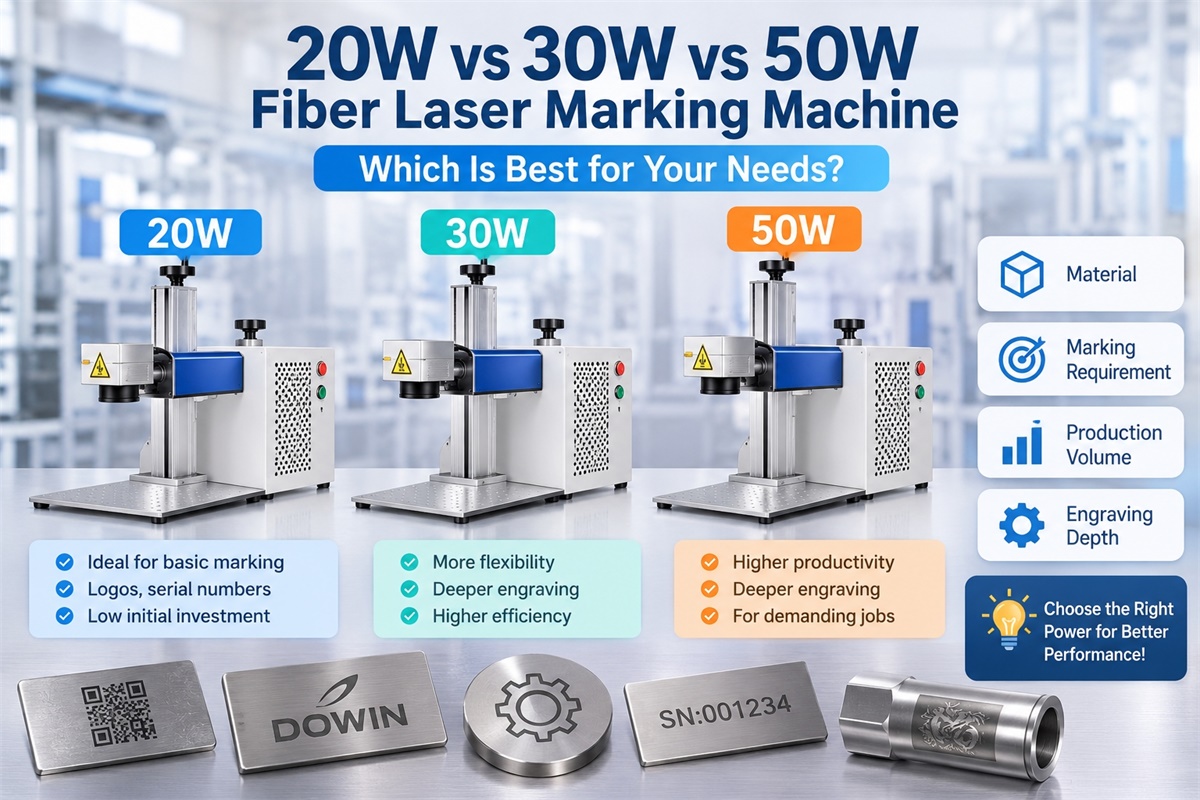
Choosing between a 20W, 30W, and 50W fiber laser marking machine is not simply a matter of selecting the highest power. Each configuration has different advantages in marking speed, engraving depth, production efficiency, and operating cost.
For buyers comparing industrial marking solutions, the right choice depends on the material, marking requirements, daily production volume, and whether the application involves surface marking or deeper metal engraving. You can explore the available Dowin fiber laser marking machines and the 20W/30W/50W portable fiber laser marking machine for different configurations.
1. What Is the Difference Between 20W, 30W, and 50W Fiber Lasers?
The main difference is the laser’s rated output power. Under comparable operating conditions, a higher-power laser can deliver more energy to the material over a given period, potentially increasing processing efficiency and material removal.
However, actual performance also depends on pulse frequency, pulse characteristics, scanning speed, focal spot size, marking density, and material properties.
| Comparison | 20W | 30W | 50W |
|---|---|---|---|
| Output power | 20W | 30W | 50W |
| Surface marking | Suitable | Suitable | Suitable |
| Deep engraving | Light-duty applications | More demanding jobs | Better potential for deeper engraving |
| Processing efficiency | Standard | Higher potential | Higher potential |
| Initial investment | Lower | Medium | Higher |
| Typical application | Logos, serial numbers | General industrial marking | Production marking and deeper engraving |
These are general selection guidelines rather than guaranteed performance results. Actual engraving depth and cycle time must be verified through sample testing.
2. 20W Fiber Laser Marking Machine: Best for Basic Marking
A 20W fiber laser marking machine is a practical option for businesses that mainly need permanent surface identification rather than substantial material removal.
Typical applications include:
-
Serial numbers and product identification
-
Company logos and text
-
Barcodes and QR codes
-
Stainless steel nameplates
-
Aluminum components
-
Small metal accessories
Its relatively low initial investment makes it attractive for small workshops, startups, and businesses with moderate production requirements.
Advantages
A 20W machine can produce clear and permanent markings on many metal surfaces. It is particularly suitable for standard identification tasks where deep engraving is unnecessary.
Limitations
When processing dense graphics, large marking areas, or deeper engraving patterns, production time can become a concern. Multiple passes may be necessary to achieve the required depth.
If your primary requirement is basic metal identification, purchasing a higher-power machine may not provide enough additional value to justify the extra investment.
3. 30W Fiber Laser Marking Machine: A Balanced Choice
A 30W fiber laser marking machine offers a middle ground between investment cost and processing capability.
Compared with a 20W configuration, the additional output power provides greater flexibility for applications involving denser marking patterns, larger graphics, and moderate material removal.
Typical applications include:
-
Industrial metal components
-
Stainless steel and aluminum parts
-
Tool identification
-
Metal labels and nameplates
-
Serial numbers with deeper engraving requirements
-
Small-batch production
Advantages
A 30W machine can offer better processing efficiency when the application requires multiple passes or relatively dense marking.
It is also a practical option for businesses that handle different products and need more flexibility than a basic 20W machine.
Limitations
A 30W laser is not automatically twice as fast as a 20W laser. The actual improvement depends on the material, marking pattern, and parameter settings.
For applications requiring substantial material removal or continuous high-volume production, a 50W configuration may be worth considering.
4. 50W Fiber Laser Marking Machine: For Higher Productivity and Deeper Engraving
A 50W fiber laser marking machine is designed for applications where processing efficiency and material removal are more important.
Its higher output power provides greater potential for faster processing and deeper engraving, particularly when working with metals.
Typical applications include:
-
Deep engraving on stainless steel
-
Metal tools and industrial components
-
Permanent identification on mechanical parts
-
Engraved metal plates
-
Dense logos and graphics
-
Batch production with demanding cycle times
Advantages
A 50W machine generally offers more processing flexibility for demanding applications. It can reduce the number of passes required for certain engraving jobs and improve production throughput.
For manufacturers processing large quantities of similar components, even a modest reduction in cycle time can make a meaningful difference in overall productivity.
Limitations
A higher-power machine usually requires a larger initial investment. It may also require more careful parameter adjustment to avoid excessive material removal, unwanted heat effects, or reduced detail quality.
For simple serial numbers and basic logos, the additional power may not be necessary.
5. Which Laser Power Is Better for Deep Metal Engraving?
Deep laser engraving is different from ordinary surface marking.
Surface marking generally changes the appearance of the material or removes a thin surface layer. Deep engraving removes more material to create a measurable recessed pattern.
For this reason, laser power becomes an important selection factor.
A 20W laser can handle relatively shallow engraving, but achieving greater depth may require multiple passes and longer processing times.
A 30W laser offers additional flexibility for moderate engraving requirements.
A 50W laser generally provides better potential for deeper engraving and higher material removal rates.
However, power alone does not determine engraving depth. Pulse energy, frequency, scanning speed, hatch spacing, focus position, and the properties of the metal all affect the final result.
For buyers who need a specific engraving depth, it is better to request a sample test using the actual material and target dimensions before purchasing.
6. How Much Faster Is a 50W Laser Than a 20W Laser?
This is one of the most common questions from buyers.
A 50W laser has 2.5 times the rated output power of a 20W laser. However, this does not mean it will complete every marking job 2.5 times faster.
For simple text marking, the difference may be relatively small because the scanning system and marking parameters can become limiting factors.
For deeper engraving, where material removal is the main objective, the higher output power can provide a more noticeable productivity advantage.
Consider the following factors when comparing actual production speed:
-
Material type and surface condition
-
Engraving depth
-
Graphic size and filling density
-
Pulse frequency and pulse width
-
Scanning speed
-
Number of passes
-
Required marking contrast
The most reliable comparison is a side-by-side sample test using identical graphics, materials, and quality requirements.
7. How to Choose Between 20W, 30W, and 50W?
Your production requirements should determine the laser power, rather than simply choosing the highest available wattage.
| Your requirement | Recommended starting point |
|---|---|
| Basic logos and serial numbers | 20W |
| Small workshop applications | 20W or 30W |
| General industrial marking | 30W |
| Moderate-depth metal engraving | 30W or 50W |
| More demanding deep engraving | 50W |
| Higher-volume production | 50W, subject to cycle-time testing |
Before making a decision, consider three important questions:
First: What material do you process?
Stainless steel, aluminum, brass, and other metals can respond differently to the same laser parameters.
Second: How deep must the engraving be?
If you only need permanent surface identification, 20W or 30W may be sufficient. If you need measurable recessed engraving, compare 30W and 50W using actual samples.
Third: How many products do you process daily?
For low production volumes, the lower initial investment may be more important. For repetitive industrial production, processing time and total operating efficiency deserve greater attention.
8. Why Choose Dowin Fiber Laser Marking Machines?
Dowin provides fiber laser marking machine configurations for different metal marking and engraving requirements.
Depending on the machine configuration, available options include 20W, 30W, and 50W laser power, with air-cooled operation and EZCAD control software.
The machines can be used for applications involving stainless steel, aluminum, brass, steel components, hardware tools, and industrial identification.
For buyers comparing different power configurations, Dowin can help evaluate the application and identify a suitable setup based on the required marking area, material, engraving depth, and production volume.
Explore the Dowin Laser Marking Machine Collection to review available equipment.
Frequently Asked Questions
Is a 20W fiber laser powerful enough for metal engraving?
Yes. A 20W fiber laser can engrave many metal surfaces, particularly for shallow engraving and identification. Deeper engraving may require multiple passes and longer processing times.
Is a 30W fiber laser better than a 20W machine?
A 30W machine offers more output power and potentially better processing efficiency. It is a useful upgrade when marking density, production volume, or engraving requirements increase.
Can a 50W fiber laser cut metal?
A standard fiber laser marking machine is primarily designed for marking and engraving, not industrial metal cutting. Some thin-material cutting experiments may be possible under specific conditions, but this should not be confused with a dedicated fiber laser cutting machine.
Which fiber laser is best for deep engraving stainless steel?
A 50W fiber laser is generally a stronger starting point when deeper engraving is required. However, the achievable depth depends on the stainless steel grade, laser source, pulse parameters, and processing strategy.
Does higher laser power always mean better marking quality?
No. Higher power does not automatically produce finer or darker marks. Marking quality depends on the combination of laser parameters, material characteristics, optical configuration, and processing technique.
Conclusion
The choice between 20W, 30W, and 50W fiber laser marking machines depends on the balance between investment, production efficiency, and engraving requirements.
A 20W machine is suitable for standard marking applications. A 30W machine provides additional flexibility for general industrial work. A 50W machine is worth considering when higher productivity and deeper engraving are priorities.
The best way to select the right configuration is to test your actual material and compare marking quality, engraving depth, and processing time before making a purchase.
Post time: Nov-03-2026
