
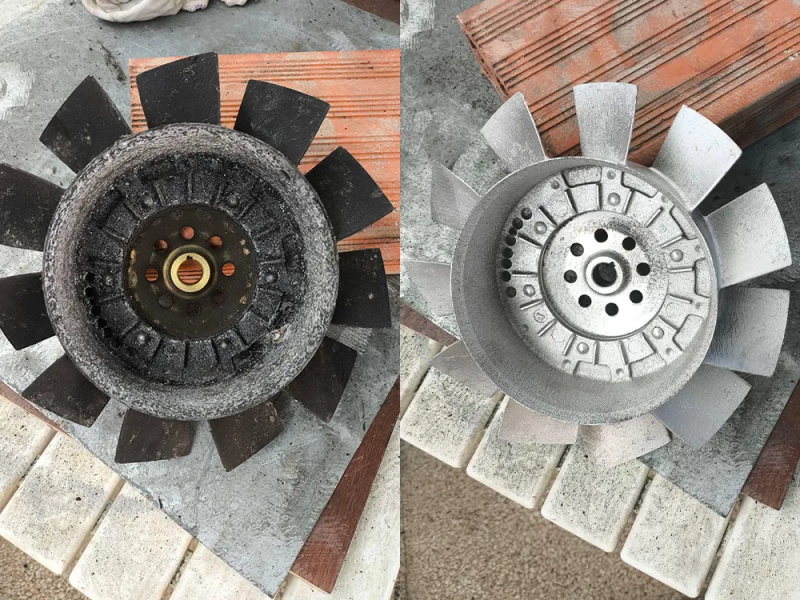
A Shift Toward Smarter Cleaning Technologies
Industrial cleaning is no longer defined by brute force. As manufacturing standards tighten and environmental regulations intensify, traditional methods—such as sandblasting and chemical stripping—are increasingly seen as inefficient, inconsistent, and costly over time.
In this context, 200W–300W pulsed laser cleaning machines have emerged as a highly targeted solution. They are not designed to replace heavy-duty systems, but to dominate a more nuanced space: light to medium contamination removal with precision, control, and repeatability.
What Makes 200W–300W Pulsed Laser Systems Relevant Today
The rise of mid-power pulsed laser cleaning is directly linked to structural changes across industries:
- Increased use of precision components that cannot tolerate abrasive damage
- Growing demand for surface preparation quality before welding, coating, or bonding
- Stronger environmental policies limiting chemical cleaning processes
- Expansion of maintenance-driven industries (automotive repair, equipment servicing, mold care)
Within this landscape, machines in the 200W–300W range offer a critical balance:
enough power for efficiency, but controlled enough for delicate surfaces.
Core Capabilities: More Than Just Rust Removal
Modern pulsed laser cleaners in this range are engineered for multi-purpose surface treatment. Typical applications include:
- Light to moderate rust removal on metal surfaces
- Oil and grease cleaning before assembly or coating
- Paint stripping for refurbishment or re-coating
- Coating removal in precision manufacturing processes
Unlike traditional methods, these systems rely on short, high-energy pulses to break the bond between contaminants and the substrate—without physical contact.
Result:
Minimal damage, no consumables, and consistent outcomes across repeated operations.
SEAGULL2: Focused Performance in the Mid-Power Segment
The SEAGULL2 pulsed laser cleaning system is designed specifically for this operational sweet spot.
It offers:
- 200W and 300W pulsed laser power options
- Stable output for consistent cleaning performance
- High efficiency in removing surface contaminants
- Flexibility across multiple cleaning scenarios
This positioning is deliberate. Instead of competing with high-power industrial systems, SEAGULL2 focuses on precision-driven applications where control matters more than raw power.
Why Mid-Power Laser Cleaning Is Gaining Market Share
1. Precision Over Aggression
Heavy-duty cleaning systems often introduce unnecessary risk when dealing with:
- Thin metal sheets
- Precision molds
- Sensitive components
Mid-power pulsed lasers allow operators to remove contaminants layer by layer, preserving the integrity of the base material.
2. Lower Operational Complexity
Compared to high-power systems, 200W–300W machines:
- Require less parameter tuning
- Offer easier handling and control
- Reduce the risk of overheating or substrate damage
This makes them ideal for workshops, small production lines, and maintenance teams.
3. Cost-Efficiency Beyond Purchase Price
While the initial investment may exceed traditional tools, long-term savings are significant:
- No abrasives or chemicals
- Reduced labor intensity
- Minimal maintenance requirements
Over time, the cost per cleaned unit drops substantially, especially in repetitive cleaning tasks.
4. Environmental Compliance Built-In
Laser cleaning eliminates:
- Chemical waste
- Secondary pollution
- Hazardous disposal processes
As regulatory pressure increases, this becomes not just an advantage—but a necessity.
Where 200W–300W Systems Perform Best
These machines are particularly effective in:
- Automotive parts restoration
- Mold cleaning and maintenance
- Small-scale manufacturing lines
- Pre-treatment before welding or coating
- Equipment maintenance in industrial facilities
They are not intended for heavy corrosion or thick industrial coatings—but within their range, they deliver exceptional efficiency and control.
Breaking a Common Misconception
Many buyers assume:
“Higher power always means better performance.”
This is flawed.
In reality:
- Excessive power can damage substrates
- It increases energy consumption unnecessarily
- It reduces precision in fine cleaning tasks
Optimal cleaning is not about maximum power—it is about matching power to application.
The Future: Modular and Application-Specific Cleaning
The trend in laser cleaning is moving away from “one-size-fits-all” machines toward application-specific solutions.
In this evolution:
- 200W–300W systems will dominate precision cleaning and maintenance sectors
- Higher power systems will remain in heavy industrial applications
- Integration with automation and robotics will further expand use cases
Conclusion: Small Power, Strategic Impact
200W–300W pulsed laser cleaning machines represent a critical layer in the modern industrial ecosystem.
They are:
- Precise enough for delicate tasks
- Powerful enough for efficient operation
- Flexible enough for diverse applications
Systems like SEAGULL2 demonstrate that innovation is not always about scaling up—it is about refining the balance between power and control.
Final Insight:
In industrial cleaning, the future belongs not to the strongest tool—but to the most adaptable one.
Post time: Apr-21-2026
