
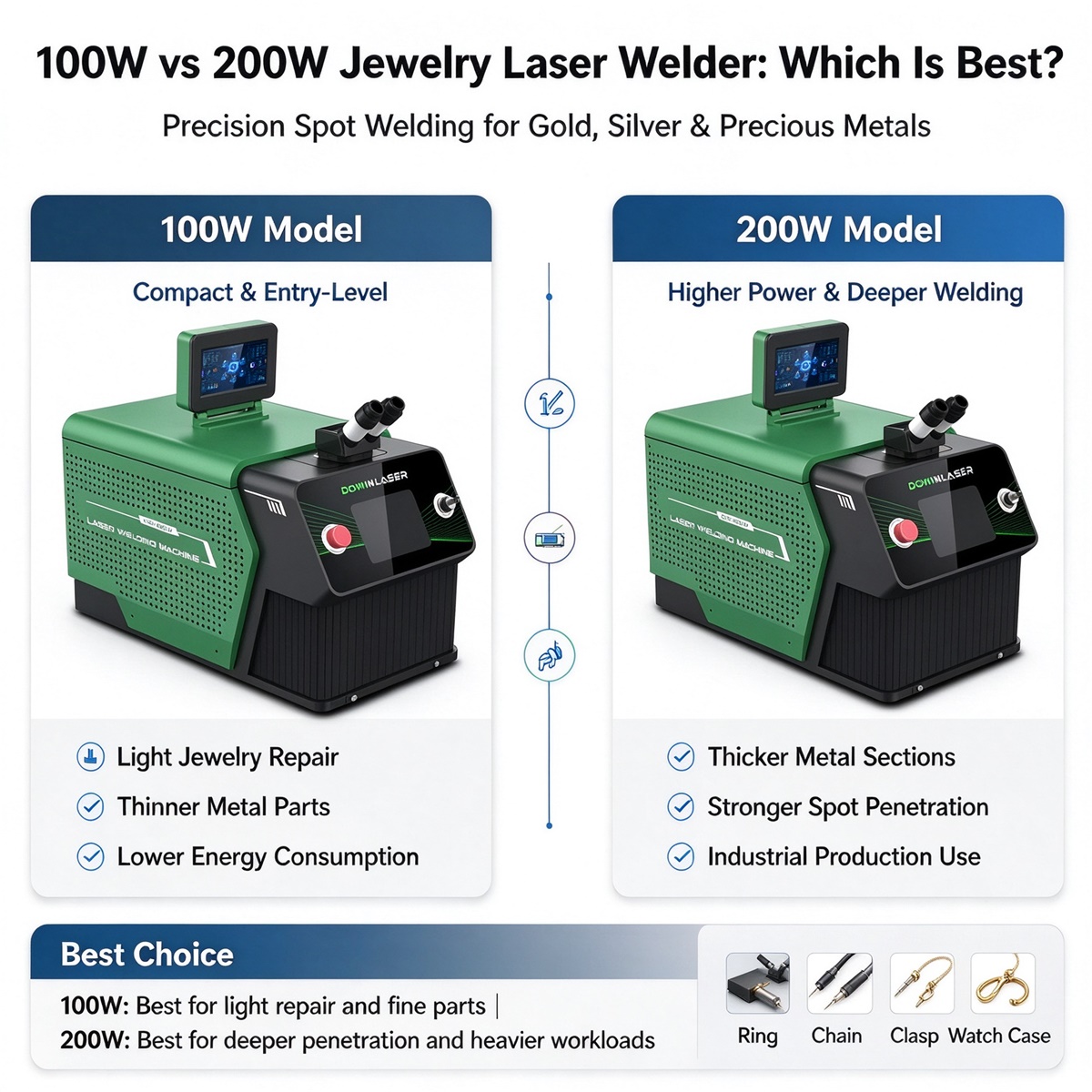
Choosing between a 100W and a 200W jewelry laser welder is not simply a matter of deciding which machine has more power. The right choice depends on the type of jewelry you repair, the thickness of the metal, the size of the weld, and how frequently you use the machine.
For jewelry repair shops, goldsmiths, jewelry manufacturers, and precious metal processing businesses, choosing the wrong power level can mean slower production, unnecessary equipment costs, or difficulty handling certain welding jobs.
A 100W jewelry laser welder may be sufficient for delicate repairs and small-scale jewelry work. A 200W jewelry laser welder offers greater energy capacity and may be more suitable for thicker components, demanding repair jobs, and higher production requirements.
This guide compares 100W and 200W jewelry laser welding machines in terms of welding capability, precision, material thickness, productivity, operating costs, and purchasing considerations.
1. 100W vs 200W Jewelry Laser Welder: Key Differences
The primary difference is the available laser power. However, actual welding performance also depends on pulse energy, pulse duration, spot diameter, repetition frequency, optical configuration, and the material being welded.
| Comparison | 100W Jewelry Laser Welder | 200W Jewelry Laser Welder |
|---|---|---|
| Typical application | Fine jewelry repair and light production | More demanding repair and production work |
| Small, delicate components | Well suited with appropriate settings | Also suitable when pulse parameters are properly controlled |
| Thicker metal components | May require more time or multiple passes | Greater potential for faster or deeper welding |
| Heat input control | Depends on pulse settings and technique | Depends on pulse settings and technique |
| Production workload | Light to moderate workloads | Moderate to higher workloads, depending on the job |
| Initial investment | Often lower | Often higher |
| Best purchasing priority | Fine work and budget-conscious buyers | Greater welding capacity and production flexibility |
Important: These are general selection guidelines, not universal performance guarantees. A well-configured 100W machine may outperform a poorly configured 200W machine on a particular task. Compare actual pulse energy and tested welding results rather than relying on wattage alone.
2. When Is a 100W Jewelry Laser Welder Enough?
A 100W jewelry laser welder is worth considering if your primary work involves small jewelry components, delicate repairs, and relatively light welding workloads.
Typical applications include:
-
Repairing broken gold and silver chains.
-
Fixing small cracks in rings and pendants.
-
Repairing delicate decorative components.
-
Reworking small jewelry joints.
-
Carrying out occasional repairs in jewelry shops.
-
Performing fine welding tasks on compatible precious metal components.
For these applications, the goal is often to produce a reliable joint while limiting unwanted heat exposure to nearby stones, decorative details, and finished surfaces.
A 100W machine can be an economical choice when its available pulse energy and welding parameters meet your actual requirements.
However, lower nominal power does not automatically guarantee a smaller heat-affected zone or better precision. The result depends on how the laser energy is delivered, the spot size, the material, and the operator’s settings.
Advantages of a 100W Jewelry Laser Welder
Lower equipment cost in many configurations
A 100W machine may cost less than a comparable 200W model, making it attractive to small repair businesses and workshops with limited capital budgets.
Suitable for many routine repair tasks
When working with small components and compatible materials, 100W equipment can provide sufficient welding capability without requiring a higher-power system.
Potentially lower energy consumption
A lower-power laser source may reduce laser-source electricity consumption under comparable operating conditions. However, the complete machine’s consumption also depends on cooling, lighting, control electronics, and operating duty cycle.
Where Can a 100W Machine Become a Limitation?
If you frequently repair thicker components or need to weld larger joints, a 100W machine may require slower processing, multiple passes, or a different pulse configuration.
It may also be less suitable when your production schedule demands consistently high throughput on more demanding welding jobs.
Before purchasing, ask the supplier to demonstrate the machine on the actual jewelry pieces you intend to process.
3. When Should You Choose a 200W Jewelry Laser Welder?
A 200W jewelry laser welder is worth considering when your workload requires greater welding capacity or when you regularly encounter jobs that challenge a lower-power machine.
Potential applications include:
-
Repairing thicker ring sections and metal components.
-
Welding larger jewelry joints.
-
Rebuilding worn or damaged areas before finishing.
-
Processing a broader range of jewelry repair jobs.
-
Supporting more demanding workshop production schedules.
The additional power provides greater potential for delivering energy to the workpiece, but the actual benefit depends on the machine’s pulse characteristics and optical system.
Advantages of a 200W Jewelry Laser Welder
Greater welding capacity
A properly configured 200W machine may deliver more energy or sustain higher average output, depending on its design. This can help when working with thicker sections or joints requiring greater energy input.
Potential productivity improvements
For suitable applications, a 200W system may complete certain welding tasks more quickly or reduce the number of passes required.
The improvement is not necessarily proportional to the increase in rated power. A 200W machine does not automatically weld every part twice as fast as a 100W machine.
More flexibility for demanding jobs
If your workshop handles a wide range of jewelry repairs, additional power capacity can provide more options for adjusting welding parameters to the job.
Is 200W Too Powerful for Delicate Jewelry?
Not necessarily.
A 200W jewelry laser welder can perform delicate work when the machine offers suitable pulse-energy adjustment, pulse-duration control, spot-size selection, and stable operation.
The key is to control the energy delivered to the workpiece rather than simply selecting the lowest available wattage.
For delicate rings, fine chains, or jewelry near heat-sensitive settings, the operator must select appropriate parameters and verify the result through testing.
4. Does 200W Mean Better Welding Precision?
No. Rated power and welding precision are different characteristics.
Precision depends on several factors:
-
Laser spot diameter: A smaller spot can concentrate energy in a smaller area.
-
Pulse duration: Shorter pulses can help limit heat diffusion in suitable applications.
-
Pulse energy: The energy delivered in each pulse affects penetration and melting.
-
Positioning system: Stable positioning helps place the weld accurately.
-
Microscope and illumination: Clear magnified observation helps operators identify the target area.
-
Operator experience: Skilled parameter adjustment is essential for consistent results.
For example, a jewelry repair shop working primarily on thin chains may benefit more from excellent pulse control and clear microscope viewing than from simply upgrading to a higher-power machine.
Conversely, a workshop repairing thicker metal sections may value the additional welding capacity of a 200W model.
The best machine is the one that delivers the required weld quality across your actual workload.
5. Can Both Machines Weld Gold, Silver, and Platinum?
Both 100W and 200W jewelry laser welders can be suitable for gold, silver, platinum, and certain other jewelry metals, provided the machine is correctly configured for the material and application.
However, different metals behave differently during welding.
Gold: Gold alloys are common laser-welding applications. Alloy composition, component thickness, and nearby gemstones influence the required parameters.
Silver: Silver’s high thermal conductivity can make it challenging to concentrate heat in a small area. The appropriate pulse energy and duration are particularly important.
Platinum: Platinum jewelry may require specific parameter adjustment based on alloy composition, joint geometry, and the required penetration.
White gold: The alloy composition and surface treatment can influence the welding process. Test the actual alloy rather than assuming all white gold behaves identically.
For every material, test weld quality, penetration, joint strength, surface appearance, and the condition of surrounding components.
Neither 100W nor 200W guarantees successful welding on every metal thickness or alloy.
6. Which Machine Is Better for Jewelry Repair Shops?
The best option depends on the type of work your business handles most frequently.
| Business type | Suggested starting point | Reason |
|---|---|---|
| Small jewelry repair shop | 100W or 200W, depending on actual jobs | Match the machine to common repair requirements |
| Goldsmith specializing in fine repairs | A system with precise pulse control | Controlled energy delivery matters more than wattage alone |
| Workshop repairing thicker components | Consider 200W | Additional power capacity may improve processing capability |
| Jewelry manufacturer with recurring production jobs | Evaluate both using production tests | Throughput and repeatability determine productivity |
| Business handling diverse repair work | Consider 200W if its additional capacity is needed | Broader workloads may benefit from greater operating flexibility |
A higher-power machine is not automatically the better investment for every business. If most of your jobs involve small, delicate components, a well-equipped 100W machine may be entirely sufficient.
If your workload frequently includes thicker parts, larger joints, or production bottlenecks caused by insufficient welding capacity, a 200W machine deserves closer consideration.
7. 100W vs 200W Jewelry Laser Welder: Which Offers Better Value?
To compare the total cost of ownership, consider more than the purchase price.
Initial Purchase Price
A 100W model is often less expensive than a comparable 200W model, although pricing varies by manufacturer, laser source, optical configuration, cooling system, and included accessories.
Request quotations for machines with comparable specifications.
Operating Costs
Compare the complete machine’s power consumption, cooling requirements, maintenance schedule, and consumable requirements.
Do not assume that doubling rated laser power doubles the total electricity bill. Actual consumption depends on the laser source and the rest of the machine.
Labor Productivity
If a 200W machine reduces processing time on frequently performed jobs, it may improve the workshop’s production capacity.
To estimate the value, record the current time required for welding, rework, and finishing. Then compare the results using representative samples on both machines.
Rework and Material Loss
A poorly matched machine can increase rework, especially when welding delicate or expensive jewelry.
Evaluate the percentage of acceptable welds, finishing time, and any damage to nearby components. These factors can have a greater financial impact than a modest difference in purchase price.
A Practical Purchasing Rule
Choose 100W if it meets your welding requirements and offers the best balance of cost and performance.
Choose 200W if its additional capability demonstrably improves the jobs you perform regularly.
If possible, send representative samples to the manufacturer for a welding test before placing an order.
8. What Specifications Should You Compare Before Buying?
When comparing two jewelry laser welding machines, request the following information:
-
Rated laser power: Confirm whether the specification refers to average output power and how it is measured.
-
Maximum pulse energy: Important for understanding the energy available in each pulse.
-
Pulse duration: Affects how energy is delivered and how heat spreads through the material.
-
Repetition frequency: Influences how frequently pulses can be delivered.
-
Spot-size adjustment: Helps determine the working area and energy concentration.
-
Viewing system: Check microscope magnification, clarity, and illumination.
-
Cooling system: Confirm the manufacturer’s recommended operating conditions and duty cycle.
-
Material testing: Request welding samples using your actual metal alloy and component thickness.
-
Warranty and technical support: Confirm coverage, service arrangements, and access to replacement parts.
-
Training and parameter guidance: Ensure that the supplier can help you establish reliable settings for common jewelry repairs.
These specifications provide a more meaningful comparison than rated power alone.
9. Frequently Asked Questions
Is a 200W jewelry laser welder twice as powerful as a 100W model?
Its rated output power is twice as high, but this does not mean it will weld every component twice as fast or produce twice the penetration. Pulse energy, pulse duration, spot size, and material properties determine actual performance.
Can a 100W jewelry laser welder repair gold rings?
Yes, a suitable 100W machine can repair many gold rings. The result depends on ring thickness, alloy composition, joint geometry, and the machine’s available pulse parameters.
Can a 200W jewelry laser welder weld thin gold chains?
Yes, provided the machine supports sufficiently controlled pulse settings and the operator selects appropriate parameters. Test on representative samples before working on valuable finished jewelry.
Which machine is better for silver jewelry?
Both power levels can work with silver. Because silver conducts heat efficiently, pulse control and process testing are important. Choose the machine that produces acceptable penetration and joint quality without excessive damage to surrounding areas.
Does a 200W jewelry laser welder consume twice as much electricity?
Not necessarily. Rated laser output is not the same as total electrical consumption. Compare the complete machines’ specified power consumption and typical operating conditions.
Is a jewelry laser welder suitable for beginners?
It can be, provided the operator receives appropriate training and follows the manufacturer’s safety procedures. Beginners should practice on scrap material, learn parameter adjustment, and use the required laser safety equipment before repairing valuable jewelry.
How do I know whether I need 100W or 200W?
List your most common jewelry repair jobs, including metal type, component thickness, joint size, and daily workload. Ask the supplier to test representative samples on both machines. Compare weld quality, processing time, rework, and total cost before deciding.
Conclusion
The choice between a 100W and a 200W jewelry laser welder comes down to the balance between precision, welding capacity, productivity, and cost.
A 100W model can be a practical solution for jewelry repair shops focused on routine repairs and delicate components. A 200W model may be a better fit for workshops that regularly process thicker parts, larger joints, or more demanding workloads.
Before making a purchase, compare pulse energy, pulse duration, spot-size control, viewing quality, and real welding results. The best jewelry laser welder is not necessarily the one with the highest wattage, but the one that consistently meets your production requirements.
If you are comparing machines for your workshop, define the metals and component thicknesses you work with most often, then request a sample-welding test. This is one of the most reliable ways to determine whether 100W is sufficient or whether the additional capacity of a 200W system justifies the investment.
Post time: Oct-15-2026
